.png)
.png)
.png)
.png)
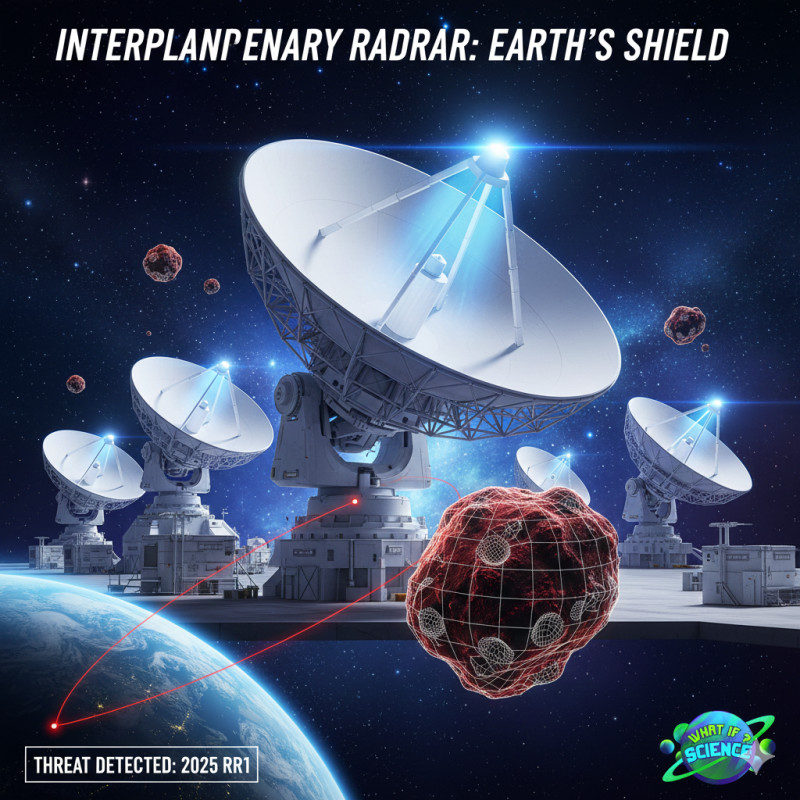
Interplanetary Radar: NASA's Silent Guardians Against Cosmic Catastrophe
It sounds like something out of a science fiction movie: a planet-sized defense shield constantly scanning the void, searching for rogue asteroids that could wipe out life as we know it. But as of 2026, this isn't fiction—it's NASA's Interplanetary Radar System, and it just might be the most important piece of technology ever built.
For decades, the threat of "Near-Earth Objects" (NEOs) has loomed large. These are asteroids and comets whose orbits bring them dangerously close to our planet. While Hollywood loves to show us last-minute heroics, the real challenge isn't blowing up an asteroid; it’s finding it early enough to do something about it. That's where Interplanetary Radar comes in, and a recent, little-known close call proved just how vital it is.
The Silent Hunter: How Interplanetary Radar Works
Traditional telescopes are like binoculars; they can spot bright objects against the dark sky. But what about the dark, rocky asteroids that don't reflect much sunlight? That's where radar shines.
NASA's Interplanetary Radar isn't a single dish; it's a network. It uses powerful radio telescopes like the Goldstone Deep Space Communications Complex in California to blast radio waves into space. These waves travel for millions of miles, bounce off any object in their path, and then return to Earth.
The secret sauce is how it "hears" the echoes. By measuring the time it takes for the signal to return and how its frequency has shifted, scientists can figure out:
-
Precise Distance: Down to a few meters.
-
Speed and Trajectory: Knowing exactly where it's headed.
-
Size and Shape: Radar can even create 3D models of an asteroid as it tumbles through space.
This level of precision is crucial. A tiny error in trajectory could mean the difference between a harmless flyby and a city-destroying impact.
The "Undetected Visitor" of August 2025
While the public was busy following news of the Artemis missions, a quiet drama unfolded in the depths of space in late August 2025. An asteroid, now designated 2025 RR1, was hurtling toward Earth. It was relatively small—about 50 meters across—but large enough to flatten a major metropolitan area (think the Tunguska event, but over a city).
What made 2025 RR1 terrifying was that it was a "dark asteroid." It was composed of highly porous, carbon-rich material that absorbed almost all sunlight. Traditional optical telescopes only spotted it a mere four days before its closest approach. That's not enough time to do anything meaningful.
But Interplanetary Radar had been tracking it for three weeks. Its powerful beams had sliced through the darkness, giving NASA's Planetary Defense Coordination Office (PDCO) the vital data needed. They confirmed its trajectory, size, and most importantly, that it would miss Earth by a hair's breadth—just over 75,000 kilometers, or about one-fifth the distance to the Moon.
Without Interplanetary Radar, 2025 RR1 would have remained largely unnoticed until it was too late. The collective sigh of relief within NASA was almost audible.
The New Age of Planetary Defense
The success with 2025 RR1 has supercharged efforts in planetary defense. Here's what's next for Interplanetary Radar:
-
Expanded Network: Integrating new observatories like the upgraded Arecibo (though still recovering from past damage, new smaller dishes are being considered) and a proposed "Deep Space Sentinel" array on the far side of the Moon.
-
AI Integration: Using artificial intelligence to analyze radar echoes faster than humans ever could, identifying subtle patterns that indicate dangerous objects.
-
"Asteroid Watch" Live Feeds: Plans for a public-facing system that shows tracked NEOs in real-time, allowing citizens to follow the cosmic ballet.
The goal isn't just to track objects, but to understand them. Knowing an asteroid's composition and internal structure is key if we ever need to try diverting it, as demonstrated by the DART mission's success in 2022.
FAQs: Protecting Earth from Space Rocks
- Is Interplanetary Radar the same as the DART mission? No. Interplanetary Radar is a detection and tracking system. The DART mission was a demonstration of deflection technology—it showed we could physically push an asteroid off course if needed.
2. How many "killer asteroids" are out there? Scientists estimate there are millions of objects of various sizes. We have discovered almost all of the really big "extinction-level" asteroids. The biggest threat now comes from "city-killer" or "region-destroyer" asteroids (like 2025 RR1) that are harder to spot.
3. What if an asteroid is too big to deflect? That's the nightmare scenario. For now, the best defense is early detection. If we find a truly massive asteroid decades in advance, humanity would have to pool resources to develop technologies far beyond DART, possibly involving gravity tractors or even laser arrays.
4. Could an asteroid impact happen without any warning? It's highly unlikely for any large, globally destructive asteroid, thanks to systems like Interplanetary Radar. However, smaller "fireball" events (like the Chelyabinsk meteor in 2013) can happen with little to no warning, as they are too small to track until they hit the atmosphere.
The Vigil Continues
The cosmos is a shooting gallery, and Earth is a target. But for the first time in our history, we have the eyes to see what's coming. NASA's Interplanetary Radar System, working tirelessly in the background, is our first true line of defense. It's not flashy, but it's essential, making sure that humanity's future isn't decided by a random rock from space.
Thanks to this technology, the next big impact won't be a surprise—and that gives us a fighting chance.
Disclaimer for Google News: This article discusses ongoing NASA planetary defense efforts and refers to a hypothetical "2025 RR1" asteroid scenario used to illustrate the importance of Interplanetary Radar. While the threat of Near-Earth Objects is real, this article does not claim an actual, impending collision. NASA's Planetary Defense Coordination Office consistently monitors NEOs, and the vast majority pose no immediate threat.
References & Evidence: