.png)
.png)
.png)
.png)
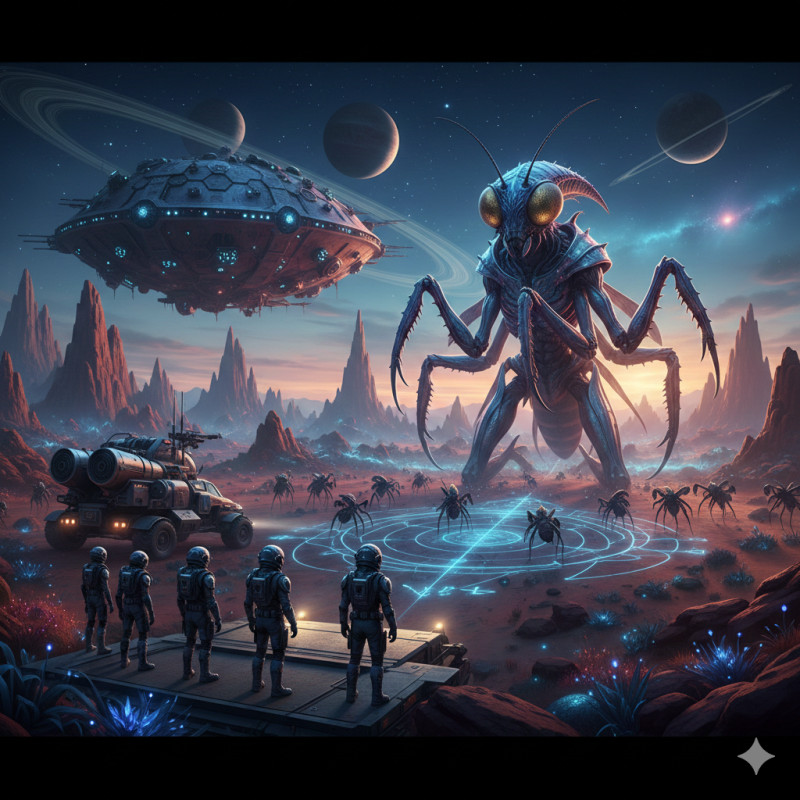
Imagine looking up at the night sky and seeing a flicker that isn't a star. A ship descends, the hatch opens, and out steps… a giant praying mantis. Or perhaps something with six legs, iridescent wings, and multifaceted eyes that see in spectra we can’t even imagine.
For decades, Hollywood has obsessed over "Little Green Men" or tall, glowing humanoids. But many astrobiologists and futurists think our first cosmic neighbors might look a lot more like the critters in your backyard. We’re talking about insectoid aliens.
But here’s the real kicker: if we meet a civilization built by hive-minded, chitin-covered beings, we won't be speaking English or even binary. We might be dancing. Specifically, we might be using the same "math-based dance" that honeybees use to survive.
The Hive Mind: Why Insects Are the Ultimate Survivalists
If you want to find life in the universe, you look for what works. On Earth, insects are the undisputed heavyweight champions of biology. They’ve survived mass extinctions that wiped out the dinosaurs. They are masters of architecture, chemical warfare, and—most importantly—social organization.
When we talk about "Insectoid Aliens," we aren't just talking about giant bugs. We are talking about distributed intelligence. In a hive, no single bee knows the whole plan, yet the hive "knows" exactly how to build a perfect geometric honeycomb and regulate temperature within a fraction of a degree.
If a distant planet has higher gravity or a more volatile atmosphere, an exoskeleton and a hive-mind structure might be the only way for a species to thrive and eventually reach the stars.
The Waggle Dance: A Mathematical Masterpiece
To talk to an alien, we need a common language. Physics and math are the usual suspects, but how do you express "The sun is at a 40-degree angle, and the fuel is three miles that way" without words?
Bees already solved this millions of years ago with the Waggle Dance.
When a honeybee finds a patch of nectar, she returns to the hive and performs a figure-eight movement. This isn't just a happy jig; it’s a sophisticated data transfer.
-
The Angle: The angle of her run relative to "up" on the honeycomb tells the other bees the direction of the food relative to the sun.
-
The Duration: The length of the "waggle" tells them the exact distance.
-
The Intensity: The vigor of the shake indicates the quality of the resource.
This is vector calculus performed by a creature with a brain the size of a sesame seed. If an insectoid alien arrived, their "language" might be a visual, rhythmic representation of spatial mathematics.
Why This is Our "Rosetta Stone"
The Rosetta Stone was the key to unlocking Egyptian hieroglyphs because it featured the same text in three different scripts. In the hunt for ET, the three "scripts" are Math, Physical Motion, and Stellar Navigation.
If we encounter an insectoid species, they likely won't have vocal cords. They might communicate through:
-
Pheromones: Chemical signals that carry complex emotional and instructional data.
-
Bioluminescence: Flashing patterns of light (think fireflies on steroids).
-
Stridulation: Sounds made by rubbing body parts together.
However, the bridge between us will be the spatial math found in the bee dance. By observing how they move in relation to celestial bodies, we can "decode" their coordinate system. We don't need to know their word for "home" if we can understand the geometric proof they are dancing in front of us.
The "Otherness" of Insect Intelligence
The most exciting (and slightly terrifying) part of meeting insectoid aliens is the lack of "I."
Human communication is built on the individual. "I want," "I feel," "I think." A hive-based alien species might not have a concept of the self. Their "language" might be a constant stream of data meant to optimize the group.
Understanding bees helps us prep for this. When we study bees, we aren't looking for a "leader" giving orders; we are looking at a decentralized system. Communicating with an insectoid alien might feel less like a conversation and more like syncing up with a biological internet.
Preparing for First Contact
How do we get ready? Scientists are already using AI and high-speed cameras to decode the nuances of insect communication more deeply than ever before. We are learning that bees can count, understand the concept of "zero," and even solve the "Traveling Salesman Problem" (a complex routing puzzle) faster than some computers.
By mastering the "math" of our own Earthly insects, we are essentially building a translation layer. When that shimmering ship finally lands, and a six-legged explorer starts moving in a rhythmic, geometric pattern, we won't be baffled. We’ll grab our calculators, look at the sun, and start dancing back.
FAQs: Everything You Need to Know
Could aliens really look like bugs?
Yes. Evolutionary biologists suggest that the "arthropod" body plan (exoskeletons and jointed limbs) is incredibly efficient. On planets with different oxygen levels or gravity, this form might be even more successful than the vertebrate (human) form.
Do bees actually understand math?
They don't use pens and paper, but their brains are hardwired for "biological math." They can calculate angles, measure distance via "optic flow" (how fast the ground moves beneath them), and communicate those variables to others.
Why would an alien use "dancing" instead of radio waves?
They likely would use technology for long distances. But for "face-to-face" interaction, their primary biological mode of communication—honed over millions of years—would be their natural "language," which for insectoids would likely involve movement and chemistry.
What is Xenolinguistics?
It’s the hypothetical study of alien languages. Unlike human linguistics, it focuses on non-vocal communication, including math, light, and chemical signals.
Sources & References
-
The Royal Society: Research on honeybee spatial memory and navigation.
-
National Geographic: The complexity of the Waggle Dance explained.
-
SETI Institute: Speculations on non-humanoid intelligence and communication.
-
Journal of Insect Behavior: Studies on decentralized decision-making in hive species.
Disclaimer: This article explores theoretical possibilities in astrobiology and xenolinguistics based on current entomological research. While the mathematical abilities of bees are documented, the existence of insectoid aliens remains speculative.