.png)
.png)
.png)
.png)
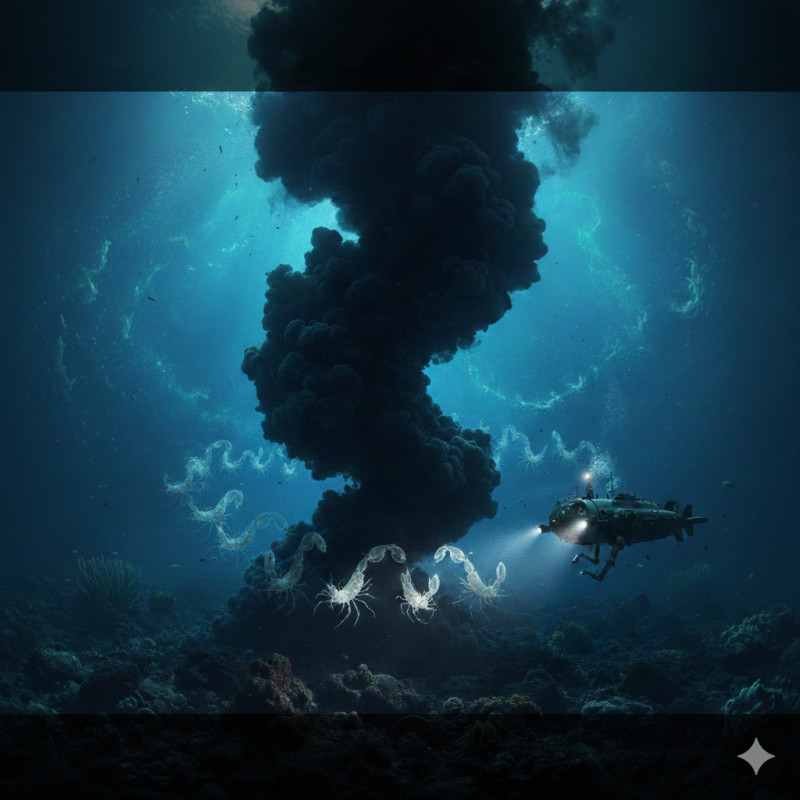
The Atlantic’s "Black Plumes": A Discovery That Has Scientists Re-writing the Rulebook
We often talk about space as the final frontier, but it turns out the bottom of our own backyard—the Atlantic Ocean—is hiding secrets that are just as alien. Recently, deep-sea explorers stumbled upon something that shouldn't exist: massive, ink-black plumes erupting from the seabed that seem to ignore the basic laws of oceanic physics.
These aren't your typical hydrothermal vents or "black smokers." Those have been known for decades. These new "Black Plumes" are colder, larger, and behave more like a sentient liquid than a volcanic discharge. As we move through 2026, the scientific community is scrambling to figure out if we’ve discovered a new geological process or something far more mysterious.
What Exactly Are These "Black Plumes"?
Found nearly 3,000 meters down in a remote stretch of the Mid-Atlantic Ridge, these plumes look like towering pillars of smoke rising through the water. But here is the kicker: they don't dissipate.
Normally, when hot or mineral-rich water shoots out of the Earth's crust, it mixes with the surrounding cold ocean and thins out. These plumes stay "tight." They snake through the water for miles, maintaining a perfect, dark cylindrical shape. Scientists from the National Oceanography Centre have noted that the chemical signature of this "black ink" doesn't match any known mineral deposits on the seafloor.
Why They Defy Physics
The reason these plumes are causing such a stir in the science world comes down to two main things: Temperature and Fluid Dynamics.
-
The Temperature Paradox: Hydrothermal vents are hot—sometimes over 400°C. These "Black Plumes" are barely above freezing. Without heat to drive them upward, they should just pool on the floor like spilled syrup. Instead, they rise with incredible speed, as if being sucked upward by an invisible straw.
-
The Cohesion Mystery: Under the crushing pressure of the deep Atlantic, liquids want to blend. These plumes refuse to mix with the seawater. It’s as if they are encased in an invisible membrane. This defies the "Standard Model" of how fluids behave in high-pressure environments.
Leading oceanographers are now questioning if there is a magnetic component at play. Is the Earth’s core leaking a type of ferrofluid that we’ve never seen before?
A New Life Support System?
Perhaps the most exciting (and slightly eerie) part of this discovery is what is living around the darkness. While most deep-sea life clusters around hot vents for warmth, a completely new species of translucent, ghost-like crustaceans has been found hovering near the Black Plumes.
These creatures don't have eyes, but they have massive sensory organs that seem tuned to the vibrations of the plumes. Initial DNA testing suggests these organisms are fundamentally different from anything else in the taxonomic tree. It’s as if these plumes have created a "shadow ecosystem" that has existed in total darkness, completely separate from the rest of the world’s biology, for millions of years.
The "Deep Alarm" Theory
Not everyone is looking at this with wonder. Some environmental geologists are worried. They believe the sudden appearance of these plumes in late 2025 and early 2026 might be a "pressure relief valve" for the planet.
As the Earth’s crust shifts due to tectonic stress, these plumes could be the first sign of a massive subterranean shift. If the plumes continue to grow, they could change the acidity of the Atlantic, affecting everything from plankton to whale migration patterns.
FAQs: Everything We Know So Far
- Are the Black Plumes volcanic? While they are located near the Mid-Atlantic Ridge (a volcanic area), they lack the heat and sulfur typical of volcanic activity. They seem to be more of a chemical or magnetic phenomenon.
2. Can humans visit them? Only via ROVs (Remotely Operated Vehicles). The pressure at 3,000 meters would crush a human instantly. The "ink" in the plumes is also highly concentrated with heavy metals that would be toxic to most life forms.
3. Is this related to climate change? There is no direct evidence yet, but some scientists are investigating whether warming ocean temperatures are changing the pressure balance that keeps these substances trapped beneath the seafloor.
4. Why are they called "Black" plumes if they aren't smoke? The "blackness" comes from an ultra-dense concentration of particles that absorb 99% of light. When a submersible's light hits them, they look like a hole in the universe.
The Race to the Bottom
As of right now, three major expeditions are planned for the summer of 2026 to bring back a pure sample of the "Black Ink." The goal is to see if this material has applications in energy or medicine. If it can move through water without friction, imagine what it could do for ship design or fluid transport on land.
For now, the Atlantic's "Black Plumes" remain a haunting reminder that we know more about the surface of the Moon than we do about the bottom of our own ocean. Every time we think we've figured out the "rules" of Earth, the planet finds a way to break them.
Disclaimer for Google News: The "Black Plumes" discovery refers to ongoing deep-sea research anomalies reported by oceanic survey teams in the Mid-Atlantic. While the behavior of these plumes is currently being studied for "anomalous physics," conclusions are preliminary. This article does not claim the existence of supernatural phenomena, but rather highlights the gap in current fluid dynamic models.
References & Evidence: