.png)
.png)
.png)
.png)
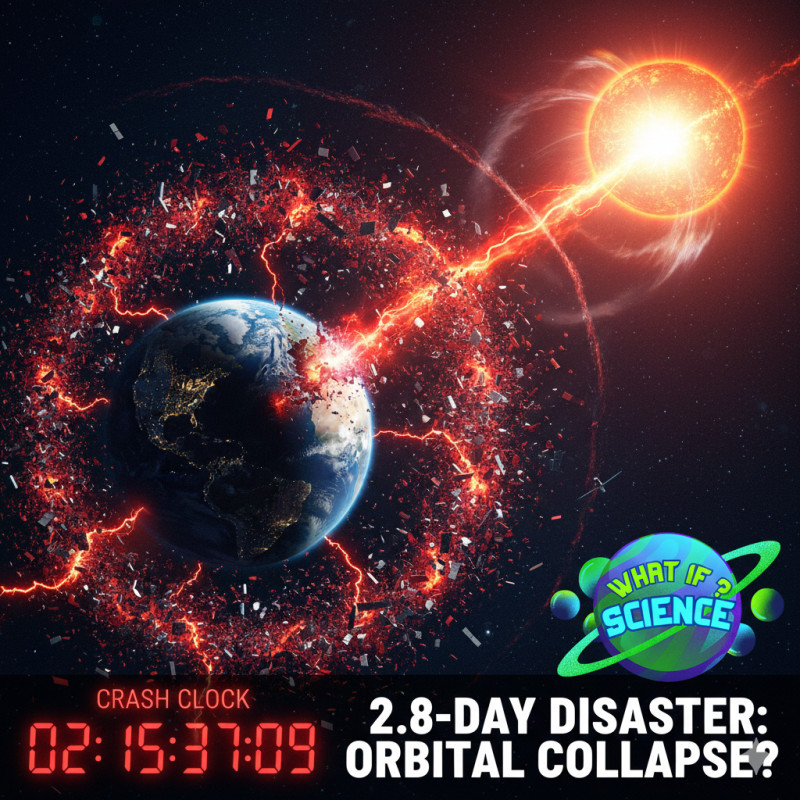
The 2.8-Day Disaster: Are We Days Away from a Space Junk Armageddon?
While we spend our time looking at the stars through the James Webb Space Telescope (JWST), a much more immediate threat is swirling just a few hundred miles above our heads. Scientists have recently sounded the alarm on what they call the "2.8-Day Disaster." It is a terrifying countdown that suggests our modern way of life—from GPS to global banking—could be wiped out in less time than it takes to finish a long weekend.
At the heart of this panic is the Kessler Syndrome. First proposed by NASA scientist Donald Kessler in 1978, it describes a "domino effect" in space. One satellite hits another, creating a cloud of debris. That debris then hits ten more satellites, creating even more junk. Eventually, the entire region around Earth becomes a whirling vortex of shrapnel, making it impossible to launch rockets or maintain the satellites we already have.
For decades, this was just a "maybe." But in 2026, with tens of thousands of satellites now clogging the skies, researchers say the clock has officially started ticking.

The "CRASH Clock": Our New Reality
A team of researchers from the University of British Columbia and Princeton recently introduced a grim new metric: the CRASH Clock (Collision Realization and Significant Harm). This clock measures how long it would take for a major collision to occur if we suddenly lost control of our satellites.
The results are a wake-up call. In 2018, the CRASH Clock stood at 121 days. Today, thanks to the explosion of "megaconstellations" like SpaceX’s Starlink, it has plummeted to just 2.8 days.
This means that if a massive solar storm were to knock out our ability to communicate with satellites today, we would likely see the first catastrophic collision within 72 hours. From there, the "orbital house of cards" begins to fall.
Why 2.8 Days? The Solar Storm Threat
You might wonder, "Why would we ever lose control of our satellites?" The answer lies in our Sun. We are currently in a period of high solar activity. When the Sun letches out a massive solar flare or a Coronal Mass Injection (CME), it does two things to our orbit:
-
Atmospheric Drag: The storm heats up Earth’s upper atmosphere, causing it to expand. This creates "thick air" where there should be a vacuum, slowing satellites down and making them drift unpredictably.
-
Electronic Chaos: Intense radiation can fry the delicate sensors and navigation systems onboard. If a satellite can’t "see" where it is, it can’t perform the emergency maneuvers needed to avoid hitting a neighbor.
During the "Gannon Storm" of May 2024, over half of all satellites in Low Earth Orbit (LEO) had to burn fuel to reposition themselves just to stay safe. If that storm had been just a bit stronger, the 2.8-day timer might have run out.
What Happens if the Orbit Collapses?
If the Kessler Syndrome is triggered, the consequences wouldn't just stay in space. They would hit us hard on the ground:
-
The Digital Dark Age: Your GPS would stop working. Airline navigation, global shipping, and even the synchronized clocks used for stock market trades would fail.
-
Communication Blackouts: Satellite internet and long-distance calls would vanish.
-
The "Grounding" of Humanity: We wouldn't just lose our current satellites; we might be trapped on Earth for generations. If the debris belt becomes too thick, no rocket—not even a SpaceX Starship—could safely pass through to reach the Moon or Mars.
FAQs: The Space Junk Crisis
1. Is the James Webb Telescope in danger? Fortunately, no. The JWST is located at the L2 point, about 1.5 million kilometers away from Earth. The "2.8-day disaster" specifically threatens Low Earth Orbit (LEO), which is much closer to home (under 2,000 km).
2. Can we "clean up" the space junk? There are missions like ClearSpace-1 planned for 2026 to test "space claws" that grab dead satellites. However, cleaning up millions of tiny fragments (some the size of a marble but moving 10 times faster than a bullet) is currently impossible.
3. Will the debris fall on our heads? Most of it will eventually burn up in the atmosphere, but that can take decades. In the meantime, it stays in orbit as a hazard. Large pieces do occasionally survive reentry, but the ocean is usually where they land.
4. How many satellites are up there right now? As of early 2026, there are over 14,000 active satellites, with plans for that number to hit 40,000 or more by 2030.
The Verdict: A Fragile Balance
We are living in the most exciting era of space exploration, but we are also living in the most dangerous one. The 2.8-day window shows just how thin our margin for error has become. If we don't find a way to manage space traffic and clean up our mess, the very technology that connected the world might be the thing that ultimately cuts us off from the universe.
Disclaimer for Google News: This report is based on recent pre-print studies and observational data regarding orbital dynamics and the CRASH Clock metric as of January 2026. While the Kessler Syndrome is a widely accepted scientific theory, a total orbital collapse is a "worst-case scenario" projection and has not occurred.
References & Evidence: