.png)
.png)
.png)
.png)
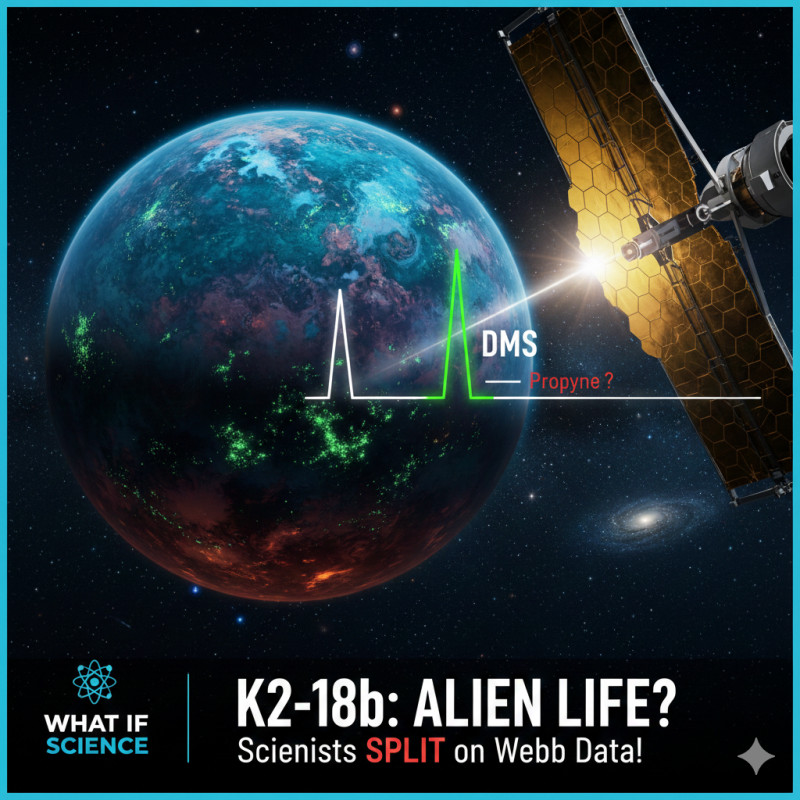
The K2-18b Mystery: Are We Looking at Aliens or Just a Gas Cloud?
Imagine looking through a keyhole at a house 120 light-years away and trying to figure out if someone is home just by the smell of the air wafting through the cracks. That is essentially what astronomers are doing with K2-18b, a massive "Hycean" world that has recently become the center of the most heated debate in modern science.
The buzz started when the James Webb Space Telescope (JWST)—our $10 billion eye in the sky—sniffed out something peculiar in the planet's atmosphere: a molecule called Dimethyl Sulphide (DMS). On Earth, this stuff doesn't just "happen." It is almost exclusively produced by microscopic life in our oceans, like phytoplankton.
Naturally, the world went wild. Headlines screamed, "Alien Life Found!" But as the dust (and space gas) settles in 2026, the scientific community is split right down the middle. Is this the "smoking gun" for extraterrestrial life, or are we just seeing a cosmic mirage?
Why All the Excitement? The Hycean Dream
K2-18b isn't your average space rock. It’s a "sub-Neptune," about 8.6 times the mass of Earth. But what makes it special is the theory that it’s a Hycean world—a portmanteau of "Hydrogen" and "Ocean."
Scientists, led by Professor Nikku Madhusudhan at the University of Cambridge, suggested that underneath its thick hydrogen atmosphere lies a planet-wide liquid water ocean. On Earth, where there is water, there is life. When JWST detected methane and carbon dioxide but a total lack of ammonia, the "ocean" theory gained massive traction. But it was the hint of DMS that turned a quiet scientific observation into a global sensation.
The Controversy: The "False Alarm" Argument
As we move into 2026, the "Alien" hype is facing a reality check. A new wave of researchers, including teams from Arizona State University, have re-analyzed the same data and aren't so convinced.
The problem lies in how JWST "sees." It doesn't take a photo; it records a spectrum—a barcode of light. Different gases block different parts of that light. The signal for DMS is tiny, overlapping with other common gases like methane.
Critics argue that:
-
Statistical Noise: The "spike" that looks like DMS might just be a glitch in the instruments or "red noise" from the telescope's sensors.
-
The Propyne Problem: Some researchers found that a simple hydrocarbon called propyne—which has nothing to do with life—actually fits the data better than DMS.
-
Abiotic Origins: Even if DMS is there, who says it must be life? New lab experiments show that under extreme pressure and radiation, DMS can form through pure chemistry, no microbes required.
The "Hellishly Hot" Reality Check
Not everyone even agrees there is an ocean. Some planetary physicists argue that K2-18b is trapped in a runaway greenhouse effect. Instead of a pleasant tropical sea, the "ocean" might actually be a layer of supercritical fluid or even a molten magma sea. If the surface is thousands of degrees hot, those "alien microbes" would be toast before they ever had a chance to evolve.
What Happens Next?
The debate isn't over—it’s just getting started. The beauty of science is that it’s self-correcting. Astronomers have already booked more time with the James Webb Telescope for 2026 to look specifically for Ethane. Why? Because if DMS is biological, we should see Ethane too. If we don't, the "life" theory might finally go cold.
We are also looking toward the Extremely Large Telescope (ELT) currently under construction on Earth. Once it goes live, it will have the resolution to finally tell us if we are looking at a living world or just a very interesting chemistry set.
FAQs: Your Quick Guide to the K2-18b Debate
1. Is K2-18b a second Earth? Not exactly. It’s much bigger (a sub-Neptune) and has a very thick hydrogen atmosphere. While it might have water, the pressure and gravity would be vastly different from Earth.
2. What is Dimethyl Sulphide (DMS)? It’s a sulfur-based compound. On Earth, it’s the "smell of the sea." It is primarily made by marine life, which is why finding it on another planet is such a big deal.
3. Did NASA confirm alien life? No. NASA has been very cautious, stating that while the hints are exciting, they don't meet the "five-sigma" (99.9999%) certainty required to declare a discovery.
4. Can I see K2-18b with a backyard telescope? Unfortunately, no. It orbits a faint red dwarf star 120 light-years away in the constellation Leo. You need a powerhouse like JWST to even see its light.
The Verdict: A Tantalizing "Maybe"
Right now, K2-18b is the ultimate "What If." It represents the frontier of human knowledge. Whether it’s a living ocean or a boiling gas giant, it’s teaching us how to look for life. And even if this specific lead turns out to be a dead end, it proves one thing: we are finally close enough to start asking the right questions.
Disclaimer for Google News: This article discusses ongoing scientific debates and peer-reviewed pre-prints. No definitive discovery of extraterrestrial life has been confirmed by NASA or the ESA as of January 2026. Scientific consensus is subject to change as new data from the JWST MIRI and NIRSpec instruments are processed.
References & Sources: