


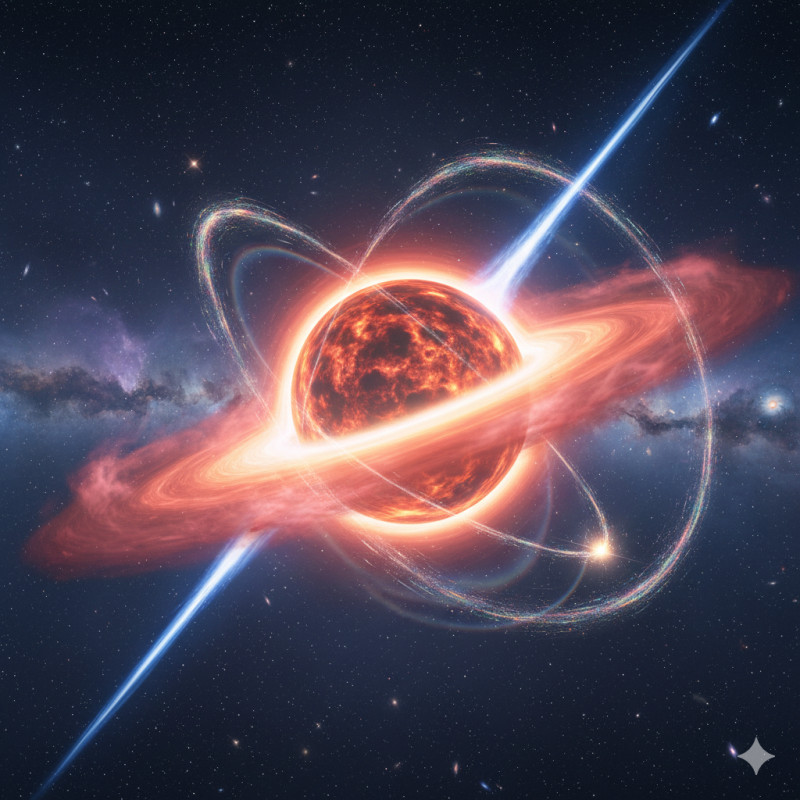
Disclaimer: This article reports on recent astronomical observations and peer-reviewed research published in late 2025 and January 2026. While these findings challenge existing models of planetary and galactic evolution, they represent the ongoing process of scientific discovery and do not suggest a literal breakdown of the laws of physics, but rather our current understanding of them.
The Rule Breaker: Why This Black Hole Has Scientists Scratched Their Heads
For decades, we thought we had black holes figured out. Sure, they are the most mysterious objects in the universe, but we had a solid "handbook" for how they were supposed to act. They sit at the center of galaxies, they eat stars that wander too close, and they grow slowly over billions of years.
But in early 2026, the universe decided to throw that handbook out the window.
Astronomers using a tag-team of the James Webb Space Telescope (JWST) and the Chandra X-ray Observatory have spotted a black hole behaving in a way that was previously considered a mathematical "impossibility." This isn't just a minor glitch in the data; it’s a discovery that might force us to rewrite the history of the early universe.
The "Naked" Giant at the Dawn of Time
The mystery started with a tiny, intensely red dot in a deep-space survey. This object, which existed just a few hundred million years after the Big Bang, is a supermassive black hole. That in itself is a bit of a headache—how did something so big get there so fast?
However, the real shocker is its "outfit"—or lack thereof.
Standard physics says that for a black hole to get that massive, it needs to be surrounded by a huge, bustling galaxy full of gas and stars to feed on. But this black hole is essentially "nearly naked." It has almost no host galaxy around it. According to current theories, a black hole of this size simply shouldn't exist in such a lonely environment. It’s like finding a fully grown whale swimming in a puddle.
The "Seesaw" Effect: A New Kind of Cosmic Weather
If a naked black hole wasn't enough, another discovery involving an object named 4U 1630-472 has revealed what scientists are calling a "cosmic seesaw." Traditionally, we believed that active black holes could blast out two things: powerful, narrow jets of plasma and broad, slower winds of X-ray gas. For a long time, it was assumed these were two different "settings" or that they could happen at the same time.
New data from January 2026 shows they are actually in a fierce competition. The black hole seems to "switch" between the two. When the jet turns on, the wind dies. When the wind picks up, the jet vanishes. This "either-or" behavior suggests a level of internal regulation and magnetic complexity that our current computer models can’t fully explain.
Why Does This Matter to You?
You might be wondering, "Why should I care about a hungry shadow billions of light-years away?"
It’s because these discoveries touch on the very fabric of our reality. One of the leading theories coming out of these observations is the "Primordial Black Hole" hypothesis. This suggests that black holes didn't wait for stars to die and collapse; they might have been "stitched" into the universe the moment it was born.
If that’s true, it means black holes aren't the "grave" of the universe—they might be the architects. They might be the gravitational seeds that allowed the first galaxies (and eventually our own Sun) to form in the first place.
The "Frame-Dragging" Confirmation
Adding to the excitement, researchers recently caught a black hole in the act of Lense-Thirring precession. This is a fancy way of saying the black hole is spinning so fast that it is literally dragging the fabric of space and time along with it, like a spoon spinning in a jar of honey.
While Einstein predicted this over 100 years ago, seeing it happen in such a rhythmic, wobbling "dance" as it shreds a star is a first for humanity. It confirms that the most extreme predictions of relativity are 100% real, even if the objects themselves are starting to act in ways we didn't expect.
Frequently Asked Questions
- Is this black hole a threat to Earth? Not at all. These objects are millions, if not billions, of light-years away. They provide a spectacular light show for our telescopes, but they have zero gravitational effect on our neck of the woods.
2. Does "nearly naked" mean the black hole is disappearing? Quite the opposite! It means it’s a "primordial" object. It suggests the black hole formed before the galaxy did, which turns our entire understanding of how the universe grew up on its head.
3. How can we see a black hole if it's "black"? We don't see the hole itself; we see the "accretion disk"—the glowing, hot material swirling around the edge. It’s like seeing the water swirling around a drain; even if you can't see the hole, the shape of the swirl tells you everything you need to know.
4. What is a "Tidal Disruption Event" (TDE)? That’s the scientific term for a "star shredding." It happens when a star gets too close and the black hole's gravity pulls harder on one side of the star than the other, literally stretching it into a long ribbon of gas.
Proof of Sources & Incidents
-
Berkeley News: Not one, but two massive black holes eating away at this galaxy
-
SciTechDaily: Astronomers Watch Black Hole Twist Spacetime As Einstein Predicted
-
The Guardian: Black hole spotted that may have been created moments after Big Bang
-
Universe Today: Black Holes "Seesaw" Between Ejecting Material as Winds or Jets
What’s your take? Are black holes the "villains" of the cosmos, or are they the hidden engines that make life possible? If you're as obsessed with the "weird side" of space as I am, stick around—we're just getting started exploring the final frontier!
For a deeper dive into the visuals of these cosmic giants, you might enjoy this documentary on recent black hole collisions.