.png)
.png)
.png)
.png)
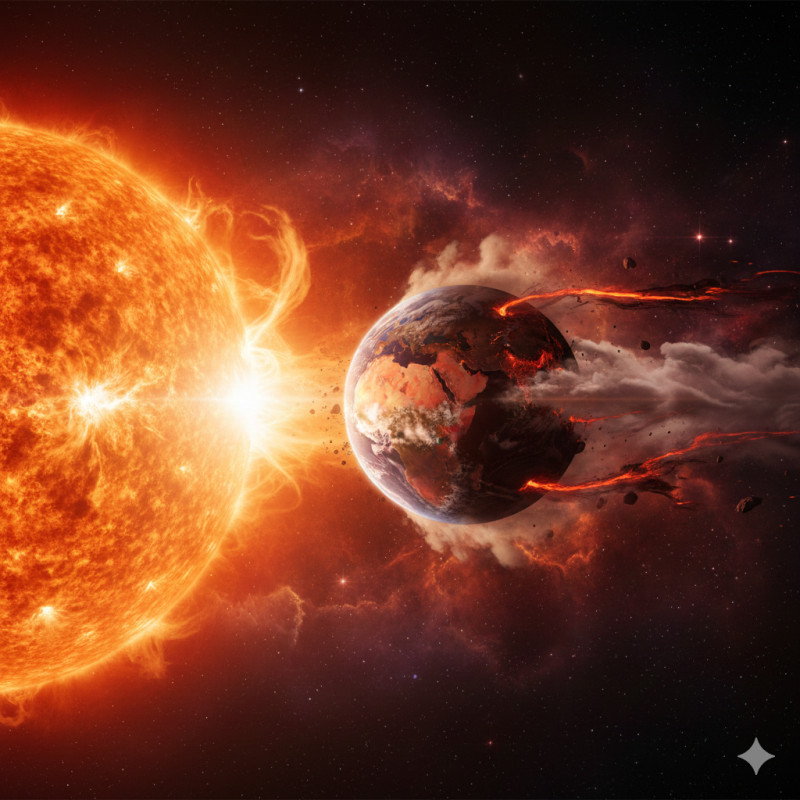
Disclaimer: The following article explores a hypothetical scientific "thought experiment." It is based on established laws of physics and celestial mechanics. No such event is predicted or possible under current scientific understanding of our solar system.
The Day the Engine Broke: What If Earth Just... Stopped?
We spend our lives worrying about the weather, our bank accounts, or whether we left the oven on. But we rarely think about the fact that we are currently screaming through the vacuum of space at about 67,000 miles per hour.
Right now, Earth is a cosmic race car, locked in a perpetual high-speed lap around the Sun. It’s this incredible speed that keeps us from falling inward. But what if, by some impossible flick of a cosmic switch, that movement just stopped? No more orbit. No more "forward" momentum. Just a dead halt.
Buckle up. It wouldn’t be a quick "lights out." It would be a cinematic, terrifying, and scientifically fascinating descent into chaos.
The Great Ejection: Physics Gets Messy
First, let’s talk about the "Stop." If the Earth stopped instantly, the planet itself might survive the initial halt, but everything on it would not.
Think about being in a car going 60 mph and hitting a wall. Now, imagine that car is the size of a planet and it’s going 1,000 times faster. Because of inertia, everything not bolted to the Earth’s bedrock—oceans, atmosphere, buildings, and us—would keep moving at 67,000 mph.
The atmosphere would essentially scour the surface of the planet clean. Oceans would become massive, continent-sized walls of water moving faster than a jet. In a fraction of a second, the surface of the Earth would be unrecognizable.
The Long, Hot Fall
Assuming we survive the initial "jolt" (perhaps the Earth slows down over a few days instead of a millisecond), we face a much bigger problem: Gravity.
The only reason we aren't being pulled into the Sun right now is our orbital velocity. It creates a balance. Without that speed to provide centrifugal force, the Sun’s massive gravitational pull would take over. Earth would no longer be a planet; it would be a falling rock.
But space is big. We wouldn't hit the Sun instantly. According to physics calculations, it would take roughly 65 days to complete the plunge.
A Timeline of the Apocalypse
If you were watching from a bunker, here is how those two months would play out:
-
Week 1: For the first few days, things might actually feel weirdly normal. The Sun would look the same size. However, the stars would stop shifting in the night sky.
-
Week 3: The Sun starts getting noticeably larger. The global temperature climbs. We’ve entered what scientists call the "Permanent Summer," but it’s not the fun kind. Crops begin to wither. Polar ice caps start a terminal meltdown.
-
Week 5: The "Sun-Day." The Sun is now twice as large in the sky as it used to be. The heat is unbearable. Most of the planet is facing extreme droughts, and the electrical grid has likely melted down under the strain of air conditioning and solar flares.
-
Week 8: The final stretch. The Sun now dominates the sky, a roaring furnace of white-hot plasma. The atmosphere begins to boil away. The oceans are literally steaming into space.
By the time we hit day 64, the Earth would be stretched into an egg shape by the Sun's tidal forces. On day 65, the planet would be vaporized, becoming nothing more than a tiny puff of metallic vapor in the Sun's outer layers.
Why Doesn't This Actually Happen?
Thankfully, the "Conservation of Angular Momentum" is a very real and very strict law of the universe. For the Earth to stop orbiting, something would have to hit us with an equal and opposite force—basically another planet-sized object smashing into us from the front.
Even then, the energy required to stop a planet is so vast that the collision itself would probably turn the Earth into a cloud of molten lava before we even had a chance to fall into the Sun.
The Scientific "Silver Lining"
While this sounds like a nightmare, these thought experiments help astronomers understand Exoplanets in other solar systems. By studying how gravity and velocity interact, we can predict which planets stay in the "Goldilocks Zone" (where life can exist) and which ones are destined to be swallowed by their stars.
Frequently Asked Questions
1. Could we use rocket engines to push Earth back into orbit?
Short answer: No. The mass of the Earth is about 1$5.97 \times 10^{24}$ kilograms.2 We don't have enough fuel on the entire planet to move it even a fraction of an inch, let alone restart an entire orbit.
2. Would we freeze or burn first?
We would definitely burn. Since we would be falling toward the heat source, the temperature would climb steadily every single day until the crust of the planet begins to melt.
3. Is there any way to survive in a bunker?
Maybe for a few weeks, but eventually, the very rocks of the Earth would melt. No bunker can withstand the temperature of the Sun’s corona.
4. Has this ever happened to other planets?
We see evidence in other star systems of "planetary engulfment," where stars consume their planets.3 Usually, this happens when a star dies and expands, but occasionally, orbital instabilities can send a planet spiraling inward.
Sources & Further Reading
-
NASA Solar System Exploration: Understanding Planetary Orbits
-
Cornell University - Ask an Astronomer: What if the Earth stopped in its tracks?
-
The Physics Classroom: Circular Motion and Satellite Motion
What do you think? Does the idea of a 65-day countdown sound like a great movie plot, or is it too terrifying to think about? If you want to dive deeper into the mysteries of space, let me know—we could talk about what happens if the Moon suddenly drifted away next!