.png)
.png)
.png)
.png)
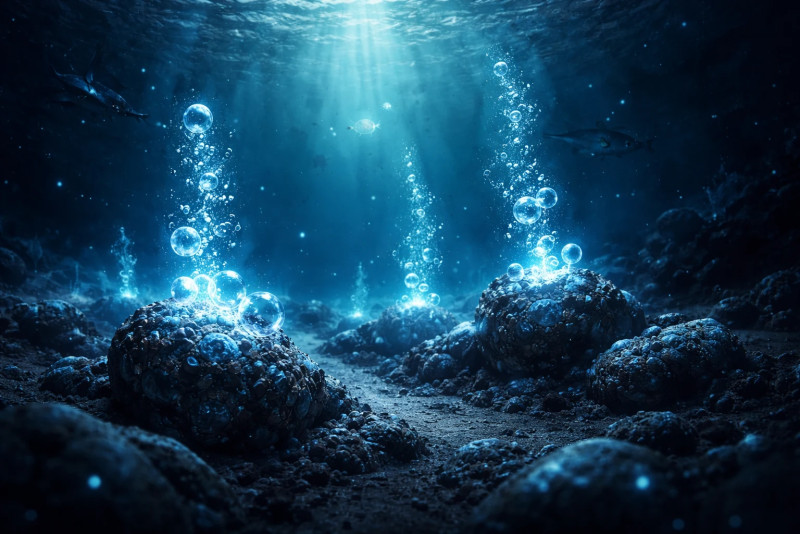
Far below sunlight, deeper than any diver has ever gone, the ocean floor may be quietly deciding the fate of intelligent life. Scientists recently detected “dark oxygen” — oxygen forming in total darkness, without sunlight, without plants, without photosynthesis. It sounds like a miracle of life. But what if it is the opposite? What if the deep sea is not nurturing life… but trapping it? The emerging “Life-Sponge” theory suggests that the deep ocean may absorb energy, oxygen, and biological potential so efficiently that advanced intelligence never gets the chance to evolve. If true, the silence of the universe may not be mysterious at all — it may be inevitable.
A Strange Discovery in Eternal Darkness
Deep-sea researchers studying polymetallic nodules — strange rock formations scattered across the abyssal plains — recently noticed something shocking. Oxygen was appearing in pitch darkness. No sunlight. No algae. No photosynthesis. Yet oxygen levels were rising.
This phenomenon is now called “dark oxygen.”
Unlike surface oxygen, which comes from plants and sunlight, dark oxygen may form through electrochemical reactions triggered by minerals, pressure, and seawater. These deep-sea rocks behave almost like slow natural batteries, splitting water molecules and releasing oxygen.
At first, this looked like a new cradle of life.
But the deeper scientists looked, the stranger the picture became.

The Ocean That Consumes Potential
The Life-Sponge theory proposes a bold idea:
The deep ocean may absorb energy and biological progress faster than it produces complexity.
Instead of pushing life upward toward intelligence, the abyss may quietly keep life trapped in simple, slow, survival-mode ecosystems.
In the deep sea:
-
Energy is scarce
-
Growth is extremely slow
-
Evolution takes millions of years longer
-
Complex brains require too much energy
Even if oxygen exists, usable energy may remain too low to support advanced organisms.
Life survives — but it never accelerates.
Dark Oxygen: A Double-Edged Sword
Dark oxygen sounds hopeful. Oxygen means metabolism. Metabolism means life.
But intelligence requires something more:
Surplus energy.
Brains are expensive organs. The human brain consumes about 20% of body energy. Without energy abundance, intelligence cannot emerge.
The Life-Sponge theory suggests dark oxygen may support basic microbial life only, not advanced organisms. The oxygen is there — but the ecosystem remains trapped in low-energy equilibrium.
Life breathes, but never rises.
Why Intelligence Needs an Energy Explosion
Throughout Earth’s history, intelligence appeared only when energy became abundant and stable:
-
The rise of oxygen from photosynthesis boosted metabolism
-
Complex ecosystems increased energy flow
-
Warm, nutrient-rich environments sped evolution
The deep sea offers the opposite:
-
Cold temperatures slow chemistry
-
Food falls slowly from above
-
Pressure restricts growth
-
Energy is minimal
Even with dark oxygen, the deep sea may remain biologically stagnant.

The Slow Motion World Below
Deep-sea creatures live in a time scale almost unimaginable:
-
Some fish grow for 100+ years
-
Microbes reproduce extremely slowly
-
Evolution crawls instead of runs
In such an environment, complex nervous systems become a disadvantage.
Simple organisms win. Efficiency wins. Survival beats intelligence.
The Life-Sponge theory argues that the abyss selects against complexity.
Could This Explain the Silence of the Universe?
One of humanity’s biggest questions is: Where is everyone?
If life is common in oceans across the universe — under ice moons, deep seas, or subsurface oceans — then many worlds may resemble Earth’s abyss.
If these environments behave like Life-Sponges, they may trap life in microbial stages forever.
Civilizations may never emerge — not because life is rare, but because intelligence is fragile.
The deep ocean is sometimes called an energy desert.
Food comes from “marine snow” — tiny particles drifting down from the surface. The journey takes weeks. By the time nutrients arrive, only a fraction remains.
Dark oxygen may add metabolism, but not enough energy density for complex evolution.
Life survives — but never accelerates into intelligence.
A Graveyard of Possibilities
The Life-Sponge theory does not claim life dies in the deep sea.
Instead, it proposes something more haunting:
Life may survive forever — without ever becoming aware.
Microbes thrive. Simple organisms persist. But:
-
No cities
-
No technology
-
No observers
-
No civilizations
Just endless survival in darkness.
Could Earth Have Been Trapped Too?
Earth almost remained a microbial world for billions of years. Complex life appeared only after oxygen surged dramatically during the Great Oxygenation Event.
Without that surge, Earth might still be a planet of microbes.
The Life-Sponge theory suggests many ocean worlds may never experience that turning point.
They remain alive — but silent.
What Scientists Are Still Debating
It is important to be clear: The Life-Sponge theory is still speculative.
Scientists are actively investigating:
-
How dark oxygen forms
-
Whether it supports complex organisms
-
How much energy deep ecosystems truly generate
-
Whether intelligence can evolve in extreme environments
New deep-sea missions and robotic explorers may soon provide answers.

A Universe Full of Life… and Silence
If the Life-Sponge theory is correct, the universe may not be empty.
It may be quietly alive everywhere — but rarely intelligent.
Oceans may dominate planetary biology, trapping life in slow, stable, low-energy ecosystems that never reach awareness.
The silence of space may not be mystery.
It may be biology.
Disclaimer
The “Life-Sponge” concept is a theoretical interpretation based on emerging deep-sea research, dark oxygen observations, and energy-limited ecosystem models. It is not yet proven and remains under scientific debate. Current research continues to explore deep ocean chemistry, electrochemical oxygen generation, and evolutionary constraints in low-energy environments.
FAQ
What is dark oxygen?
Dark oxygen is oxygen produced in complete darkness through electrochemical reactions involving deep-sea minerals, rather than sunlight-driven photosynthesis.
Is the Life-Sponge theory proven?
No. It is a developing scientific idea based on energy-limited ecosystems and deep-sea oxygen formation. More research is needed.
Why would dark oxygen prevent intelligence?
Because oxygen alone is not enough. Intelligence requires high and stable energy availability, which deep-sea environments may lack.
Could intelligent life exist in deep oceans?
It is possible but considered unlikely due to slow metabolism, low energy, and evolutionary constraints.
Does this relate to alien life?
Yes. Many planets and moons likely have subsurface oceans. If they behave like Earth’s deep sea, life there may remain simple forever.
References and Source Material
-
https://www.nature.com/articles (Deep-sea oxygen and marine chemistry research)
-
https://oceanexplorer.noaa.gov (NOAA deep ocean ecosystem studies)
-
https://www.science.org (Electrochemical reactions in marine environments)
-
https://www.nasa.gov (Ocean worlds and astrobiology research)
-
https://www.frontiersin.org (Low-energy ecosystem and microbial evolution studies)