.png)
.png)
.png)
.png)
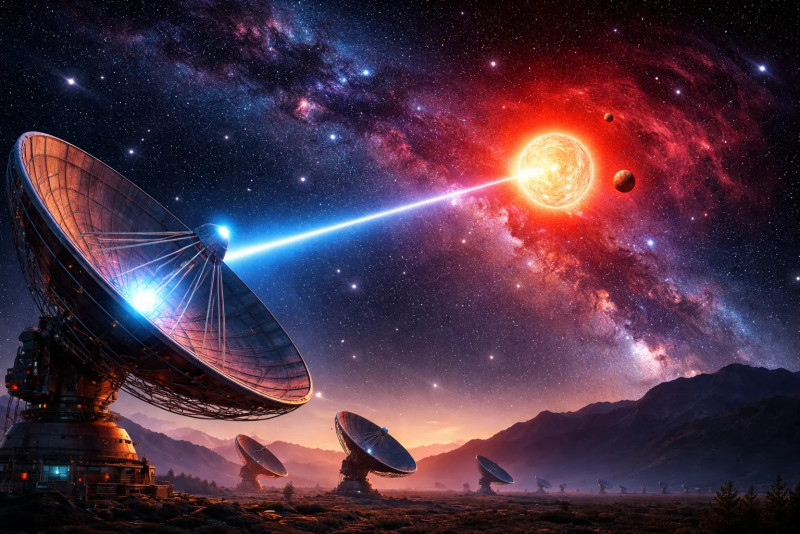
It begins quietly. No explosions. No panic. Just a faint pattern buried in cosmic noise, captured by a radio telescope scanning the nearest star to our Sun. At first, it looks like interference. Maybe a satellite. Maybe a glitch. But then scientists notice something impossible. The signal repeats. Not randomly. Not naturally. It carries structure. Order. Meaning.
Proxima Centauri, a small red star 4.24 light-years away, suddenly becomes the center of human attention. For decades, astronomers have searched for signs of intelligent life beyond Earth. Now, for the first time in history, the universe may be answering back.
The Moment of Discovery
Inside a quiet observatory control room, researchers replay the signal again and again. It is narrowband, highly focused, and unlike any natural cosmic emission ever recorded. Natural sources like pulsars or quasars produce broad, messy signals. This one is clean. Intentional. Artificial.
Within hours, independent observatories across the world are alerted. The signal is confirmed. It is real. It is coming from the direction of Proxima Centauri. And it is not from Earth.
Scientists do not announce it immediately. Verification takes priority. Data is checked, instruments recalibrated, interference ruled out. The world remains unaware for nearly forty-eight hours while the most important scientific confirmation in human history unfolds quietly behind closed doors.

The Announcement That Changes Everything
When the confirmation becomes undeniable, the news is released. A brief statement appears from an international astronomical research team.
A structured radio signal of non-natural origin has been detected from the direction of Proxima Centauri.
Within minutes, the world changes.
News spreads across the globe. Social media erupts. Television channels interrupt programming. Governments call emergency scientific briefings. The phrase “Are we alone?” suddenly has a new meaning.
Humanity has just received its first possible message from another intelligence.
What Is in the Signal?
The next challenge begins. Decoding.
At first, the signal appears simple — pulses arranged in repeating sequences. But deeper analysis reveals mathematical patterns. Prime numbers. Geometric ratios. Universal constants. Whoever sent it understands physics and mathematics, the shared language of the universe.
The message may not be words. It may be knowledge.
Scientists begin building global teams of linguists, mathematicians, cryptographers, AI analysts, and astrophysicists. The signal is translated slowly, piece by piece. The process could take months, years, or even decades.
And then the real question emerges.

Should We Respond?
This question divides humanity almost instantly.
Some scientists argue that responding is humanity’s greatest opportunity — a chance to join a wider cosmic community. Others warn it could be dangerous. What if the signal reveals our location to a hostile civilization? What if we do not understand their intentions?
The debate is not new. For decades, researchers have discussed the risks of active messaging into space. Now, it is no longer theory. It is reality.
Global scientific councils begin drafting protocols. Governments demand involvement. Philosophers, religious leaders, and historians enter the conversation. Humanity must decide together.
Are we ready to speak for Earth?
The Reality of Distance
Proxima Centauri is 4.24 light-years away. This means the signal we received today was sent more than four years ago. If we respond immediately, our reply will take another four years to arrive.
Communication will not be a conversation. It will be a slow exchange across time.
One message every eight and a half years.
This changes how scientists think about the sender. The civilization that transmitted the signal may already know we exist. Or it may simply be broadcasting into the void, hoping someone, somewhere, hears them.
Either possibility is extraordinary.
Public Reaction Across the World
Fear, wonder, excitement, disbelief — every emotion spreads across humanity.
Some people celebrate the discovery as proof we are not alone. Others feel deep anxiety about what it could mean. Financial markets fluctuate. Religious interpretations emerge. Conspiracy theories multiply. Governments urge calm, while scientific institutions focus on transparency and data sharing.
For the first time in history, humanity shares a single moment of cosmic awareness.
We are part of a larger universe.

The Scientific Breakthrough
Beyond the emotional impact, the discovery triggers the largest scientific collaboration ever attempted. Radio telescopes, space observatories, and deep-space listening networks begin continuous monitoring of Proxima Centauri.
New technology is developed rapidly. More sensitive detectors. Better signal filters. Advanced decoding systems. The search for further transmissions intensifies.
And then comes another possibility.
What if the signal contains knowledge beyond our current science?
Some experts believe an advanced civilization may embed scientific data inside a message — physics, energy systems, medicine, or cosmic maps. Even a small breakthrough could change humanity forever.
But interpreting alien knowledge carries risks. Misunderstanding could be dangerous. Scientists proceed carefully, guided by global ethical agreements.
Could It Be a Warning?
Some researchers propose a darker possibility. The signal may not be a greeting. It could be a warning.
About cosmic dangers. About hostile forces. About survival in a violent universe.
The idea may sound dramatic, but scientists take every scenario seriously. Until the message is fully decoded, its purpose remains unknown.

The First Reply
After months of debate, humanity makes a decision.
A reply will be sent.
The message is carefully designed — simple, mathematical, universal. It includes basic information about Earth, our biology, our location, and our peaceful intentions. No military data. No sensitive technology. Only identity.
The transmission begins using the most powerful radio transmitter ever built.
A beam of information leaves Earth, traveling at the speed of light toward Proxima Centauri.
Humanity has spoken into the universe for the first time, knowing the reply — if it comes — will arrive years later.
The Long Wait
And then comes silence.
Years pass. Scientists continue monitoring. Humanity lives under a quiet awareness that somewhere, across the stars, another intelligence may be listening.
Children grow up knowing Earth is not alone. Science, philosophy, and culture evolve. Space exploration accelerates. The dream of interstellar travel becomes more urgent than ever.
And one day, far in the future, another signal may arrive.
Stronger. Clearer. Closer to understanding.

Disclaimer
This article explores a scientifically plausible scenario based on ongoing research into extraterrestrial signal detection and the study of Proxima Centauri. No confirmed alien signal has been officially verified as of today. The discussion is grounded in real scientific methods, protocols, and SETI research principles while imagining a potential future event.
Frequently Asked Questions
Has a real alien signal ever been confirmed?
No confirmed extraterrestrial signal has been officially verified. Several mysterious signals have been detected in history, but none proven to be from intelligent life.
Why is Proxima Centauri important?
Proxima Centauri is the closest star to Earth and hosts at least one Earth-sized planet in its habitable zone, making it a prime target in the search for extraterrestrial life.
How long would communication take?
Because Proxima Centauri is 4.24 light-years away, a message would take over four years to travel one way.
Could responding be dangerous?
Some scientists believe revealing our presence could carry risks, while others argue advanced civilizations likely already know Earth exists.
What would scientists look for in the signal?
Mathematical patterns, structured data, non-random sequences, and universal constants are key indicators of intelligent origin.
References and Sources
SETI Institute — https://www.seti.org
NASA Exoplanet Exploration — https://exoplanets.nasa.gov
Breakthrough Listen Project — https://breakthroughinitiatives.org
European Southern Observatory (Proxima Centauri research) — https://www.eso.org
Nature Astronomy — https://www.nature.com/natureastronomy