.png)
.png)


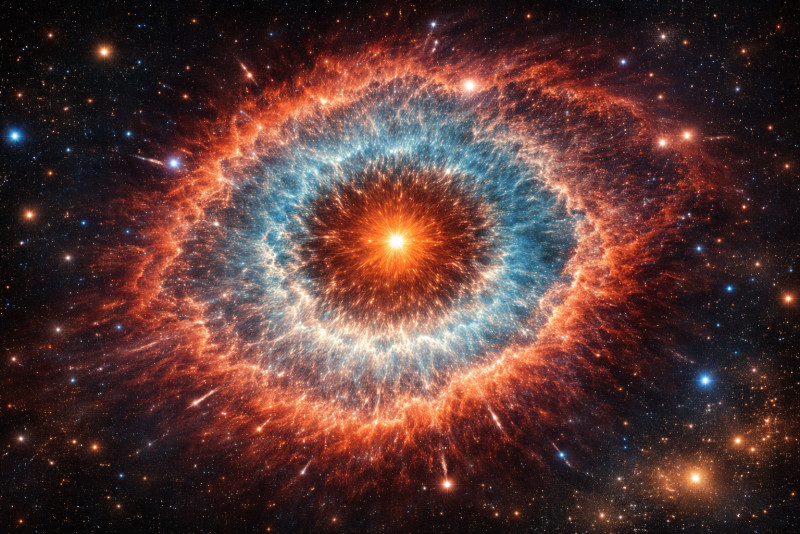
Remember that iconic, fiery eye from The Lord of the Rings that watched over Middle-earth? Imagine seeing something similar, but infinitely larger, more ancient, and far more real, staring back at you from the depths of space. Thanks to the incredible power of the James Webb Space Telescope (JWST), we now have a chillingly beautiful, high-resolution view of the Helix Nebula, which has once again earned its spooky nickname: "The Eye of Sauron."
This isn't just another pretty picture of space; it’s a cosmic farewell, a celestial ghost, and a deep dive into the dramatic end of a star much like our own Sun. And the details JWST is picking up in early 2026 are absolutely mind-blowing.
A Star's Grand Finale: The Making of the Helix
The Helix Nebula, officially known as NGC 7293, is about 650 light-years away from us, comfortably nestled in the constellation Aquarius. What you're seeing in these new JWST images is not a star being born, but a star dying.
Every star, including our Sun, has a life cycle. For stars like ours, once they’ve burned through most of their hydrogen fuel, they puff up into a massive red giant. Then, they shed their outer layers of gas and dust into space, creating these incredibly beautiful, expanding shells we call planetary nebulae. The star itself eventually collapses into a tiny, super-dense white dwarf at the center, glowing dimly.
The Helix is one of the closest and most spectacular examples of this process. It’s like watching a cosmic smoke ring expand, but instead of smoke, it's superheated gas glowing with every color imaginable.
Why "The Eye of Sauron"?
Take a look at the image. See that bright, central "pupil" and the surrounding rings of gas that look eerily like an iris? It’s hard to unsee the resemblance to the mythical Dark Lord's watchful eye. Previous telescopes, like Hubble, gave us hints, but JWST’s infrared vision cuts through the dust with unparalleled clarity, making the "eye" even more pronounced and, dare we say, a bit more menacing.
The central "pupil" is the super-hot white dwarf, the remnant of the star that cast off all this material. The vibrant blues, greens, and reds you see are different elements glowing as they’re hit by intense ultraviolet radiation from that central star. Oxygen often glows blue, hydrogen red, and nitrogen green.
JWST's Unprecedented View: What's New?
The James Webb Space Telescope, launched in late 2021, is an infrared observatory. This means it doesn't see visible light like our eyes do. Instead, it "sees" heat, allowing it to peer through thick dust clouds that would completely block traditional telescopes.
With these new 2026 observations of the Helix, JWST has done several things that are groundbreaking:
-
Unveiling the "Cometary Knots": One of the most fascinating features of the Helix are thousands of tiny, tadpole-shaped structures scattered throughout the nebula. Astronomers call them "cometary knots." They are dense blobs of gas, each about the size of our solar system, with glowing "tails" trailing behind them. JWST has resolved these knots in incredible detail, showing us how they are being eroded by the fierce radiation from the central white dwarf. It's like seeing raindrops carving paths in sand, but on a cosmic scale.
-
Mapping the Molecular Gas: JWST's instruments are incredibly sensitive to molecular hydrogen and other complex molecules. Previous images struggled to show this, but now we can see where cold gas and dust are concentrated, offering clues about how these nebulae evolve and how heavy elements are dispersed into space. This molecular gas is the raw material for future stars and planets!
-
The Faintest Outskirts: The Webb telescope is so powerful that it's detecting faint, diffuse gas far beyond what we thought was the edge of the Helix. This means the star's "death throes" actually extended much further into space than previously imagined, painting an even grander picture of its final moments.
Our Sun's Future: A Glimpse into 5 Billion Years
The Helix Nebula is often called a "prototype" for what will happen to our own Sun. In about 5 billion years, our Sun will also swell into a red giant, then shed its outer layers, forming its own planetary nebula. It won't be quite as dramatic as the Helix (our Sun is less massive), but it will follow the same general process.
By studying nebulae like the Helix with such detail, we are essentially looking into our solar system's distant future, understanding the mechanisms that shape stellar evolution and recycle the universe's building blocks.
Frequently Asked Questions
- Is the Helix Nebula actually watching us? No, thankfully! While it looks like an eye, it’s just a coincidence of its shape and how we view it from Earth. It's an expanding shell of gas, not a conscious entity.
2. How big is the "Eye of Sauron"?
The Helix Nebula stretches across about 2.5 light-years, which is about half the distance from our Sun to the nearest star, Alpha Centauri. It's truly enormous!
3. What is a "planetary nebula" anyway? Is it related to planets?
The name is a bit misleading! Early astronomers thought these objects looked like planets when viewed through their telescopes, hence "planetary nebula." They have nothing to do with planets themselves; they are the gas shells cast off by dying stars.
4. Will the Helix Nebula disappear?
Yes, eventually. These nebulae are temporary phenomena, lasting only for tens of thousands of years (a blink of an eye in cosmic terms). The gas will continue to expand and disperse into interstellar space, becoming too faint to see.
Final Thoughts: A Cosmic Masterpiece
The James Webb Space Telescope continues to deliver on its promise of revolutionizing our understanding of the universe. Its latest high-resolution views of the Helix Nebula are more than just stunning images; they are profound scientific data points, telling us stories of stellar lives and deaths, and hinting at the origins of everything around us.
So, the next time you look up at the night sky, remember that the "Eye of Sauron" is out there, not as a threat, but as a breathtaking cosmic masterpiece, courtesy of a dying star and the most powerful telescope ever built.
Disclaimer: Astronomical images are often processed to enhance specific wavelengths and details for scientific analysis and aesthetic appeal. The colors in these images are representative of various elements and temperatures but may not be what the human eye would perceive directly.
Sources and References: