.png)
.png)
.png)
.png)
For decades, we’ve looked at the stars and wondered what’s out there. We’ve sent rovers to Mars and probes to the edge of the solar system, but ironically, we know more about the surface of the Moon than we do about what’s right beneath our feet. That is all about to change.
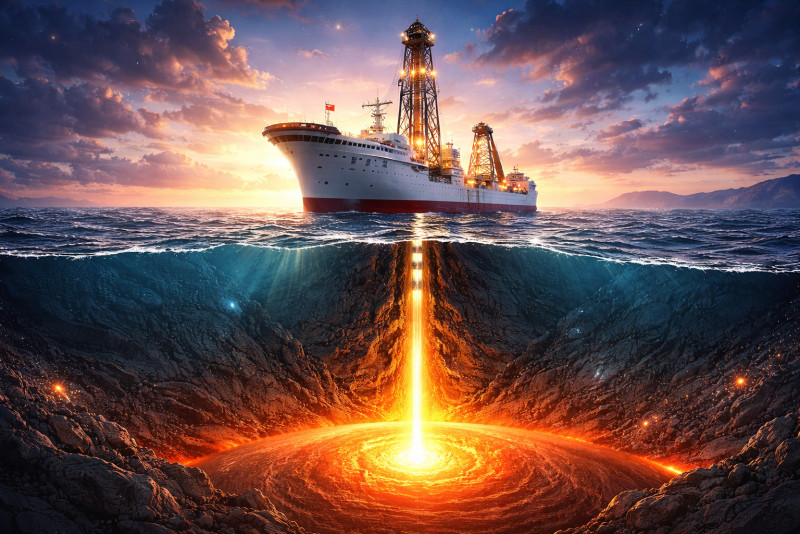
Right now, a massive ship named Mengxiang—which literally translates to "Dream"—is preparing for a mission that sounds like something straight out of a Jules Verne novel. Its goal? To drill 11 kilometers (about 6.8 miles) through the ocean floor to reach the Earth's mantle by the end of 2026.
This isn't just another scientific study; it's a high-stakes, "all or nothing" attempt to touch the very engine room of our planet.
The Vessel That Defies the Deep
To reach the mantle, you can't just use a standard oil rig. You need a monster. The Mengxiang is a 42,600-tonne engineering marvel, commissioned in late 2024 and currently undergoing the rigorous trials needed for its record-breaking deep-dive.
Think of it as a floating city of science. It’s nearly 180 meters long and can stay out at sea for 120 days straight without needing to see land. But the real "magic" is the drilling rig itself. It’s the first in the world capable of both oil exploration and ultra-deep scientific coring, with a lifting capacity of over 900 tonnes.
Why Drill in the Ocean?
You might wonder why they don't just drill on land. After all, 11km is a long way down, but the Earth's crust on land is actually much thicker—sometimes up to 70km deep! By drilling in the ocean, where the crust is naturally thinner (often only 5 to 10km), the Mengxiang has a "shortcut" to the Moho, the boundary where the crust ends and the mantle begins.
Why the Mantle Matters
So, why are we spending billions to poke a hole in the seafloor? Because the mantle is where the "real" Earth lives. It makes up about 80% of our planet's volume, yet no human has ever touched it.
Earthquake Secrets
By studying the mantle, scientists can better understand plate tectonics. This could lead to a revolution in how we predict earthquakes and tsunamis. Currently, we can only react to what happens on the surface; reaching the mantle lets us see the source of the pressure.
The Origin of Life
Some researchers believe that deep within the crust-mantle boundary, there may be "extremophile" life forms that don't rely on sunlight. Finding them would change our definition of life itself and could give us clues about where to look for life on other planets like Europa or Enceladus.
A Time Capsule
The rocks down there haven't seen the surface for billions of years. They hold the chemical "DNA" of how Earth was formed. Analyzing these samples is like reading the original blueprint of our home world.
The "Moon Landing" of Earth Science
Reaching the mantle is often called the "Inner Space" equivalent of the Apollo 11 moon landing. Many have tried before—the U.S. had "Project Mohole" in the 60s, and Russia's Kola Superdeep Borehole went deep but was on land—but no one has successfully retrieved a "fresh" piece of the mantle from beneath the ocean.
The technical hurdles are insane. At 11km down, the pressure is 1,300 times higher than at sea level, and temperatures can soar to over 200°C (nearly 400°F). The Mengxiang uses specialized titanium alloy drill rods and diamond-tipped bits just to survive the heat and the crushing weight of two miles of water and six miles of rock.
What Happens in 2026?
As we move through 2026, the Mengxiang will begin its most ambitious drilling phases. The team is currently identifying the perfect "sweet spot" in the ocean where the crust is thinnest and the geological conditions are stable enough to keep a 11km-long drill string from snapping like a toothpick.
If they succeed by the end of the year, it won't just be a win for China; it will be a win for global science. The data collected will be shared with the international community, helping us all understand the ground we walk on.
Frequently Asked Questions
Is 11km the deepest hole ever drilled?
Actually, no. The Kola Superdeep Borehole in Russia reached over 12km, but that was on land. The Mengxiang's mission is unique because it's drilling through the oceanic crust, which is much harder to do but gives us direct access to the mantle.
Could drilling this deep cause a volcano or earthquake?
Not likely. The hole is incredibly narrow—often only a few inches wide at the bottom. It’s like a tiny needle prick on the scale of the Earth. It doesn't have the "room" or the internal pressure to trigger a massive geological event.
What does "Mengxiang" mean?
It means "Dream." It represents the long-held dream of geologists to finally see what the Earth's interior actually looks like without relying on seismic computer models.
Final Thoughts: The Final Frontier is Under Us
We spend so much time looking at the stars that we forget there is an entire world of mystery right under our feet. The Mengxiang isn't just a ship; it's a bridge to a part of our planet that has been hidden for 4.5 billion years. By the end of 2026, we might finally have the answers to how our world was built.
Keep an eye on the news—the "Dream" is about to become a reality.
Disclaimer: Deep-sea drilling is a complex and evolving field. Timelines and depth goals are subject to geological conditions and technical adjustments. This article reflects the mission goals and vessel capabilities as of early 2026.
Sources and References:
-
Official Portal of the Government of the People's Republic of China - Mengxiang Commissioning
-
Guangzhou Marine Geological Survey (GMGS) - Technical Reports
-
International Ocean Discovery Program (IODP) - Deep Sea Drilling Framework
China's first deep-ocean drilling vessel Meng Xiang enters service