.png)
.png)
.png)
.png)
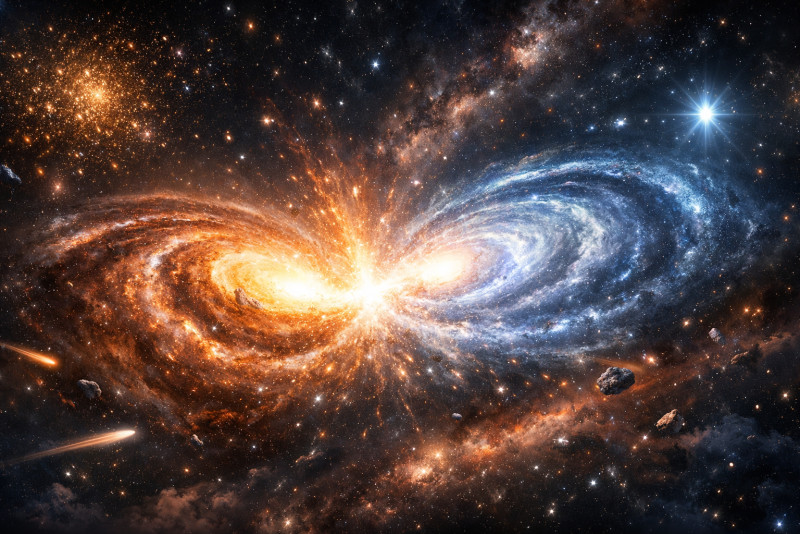
The universe has a funny way of throwing a party. While we were busy ringing in 2026 here on Earth, deep in the silent vacuum of space, a collision of truly biblical proportions was making its grand debut. Astronomers have just caught two titanic galaxy clusters in the middle of a slow-motion smashup that makes a highway pileup look like a minor fender bender.
Located in a region of space now famously dubbed the “Champagne Cluster,” this event is being hailed as the Great Collision of 2026. It’s messy, it’s violent, and it’s arguably the most beautiful thing happening in the night sky right now.
What Exactly is the 'Champagne Cluster'?
Before we get into the "crash" details, let’s talk about the name. It sounds fancy, right? The Champagne Cluster (officially known by the much less poetic name RM J130558.9+263048.4) earned its nickname for two reasons. First, it was discovered on New Year’s Eve. Second, when you look at the X-ray images, the superheated gas looks exactly like bubbles fizzing up in a glass of Moët.
But don’t let the bubbly name fool you. This isn’t one single cluster. It’s actually two massive families of galaxies—each containing hundreds of individual star systems—that are currently slamming into one another.
The Physics of a Cosmic Smashup
When we say "smashing together," it doesn't mean stars are hitting each other. Space is mostly empty, so the stars actually glide past one another like ghosts. The real action happens with the gas and the dark matter.
1. The Superheated Gas
The purple haze you see in the latest NASA photos is gas heated to millions of degrees. When these two clusters hit, the gas clouds slammed into each other, creating a massive "shock wave." This gas is so heavy that it actually outweighs all the hundreds of galaxies in the cluster combined.
2. The Dark Matter Mystery
This is the part that has scientists losing sleep. Dark matter—the invisible "glue" of the universe—doesn't care about the collision. While the gas gets stuck and tangled in the middle (like a cosmic traffic jam), the dark matter and the galaxies just sail right through. This separation is giving researchers a front-row seat to study how dark matter behaves when things get rowdy.
Two Scenarios: What Happens Next?
Based on the data coming in this January from the Chandra X-ray Observatory, astronomers are debating two possible timelines for this event:
-
The "Second Date" Scenario: Some believe these two clusters already hit each other about two billion years ago. They flew apart, reached the end of their gravitational "leash," and are now swinging back for a second, even more violent encounter.
-
The "Fresh Start" Scenario: Others argue this is their very first meeting, a single high-speed collision that started about 400 million years ago and is only now reaching its peak visibility.
Regardless of which theory is right, the result is the same: a mega-structure is being born that will eventually become one of the largest objects in the known universe.
Comparison: Champagne Cluster vs. The Bullet Cluster
| Feature | Champagne Cluster (2026) | The Bullet Cluster |
| Discovery | New Year's Eve | Early 2000s |
| Key Visual | Stretched, "bubbly" purple gas | Bow-shaped shock wave |
| Scientific Value | Probing Dark Matter's "drag" | First proof of Dark Matter |
| Distance | Billions of light-years | 3.7 Billion light-years |
Why This Matters for You
You might be wondering, "Why should I care about some gas bubbles billions of light-years away?" Well, these collisions are the building blocks of the universe. Our own Milky Way is on a collision course with the Andromeda galaxy. By watching the Champagne Cluster, we are essentially looking at a "preview" of our own cosmic destiny.
It’s a reminder that we live in a dynamic, evolving neighborhood. The "Great Collision" isn't just a headline; it's the universe growing up.
Frequently Asked Questions
- Can I see the Champagne Cluster with a backyard telescope? Unfortunately, no. While the event is massive, it’s also incredibly far away. You need the "heavy hitters" like NASA’s Chandra or the James Webb Space Telescope to see the X-ray glow and distant galaxies.
2. Will this collision affect Earth? Not at all! This is happening billions of light-years away. It’s a spectacular light show for our scientists, but we are perfectly safe here in our little corner of the solar system.
3. Why is it called a "Dissociative" merger? That's just a fancy science term meaning the "stuff" (gas) got separated from the "mass" (dark matter/galaxies) during the hit. It's like your hat flying off when you run into someone.
Final Thoughts: A Toast to the Stars
The Great Collision of 2026 serves as a beautiful, violent reminder of the scale of our universe. As we move further into this year, expect more "fizz" from the Champagne Cluster as the James Webb Space Telescope begins to peel back even more layers of this cosmic merger.
Stay curious, keep looking up, and maybe pour a glass for the galaxies clinking together out there in the dark.
Disclaimer: This article is for informational purposes and reflects the latest astronomical data as of January 2026. Astronomical timelines involve millions of years; "2026" refers to the year of major data release and public observation, not the physical start of the collision itself.
Sources and References: