.png)
.png)
.png)
.png)
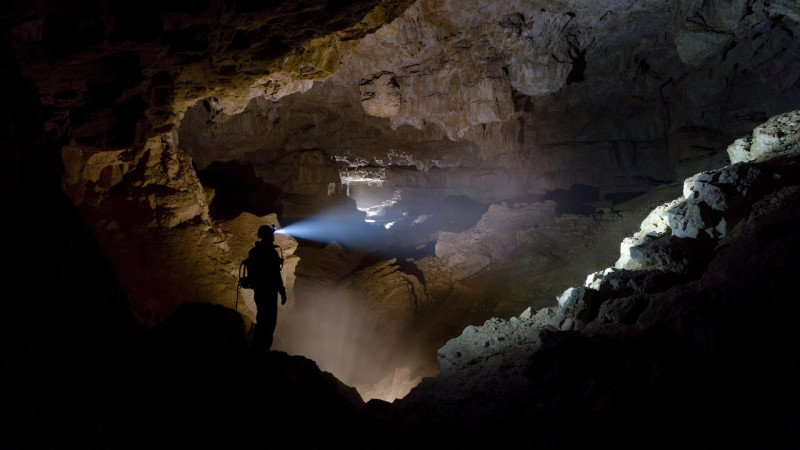
Acoustic anomalies that spook even seasoned explorers
You step past the last beam of daylight, your headlamp eats away at the dark, and somewhere far below a sound folds and returns to you — a whisper, a hum, almost like someone exhaling your name. Experienced cavers shrug and laugh off the theatrics. But the truth is more interesting than ghosts: deep caves are acoustic theaters that can turn wind, water, and rock into voice-like signals. Here's how that happens — and why even veteran spelunkers sometimes leave with goosebumps.

Cavern architecture acts like a giant instrument
Caves are not hollow holes; they are complex chambers, tunnels, domes and narrow throats that shape sound. When a sound source — dripping water, a gust of wind, a rattling rock — hits those surfaces, waves bounce back and interfere. That interference can boost certain frequencies and cancel others, creating standing waves or long reverberations that stretch and warp the original noise into tones humans naturally link to voices or breathing. Scientists who study ancient caves have measured frequency-dependent amplification around human-vocal ranges, which helps explain why some cave noises sound eerily like speech.
Resonance, Helmholtz effects and "singing" pockets
Some cave hollows behave like Helmholtz resonators — the same physics behind blowing across a bottle mouth. A single chamber can reinforce low frequencies that our ears interpret as a distant male voice; a narrow tube might amplify higher pitches that sound more like whispering. Researchers mapping cave acoustics find clear resonance peaks (distinct tones) at frequencies that overlap with human vocal formants — the key components our brains use to recognize voices. That overlap primes us to hear patterns that sound like words even when none were spoken.

The brain fills gaps — pareidolia underground
Human perception loves patterns. When the ear catches a tone with the right timbre and rhythm, the brain often completes the rest, turning an ambiguous sound into a syllable or a phrase. This “auditory pareidolia” is why you’ll hear names or sentences in static or in the hiss of a kettle. In caves, long reverbs and resonant boosts create exactly the kind of ambiguous audio our brains are primed to translate into voices. Archaeologists studying ritual caves have even argued that ancient people used these acoustic quirks deliberately for ceremonies, because the textures of sound can trigger emotional, trance-like responses.
Infrasound and physiological effects
Low-frequency sounds below the normal hearing range — infrasound — can make a person feel uneasy, create a sense of pressure, or cause hairs on the neck to rise. When cave geometry amplifies infrasound, explorers sometimes report the sensation of a presence or an “unseen voice.” That’s not supernatural; it’s a physical effect of sound on the body and brain. Controlled studies show certain low-frequency bands can influence mood and perception, which helps explain why some cave encounters feel more than just creepy.

Real-life reports: when recordings go viral
You don’t have to rely on theory. In March 2023 a hiker exploring the Waldeck Mine in Western Australia captured faint whispering and chanting-like sounds on video; viewers debated whether it came from wind, animal echoes, or something stranger. The clip went viral on social media and was covered by community news outlets on March 22, 2023, sparking fresh interest in why abandoned shafts often “talk.” Anecdotes like this match decades of reports from tour mines and old shafts where visitors swear they heard voices coming from empty tunnels. While sensational, these accounts are useful: they push scientists and acoustic technicians to record and analyze the sounds rather than dismiss them.
How explorers and scientists test the mystery
Modern teams use impulse recordings, swept-sine tests and ambisonic microphones to map a cave’s acoustic fingerprint. Studies such as acoustic evaluations of Udaigiri Caves (May 2021) show distinct resonance peaks and reverberation profiles across chambers — the same kind of data that explains voice-like amplifications. Archaeoacoustic research in prehistoric sites demonstrates how specific frequencies get boosted at ritual spots, and how those boosts fall into ranges that influence human auditory perception. In short: measure the cave, run the numbers, and the mystery often unravels into physics.
Practical takeaways for cavers
If you hear a voice underground, don’t panic. Note the time and position, record with a directional mic if you can, and check for obvious sources: flowing water, wind through shafts, metal echoes, or other team members. Scientists say the best way to turn spooky into solvable is evidence — audio, measurements, and repeatable tests that match sound to structure. Many “hauntings” evaporate under close acoustic study, replaced by fascinating physical explanations.
Deep caves keep their secrets well. But the next time you hear what sounds like a whisper down there, remember: it may be less a ghost than a complicated chorus of physics, carved by time into a microphone-ready stage. Listen closely — and bring a recorder.
Reference links :
- Archaeoacoustic study of prehistoric cave site (frequency amplification): https://www.researchgate.net/publication/277328815_Archaeoacoustic_Investigation_of_a_Prehistoric_Cave_Site_Frequency-Dependent_Sound_Amplification_and_Potential_Relevance_for_Neurotheology.
- Acoustic evaluation of Udaigiri Caves (May 2021): https://www.researchgate.net/publication/351774507_Sensing_the_sound_of_past_Acoustic_evaluation_of_Udaigiri_Caves_near_Vidisha_Madhya_Pradesh_India.
- Archaeoacoustic analysis of the Ħal Saflieni Hypogeum (Malta): https://www.um.edu.mt/library/oar/bitstream/123456789/16630/1/OA%20Archaeoacoustic%20Analysis%20of%20the%20%C4%A6al%20Saflieni%20Hypogeum%20in%20Malta.pdf.
- Great Stalacpipe Organ (historical example of cave acoustics): https://en.wikipedia.org/wiki/Great_Stalacpipe_Organ.
- Hiker hears whispering in abandoned Waldeck Mine — community re
Some people have reported in their visits to these caves sightings of weird lights, orbs, ghosts, strange presence of someone invisible , disembodied voices, weird electric anomalies in their devices, pressure in the chest or seizures. Some times the anomaly forms plasma balls very charged with electricity. It is explained in a paper called "Exploring the Link Between Paranormal Phenomena and Plasma Balls".