.png)
.png)
.png)
.png)
Logistics that don’t add up — even with today’s technology
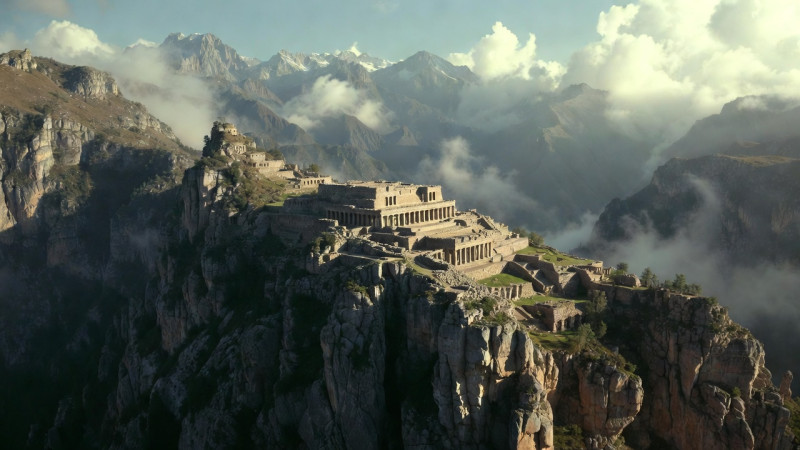
High on windswept mountains, deep inside jungles, and across barren plateaus, ancient builders left behind stone structures that still confuse engineers. These are not small ruins. They are massive complexes, carved blocks, and precision layouts placed where even modern machinery struggles to operate. The question is no longer whether these structures exist, but how they were built and supplied under conditions that seem logistically impossible.
What makes this mystery compelling is not mythology — it’s math, terrain, and time.

Mountains without roads, cities without wheels
Take Machu Picchu. Perched nearly 2,430 meters above sea level, this Inca city sits on a narrow ridge surrounded by steep slopes and dense cloud forest. Archaeologists confirm construction began around 1450 CE, decades before European contact. There were no wheeled vehicles, no iron tools, and no pack animals capable of carrying heavy stone at that altitude.
Yet the stones fit together so precisely that even a blade cannot slide between them. Transporting multi-ton granite blocks up such terrain would challenge helicopters today. No construction ramps have ever been found. The logistics remain unresolved.
Desert monuments without local resources
In Egypt, the Great Pyramid of Giza is famous — but less discussed is where its materials came from. Limestone blocks weighing up to 80 tons were quarried miles away and moved across desert terrain. According to archaeological records dated around 2560 BCE, this happened without cranes, steel cables, or engines.
Even with modern trucks, transporting and aligning stones of that size requires carefully planned infrastructure. Ancient Egypt had none of that — yet achieved architectural alignment accurate to fractions of a degree.

Jungle cities built before modern surveying
Deep in Cambodia’s forests stands Angkor Wat, constructed in the early 12th century. The site was not just a temple — it was part of a massive urban network with water management systems spanning hundreds of square kilometers.
The problem? The jungle environment constantly floods, erodes, and shifts soil. Modern engineers working in similar terrain rely on satellite mapping and ground stabilization tech. Angkor’s builders had neither — yet their canals still influence flood patterns today.
Stones heavier than modern cranes can lift
In Lebanon, the ancient site of Baalbek contains some of the largest cut stones ever used in construction. The “Stone of the Pregnant Woman” weighs an estimated 1,000 tons. It was quarried, moved, and positioned with astonishing precision.
No written Roman records explain how this was done. Modern crane simulations suggest specialized equipment would be required even today. The quarry stone dates to roughly 27 BCE, during Roman expansion — but the logistics remain absent from historical accounts.

Islands with no trees, yet massive statues
On Easter Island, nearly 900 stone statues known as moai were carved and transported across the island between 1250 and 1500 CE. Each statue weighs several tons. The island had limited timber and no metal tools.
Experiments conducted in 2012 showed statues could be “walked” upright using rope systems — but that still requires coordinated labor, precise planning, and resource availability that seems stretched for such an isolated population.
High-altitude platforms that defy erosion logic
At over 3,800 meters above sea level, Puma Punku features stone blocks cut with angles so sharp they appear machine-made. The stones were transported from quarries over 90 kilometers away.
Geological dating places construction around 500–700 CE. At that altitude, oxygen levels drop, weather is extreme, and logistics become exponentially harder. Yet the site was clearly planned, supplied, and executed over years.

What modern engineers admit
Civil engineers studying these sites agree on one thing: theoretical explanations exist, but practical proof is lacking. Rope systems, sledges, manpower, and seasonal planning might explain parts of the process — but not all of it at once.
In multiple cases, the missing piece is infrastructure. Roads, ramps, camps, and tools required for such operations are either absent or insufficiently documented. This does not imply lost technology — but it does suggest ancient societies understood logistics far better than we credit them for.
Why the mystery still matters
These structures are not just tourist attractions. They challenge assumptions about technological progress. Advanced planning, workforce coordination, and environmental adaptation existed long before modern machines.
The real mystery isn’t that ancient people built these places — it’s that they did so repeatedly, across continents, under wildly different conditions, without leaving behind the logistical footprints we expect.
And until those gaps are filled, the question remains open.
Reference Sources & Evidence
- UNESCO World Heritage Centre – Machu Picchu documentation
https://whc.unesco.org/en/list/274/ - British Museum – Ancient Egyptian stone transport studies
https://www.britishmuseum.org/collection/galleries/egypt - Archaeological Survey of Cambodia – Angkor infrastructure research
https://www.unesco.org/en/angkor - German Archaeological Institute – Baalbek megalith studies
https://www.dainst.org/en/research/projects/noslug/2187 - Journal of Archaeological Science – Moai transport experiments (2012)
https://www.sciencedirect.com/science/article/pii/S0305440312001421 - Bolivian Ministry of Cultures – Tiwanaku and Puma Punku research
https://www.minculturas.gob.bo/