


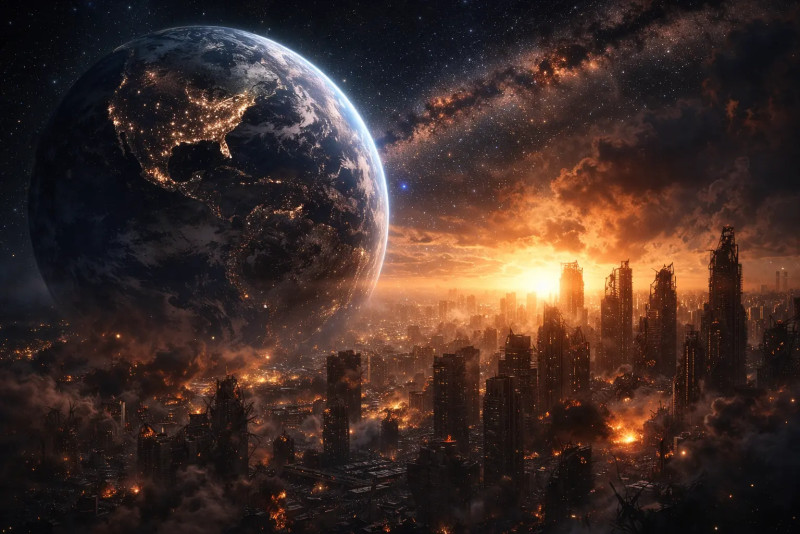
For most people, the modern world feels stable. Cities are growing. Technology is advancing. Global communication happens instantly. From space missions to artificial intelligence, humanity often appears to be moving steadily toward a powerful future.
Yet beneath this progress, some scientists have quietly raised an unsettling question.
What if modern civilization is not as stable as it seems?
Over the past several decades, researchers studying population growth, natural resources, environmental pressure, and economic systems have warned that the global system supporting modern society may face severe stress within this century.
These warnings do not come from a single dramatic prediction. Instead, they come from long-term scientific models, economic analysis, and environmental research that examine how human activity interacts with the limits of a finite planet.
One of the most discussed warnings comes from a study that began more than fifty years ago.
The Study That Started the Debate
In 1972, a team of researchers at the Massachusetts Institute of Technology published a groundbreaking report called “The Limits to Growth.”
The research was commissioned by an international think tank known as the Club of Rome. The scientists used one of the earliest large-scale computer simulations to analyze global trends.
The model examined five key variables shaping human civilization:
-
Population growth
-
Industrial production
-
Food supply
-
Natural resource depletion
-
Pollution
By running these variables through a system dynamics model known as World3, researchers explored how the global system might behave if current trends continued.
Their results were startling.
In several scenarios where economic and population growth continued without major changes, the model showed global industrial civilization reaching a peak and then entering a period of decline during the 21st century.
The study did not claim to predict the exact future. Instead, it showed what might happen if humanity ignored ecological limits.
Still, the warning triggered intense debate across the scientific and economic world.
Why the Warning Still Matters Today
For many years critics dismissed the report as overly pessimistic. Technology, they argued, would always find ways to expand resources and avoid crisis.
But in recent years researchers have revisited the original model using modern data.
One widely discussed analysis compared real-world trends with the original projections from the 1972 study. The results showed that many global indicators, including population growth, industrial output, and resource use, were tracking closely with the model’s “business-as-usual” scenario.
In that scenario, the model suggests that economic and social systems could begin experiencing major stress or decline around the middle of the 21st century if growth continues unchecked.
It is important to understand what scientists mean by “collapse.” They are not describing a sudden apocalypse.
Instead, collapse refers to a gradual breakdown of complex systems—declining industrial production, shrinking food supplies, economic instability, and falling living standards.
The Planet Has Physical Limits
The core idea behind the warning is simple.
Earth has finite resources.
Modern civilization depends on enormous flows of energy, minerals, water, fertile soil, and stable ecosystems. When consumption rises faster than nature can regenerate these resources, pressure builds inside the system.
Scientists call this condition overshoot.
Overshoot occurs when a population grows beyond what its environment can sustainably support. If overshoot continues long enough, systems eventually adjust through decline or restructuring.
Many environmental researchers believe the global economy may already be approaching this stage.
This does not guarantee collapse, but it increases the risk of serious disruptions if corrective actions are delayed.
A World Running at Full Speed
Modern civilization runs on a scale that would have been unimaginable only two centuries ago.
Today the world population exceeds eight billion people. Global supply chains stretch across continents. Cities depend on constant deliveries of food, energy, and materials.
While this interconnected system allows extraordinary productivity, it also creates vulnerability.
A disruption in one sector can ripple quickly through others.
Energy shortages affect transportation.
Transportation disruptions affect food supply.
Food shortages create economic instability.
These cascading effects are exactly the type of dynamics explored in early system models like World3.
The Energy Question
Energy plays a central role in the stability of civilization.
Industrial society was built on abundant fossil fuels—coal, oil, and natural gas. These energy sources powered factories, transportation networks, agriculture, and infrastructure.
Some researchers argue that the long-term decline of easy fossil fuel supplies could place pressure on economic systems.
One theory known as the Olduvai Theory proposes that industrial civilization may experience a gradual decline in energy availability during the 21st century, potentially leading to reduced technological complexity.
This theory remains controversial and is widely debated among energy analysts.
However, it reflects a broader concern shared by many scientists: modern civilization requires enormous energy flows to maintain its current structure.
Environmental Stress Is Growing
Environmental changes have become another major factor in discussions about civilization stability.
Climate change, biodiversity loss, deforestation, and soil degradation are increasingly studied as interconnected pressures on the global system.
These environmental stresses do not operate independently. They interact with economic and social systems.
For example:
Drought can affect food production.
Food shortages can raise prices.
Economic stress can lead to political instability.
When multiple stresses occur simultaneously, societies become more vulnerable to sudden changes.
The Seneca Effect: Collapse Can Be Fast
Another concept discussed by scientists studying complex systems is known as the Seneca Effect.
The idea comes from the Roman philosopher Seneca, who wrote that growth often occurs slowly while decline happens rapidly.
Modern system analysis has shown that many complex systems follow this pattern. A society may expand steadily for decades or centuries, but once critical limits are reached, decline can occur far more quickly than growth.
This phenomenon has been observed in historical examples such as financial crises, ecological collapses, and the fall of civilizations.
Understanding this pattern is one reason researchers emphasize early warnings rather than waiting for obvious crisis signals.
Historical Civilizations Have Collapsed Before
Human history includes many examples of civilizations that appeared powerful and stable before experiencing sudden decline.
Ancient societies such as the Maya, the Roman Empire, and the inhabitants of Easter Island all faced environmental or economic pressures that eventually disrupted their social systems.
In many cases the collapse was not caused by a single event. Instead, multiple stresses accumulated over time.
Resource depletion, political instability, environmental change, and economic imbalance often interacted in ways that pushed systems beyond their limits.
Modern civilization is far larger and more technologically advanced than these earlier societies.
However, the underlying dynamics of complex systems still apply.
A Critical Clarification
Despite the dramatic headlines often seen online, scientists rarely claim that global civilization will definitely collapse within a specific year.
Most research presents scenarios rather than predictions.
These models show what could happen if current trends continue without major changes. They also show alternative outcomes if societies adopt new technologies, sustainable practices, and improved resource management.
In other words, the future is not fixed.
The warnings are intended to encourage action rather than predict unavoidable disaster.
Technology Could Change the Outcome
Human civilization has repeatedly demonstrated the ability to adapt to major challenges.
Advances in renewable energy, sustainable agriculture, water management, and environmental protection may significantly reduce pressure on natural systems.
Artificial intelligence and advanced modeling tools also allow scientists to better understand complex global dynamics.
These innovations could help societies transition toward more sustainable systems before reaching critical limits.
Many researchers believe that the coming decades will be decisive in determining which path humanity follows.
A Century of Decisions
The 21st century may become one of the most important turning points in human history.
Population growth, environmental pressures, energy transitions, and technological breakthroughs are all happening simultaneously.
The choices made by governments, industries, and individuals during this period will shape the long-term trajectory of civilization.
Some scientists view this moment as a potential crisis.
Others see it as an opportunity for transformation.
Both perspectives agree on one point: the global system is entering a period of rapid change.
Why These Warnings Matter
Scientific warnings about long-term risks are not meant to create fear.
They are meant to provide insight.
Complex systems such as global civilization rarely fail without warning. Signals usually appear years or decades before major turning points.
Understanding those signals gives societies the chance to respond.
History shows that civilizations capable of adapting to changing conditions can survive and even thrive.
The challenge is recognizing the warning signs early enough.
Frequently Asked Questions
Did scientists really predict civilization collapse by 2040?
Some interpretations of the 1972 Limits to Growth model suggest that under certain “business-as-usual” scenarios, major economic and social decline could occur around the mid-21st century. However, researchers stress that these are scenarios, not fixed predictions.
What causes civilizational collapse in scientific models?
Most models highlight interacting factors such as population growth, resource depletion, pollution, food supply pressures, and economic instability.
Is collapse inevitable?
No. Scientists emphasize that outcomes depend heavily on human decisions, technological progress, and environmental policies.
Have past civilizations collapsed in similar ways?
Yes. Historical studies show that environmental stress, resource depletion, and political instability contributed to the decline of several ancient societies.
What can prevent large-scale societal breakdown?
Policies promoting sustainability, renewable energy, responsible resource management, and global cooperation are widely considered key strategies.
Final Thoughts
The warnings about possible civilizational stress within this century should not be read as predictions of doom.
They are signals from scientists studying how complex systems behave when growth collides with physical limits.
History shows that humanity has an extraordinary capacity to innovate and adapt.
Whether the coming decades become a story of crisis or renewal will depend largely on the decisions made today.
The silent countdown described by researchers is not a clock that cannot be stopped.
It is a reminder that the future of civilization remains in human hands.
References / Sources
https://www.clubofrome.org/publication/the-limits-to-growth/
https://en.wikipedia.org/wiki/The_Limits_to_Growth
https://interestingengineering.com/culture/mit-1972-global-collapse-warning-revisited
https://populationconnection.org/blog/are-we-nearing-global-collapse/
https://en.wikipedia.org/wiki/Olduvai_theory
https://en.wikipedia.org/wiki/Seneca_effect
https://thereader.mitpress.mit.edu/the-collapse-is-coming-will-humanity-adapt/