.png)
.png)
.png)
.png)
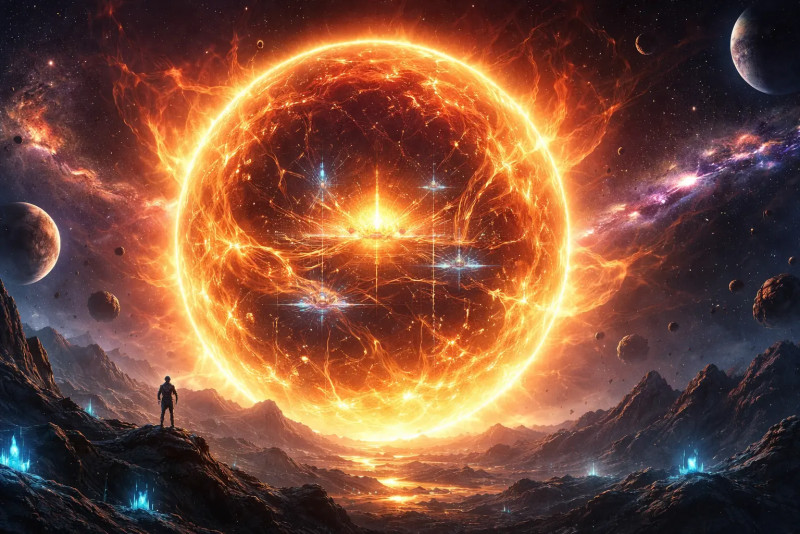
A Question That Changes How We See Life
For decades, humans have searched the universe for life beyond Earth. Most scientists focus on planets that look somewhat like our own, with water, air, and temperatures suitable for biology. This approach makes sense because every known form of life on Earth depends on these conditions. Yet the universe is unimaginably vast, and nature often surprises us. A growing line of scientific thought asks a strange but fascinating question: could life exist somewhere completely different, such as inside a star rather than on a planet?
At first glance, the idea sounds impossible. A star is a violent, blazing sphere of heat and radiation. It seems like the most hostile environment imaginable. However, science has repeatedly shown that life can take unexpected forms, and some researchers have explored whether entirely different kinds of life, not based on cells or biology, might exist in extreme environments like stars. While this concept remains theoretical, it is grounded in real physics rather than fantasy.
Understanding What a Star Truly Is
To explore this idea, it is important to understand what a star actually is. A star is not simply a giant ball of fire. Fire requires oxygen, but stars burn through nuclear fusion, where hydrogen atoms fuse into helium and release enormous energy. The result is a sphere made mostly of plasma, a state of matter where particles are electrically charged rather than arranged as solids, liquids, or gases.
Inside a star, temperatures can reach millions of degrees. Powerful magnetic fields twist and reshape the plasma continuously, and energy moves in waves and turbulent currents. For human life, this environment would be instantly fatal. Yet the question is not whether human-like life could survive there, but whether some completely different form of life could emerge under such extreme conditions.

The Concept of Life Beyond Biology
Most people think of life as something made of cells, water, and organic molecules. However, some scientists have explored the possibility of non-biological life. This idea suggests that life might not always be based on chemistry but could instead arise from physical systems capable of organizing themselves, maintaining structure, and processing information.
In the 1970s, physicist Freeman Dyson discussed how advanced life might exist in forms very different from biological organisms. He imagined entities made from electromagnetic patterns rather than matter. Later research into plasma physics showed that plasma can sometimes organize itself into stable, complex shapes that react to their surroundings and exchange energy. These behaviors resemble some basic characteristics of living systems.
Although this does not prove plasma life exists, it demonstrates that self-organizing structures can form in energetic environments, including stars.
Could Intelligence Form Inside a Star?
The possibility becomes even more intriguing when considering intelligence. Stars are filled with constantly shifting magnetic fields that create long-lasting structures within plasma. Some theoretical ideas suggest that these stable electromagnetic formations could behave like massive, invisible systems capable of storing and processing information.
If such structures existed, they would not resemble creatures with bodies, faces, or limbs. Instead, they might be vast patterns of energy interacting within the star. Their lifespans could be extremely long, perhaps lasting millions or billions of years. Communication, if it occurred, might happen through energy waves rather than sound or language. Their form of intelligence, if any, would be entirely different from human thought.
There is currently no evidence supporting this idea, but physics does not completely rule it out.

The Hoyle Perspective on Cosmic Intelligence
Astronomer Fred Hoyle once explored a related concept, suggesting that enormous clouds of gas in space might develop intelligence over long periods. His idea was inspired by the observation that large, complex systems can sometimes display organized behavior when energy flows through them. While his proposal was never proven, it reflected a broader scientific curiosity about how complexity can arise in the universe.
If vast gas clouds could theoretically form organized systems, stars, which are far more energetic, might also allow similar possibilities. Again, this remains speculative, but it shows that the idea of non-traditional life has been seriously considered within scientific discussions.
The Challenge of Extreme Heat
One of the strongest objections to the idea of life inside a star is temperature. Stars are unimaginably hot, and any known material would instantly disintegrate. However, hypothetical plasma life would not rely on solid matter. Instead, it would exist as patterns of charged particles and electromagnetic energy. In physics, some systems can remain stable even under chaotic and extreme conditions.
For example, magnetic loops observed in the Sun, known as solar flux tubes, can remain structured for long periods despite intense turbulence. Some scientists have wondered whether similar stable plasma formations could behave in ways that resemble living systems. This remains unproven, but it illustrates how complex patterns can exist in stellar environments.
Would Humans Even Detect Star Life?
If life existed inside a star, humans might not recognize it. Modern searches for extraterrestrial life look for signs such as water, oxygen, organic chemistry, or artificial radio signals. A star-based civilization might not use any of these. It might not communicate in ways we can detect, and its behavior might appear indistinguishable from natural stellar processes.
In other words, it is possible that our current methods are simply not designed to identify such unusual forms of life.

Could Advanced Civilizations Move Into Stars?
Another theory proposes that extremely advanced civilizations might eventually evolve beyond physical bodies and exist as energy-based intelligence. In such a state, a star could provide an enormous and stable source of energy. The idea connects to the Kardashev Scale, which measures civilizations based on energy usage. A civilization capable of controlling the energy of a star might operate within it rather than on a planet.
This concept is highly speculative, but it reflects ongoing scientific attempts to imagine how advanced intelligence might evolve over cosmic timescales.
Separating Scientific Possibility from Proof
It is important to distinguish between theoretical possibility and confirmed reality. Science supports the idea that plasma can self-organize and that complex structures can arise in energetic systems. However, there is currently no observational evidence of life inside stars or anywhere else beyond Earth.
The concept remains a scientific question rather than a discovery. Researchers continue studying stars, plasma behavior, and cosmic phenomena, and future advances may provide new insights.
Why This Idea Matters
Even without proof, the idea of star-based life expands scientific thinking. It challenges the assumption that life must resemble Earth biology and encourages broader exploration of how life might arise in the universe. Many discoveries, including black holes and gravitational waves, were once theoretical before evidence confirmed them.
Exploring unconventional ideas often drives science forward.
Disclaimer
As of today, no confirmed evidence exists for alien life anywhere in the universe, including inside stars. The concept discussed in this article is based on theoretical physics and scientific speculation, not proven fact. Ongoing research may clarify these questions in the future, but at present, the existence of star-dwelling civilizations remains unverified.
Frequently Asked Questions
Could biological life survive inside a star?
Biological life like humans, animals, or plants could not survive in a star because of the extreme temperature and radiation. The idea discussed here involves hypothetical non-biological forms of life based on plasma or energy rather than cells.
Has any scientist proven life inside a star exists?
No scientist has proven this. It remains a theoretical idea explored in scientific discussions about plasma physics and unconventional life.
Could advanced civilizations use stars as habitats?
Some theoretical models suggest highly advanced civilizations might use stars as energy sources or environments if they evolved beyond physical bodies. This idea is speculative and not confirmed.
Why do scientists consider such unusual possibilities?
Science explores all possibilities allowed by physics. Considering unconventional ideas helps expand understanding of how life might arise in different environments across the universe.
Are stars being studied for signs of life?
Scientists study stars mainly to understand physics, energy, and stellar evolution. The search for extraterrestrial life currently focuses more on planets, but future research may explore broader possibilities.
References and Sources
Freeman Dyson – Scientific discussions on advanced civilizations and non-biological life
https://www.scientificamerican.com/article/freeman-dyson-thought-experiments/
Fred Hoyle – Concepts related to cosmic intelligence and large-scale life possibilities
https://www.britannica.com/biography/Fred-Hoyle
NASA – Basics of stars and plasma physics
https://science.nasa.gov/astrophysics/focus-areas/how-do-stars-form-and-evolve/
Plasma Physics and Self-Organizing Structures Research Overview
https://www.sciencedirect.com/topics/physics-and-astronomy/plasma-physics
SETI Institute – Scientific search for extraterrestrial intelligence
https://www.seti.org