


Humanity’s First Contact Already Happened — In 1977 — And The Full Recording Was Never Released
In the long history of human civilization, there have been moments that quietly changed everything. The discovery of fire. The first step on the Moon. The splitting of the atom. But there is one moment, buried deep in scientific records, that many people have never fully understood — a moment when humanity may have briefly heard something not from Earth.
It lasted only seventy-two seconds.
It came from deep space.
And then it vanished forever.
This is the story of the 1977 Wow! Signal — one of the most mysterious and scientifically puzzling events ever recorded — and why some researchers believe we may never have received the complete data from that night.
The Quiet Night That Became History
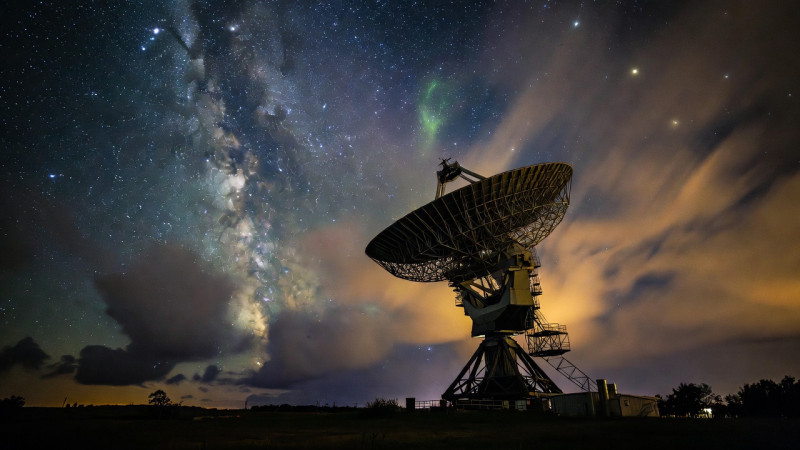
On August 15, 1977, the Big Ear radio telescope in Ohio was doing what it had done for years — silently scanning the sky for radio signals from space. The telescope was part of a scientific effort known as SETI, the Search for Extraterrestrial Intelligence, a program built on a simple but powerful idea: if intelligent life exists somewhere in the universe, it might use radio waves to communicate.
Radio waves travel enormous distances across space. They pass through dust, gas, and darkness. Unlike light, they can cross the galaxy without fading quickly. Scientists believed that if an advanced civilization wanted to make itself known, radio signals would be one of the most logical tools to use.
Most nights, the telescope detected nothing unusual. Just the steady background noise of the universe — natural radio emissions from stars, distant galaxies, pulsars, and cosmic radiation left over from the birth of the universe itself.
But that night, something different happened.

The Strange Code: 6EQUJ5
Days later, astronomer Jerry Ehman was reviewing long sheets of computer printouts generated by the telescope. The system converted radio signal strength into numbers and letters. Normally, these values stayed low, representing weak cosmic background noise.
Then he saw it.
A sequence far stronger than anything else on the page: 6EQUJ5.
The signal was unusually intense, narrow in frequency, and extremely clean. Shocked, Ehman circled it in red pen and wrote a single word beside it:
“Wow!”
That spontaneous reaction gave the signal its permanent name — the Wow! Signal.

Why Scientists Took It Seriously
To understand why the Wow! Signal caused such excitement, we must understand how radio astronomy works.
Natural cosmic signals usually spread across many frequencies. They fluctuate, drift, and change shape. Pulsars, for example, produce rhythmic pulses. Quasars produce broad noisy emissions. Thermal radiation from gas clouds spreads widely across the spectrum.
But the Wow! Signal was different.
It appeared at a very narrow frequency band, which is often considered a hallmark of artificial transmission. Human-made radio broadcasts, like television and radar, are narrowband because focused signals carry information more efficiently.
Even more intriguing was the frequency itself — 1420 MHz, known as the hydrogen line.
Hydrogen is the most abundant element in the universe. Scientists long believed that if two intelligent civilizations wanted to communicate, they might choose this universal frequency because it would be recognizable to any technologically advanced society studying physics.
The signal also matched what scientists expected from a distant stationary source. It rose gradually, peaked, and faded exactly as a fixed cosmic signal would as Earth rotated and the telescope passed through its detection beam.
It looked intentional.

The 72-Second Window
The Big Ear telescope did not track objects like modern telescopes. Instead, it used Earth’s rotation to scan the sky. As the planet turned, any signal from space would pass through the telescope’s field of view for about seventy-two seconds.
That is exactly how long the Wow! Signal lasted.
This meant the signal did not flicker or fluctuate. It stayed steady for the entire observation window, suggesting a consistent source rather than random noise.
Then it disappeared.
Scientists quickly aimed the telescope back at the same region of the sky, hoping to detect it again.
Nothing.
They tried again days later. Then months later. Then years later.
The signal never returned.
Could It Have Been Natural?
Scientists always begin with natural explanations. The universe is full of strange phenomena, and many mysterious signals have later turned out to be natural events.
Some proposed the signal might have come from a passing comet releasing hydrogen gas. Hydrogen clouds can emit radio waves near the hydrogen line frequency. Decades later, a study suggested that two comets were near the signal’s location at the time.
However, this explanation faced strong criticism. The detected signal was far stronger than known comet emissions. Additionally, subsequent observations of those comets did not reproduce anything close to the Wow! Signal’s intensity.
Others suggested rare cosmic events, such as interstellar gas bursts, unknown astrophysical phenomena, or gravitational lensing effects that could amplify distant signals. Yet none of these explanations fully matched the signal’s precision, frequency, and strength.
To this day, no natural explanation perfectly fits the data.
Could It Have Come From Earth?
Another possibility was human interference — satellites, aircraft transmissions, or military experiments. However, in 1977, there were no known satellites transmitting near the hydrogen line frequency in that region of the sky. The hydrogen band is internationally protected to avoid interference with scientific observations.
The signal also did not behave like typical human-made interference. It did not drift in frequency, did not repeat, and appeared exactly where a cosmic source would be expected.
This left scientists with a puzzle — a signal that behaved like an artificial transmission but could not be traced to Earth.

The Missing Data Mystery
One of the most intriguing and lesser-discussed aspects of the Wow! Signal is data preservation.
In 1977, digital storage was primitive. The Big Ear telescope did not record sound or full-spectrum radio data. Instead, it logged signal intensity values as printed numbers. Magnetic tapes used for storage were often reused, and long-term archival methods were limited.
The famous printout with the 6EQUJ5 sequence still exists, but the complete raw observational environment from that period may not. Some researchers have acknowledged that many early SETI recordings were not permanently preserved because storage capacity was extremely limited.
This has led to speculation that additional contextual data — background noise patterns, secondary readings, or extended signal traces — may have existed but were never archived or publicly released.
There is no confirmed hidden recording, but the possibility that humanity lost part of its most mysterious signal remains a haunting thought.
Why the Signal Never Repeated
The greatest scientific frustration is that the signal never returned.
Science relies on repeatable evidence. A single event, no matter how unusual, cannot confirm a theory without repetition. If the signal had appeared again, scientists could have triangulated its source, analyzed modulation patterns, and searched for encoded information.
But the sky stayed silent.
Modern radio telescopes, far more powerful than Big Ear, have scanned the same region countless times. Massive arrays such as those used in modern SETI research continuously monitor the sky for narrowband signals, yet nothing identical has ever been detected again.
This uniqueness is what makes the Wow! Signal both fascinating and scientifically frustrating.
Could It Have Been Intelligent?
The idea that the signal came from intelligent life remains speculative but not impossible.
If an extraterrestrial civilization sent a signal toward Earth, several scenarios could explain why it was detected only once. The signal might have been part of a directional beam that briefly intersected Earth. It could have been a one-time transmission, a scanning broadcast, or even an accidental leakage from alien technology.
Another possibility is that the signal originated from a moving source, such as a spacecraft or probe passing through space. If so, its alignment with Earth may have lasted only moments.
However, without repetition, no scientific conclusion can be drawn.

The Scientific Legacy of the Wow! Signal
Despite its mystery, the Wow! Signal had a profound impact on science. It strengthened the scientific case for searching for extraterrestrial intelligence and influenced the design of future radio observatories. Modern SETI programs now use advanced digital recording, continuous monitoring, and artificial intelligence to detect unusual signals more effectively.
The signal also changed how scientists think about communication across the cosmos. It highlighted the importance of narrowband detection, hydrogen-line frequencies, and long-term sky monitoring.
Even today, it remains one of the strongest unexplained candidate signals ever detected.
Could We Detect Another One?
With today’s technology, humanity is listening more closely than ever before. Massive radio telescopes scan billions of frequencies across the sky. Machine learning systems analyze patterns in real time. If a similar signal appears again, scientists would be able to record it fully, trace its direction, and analyze its structure in far greater detail.
If the Wow! Signal was a real message, the next one could be clearer — and impossible to ignore.
The Silence That Still Echoes
For seventy-two seconds in 1977, humanity may have briefly heard something not made by Earth. Whether it was a rare cosmic coincidence, an unknown natural phenomenon, or the faint hello of another intelligence, we may never know.
But the mystery remains.
Somewhere in the vast darkness of space, the universe once whispered.
And then it went silent.
FAQs
Many people ask whether the Wow! Signal was truly a message from extraterrestrial life. The honest answer is that no confirmed explanation exists. While the signal had characteristics consistent with artificial transmission, it was never detected again, and science requires repeatable evidence.
Another common question is why the signal lasted exactly seventy-two seconds. This duration matched the time the Big Ear telescope could observe a fixed point in the sky as Earth rotated, meaning the signal remained steady throughout the entire observation window.
People often wonder whether the full recording still exists. Only the printed data sheet with the famous 6EQUJ5 sequence is publicly preserved. Due to limited storage technology in the 1970s, additional raw data may not have been permanently saved.
Some ask whether scientists still search for similar signals today. Yes, modern SETI programs continue scanning the sky continuously using advanced technology. If a repeating signal is ever detected, it could become one of the most important discoveries in human history.
Another frequent question is whether the signal could have been natural. Several natural explanations have been proposed, including comet emissions and rare cosmic phenomena, but none fully match the signal’s strength, frequency, and behavior.
References and Research Sources
Ohio State University Radio Observatory historical records and Big Ear Telescope documentation.
SETI Institute research papers and signal analysis archives.
Jerry R. Ehman original Wow! Signal annotated printout and later scientific commentary.
NASA scientific resources on radio astronomy and hydrogen-line frequency research.
The Planetary Society publications on the Wow! Signal and search for extraterrestrial intelligence.
Peer-reviewed radio astronomy journals analyzing natural and artificial signal hypotheses.