.png)
.png)
.png)
.png)
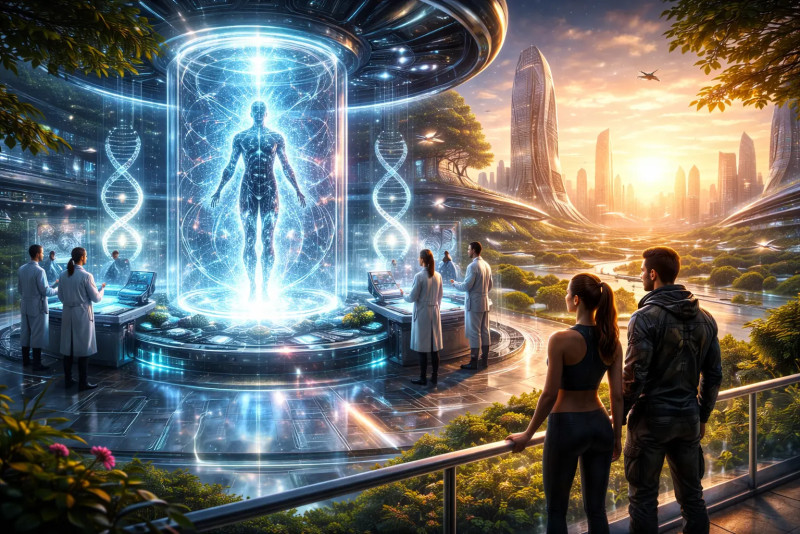
Close your eyes and think about the year 2026. For decades, we’ve been told that aging is an "inevitable slide"—a one-way ticket where the hair thins, the knees creak, and the clock eventually runs out. But what if that clock just... stopped?
We aren't talking about drinking from a mythical fountain in a jungle. We are talking about longevity science, a field that has moved from the fringes of "mad science" into the mainstream of 2026 healthcare. With breakthroughs in cellular rejuvenation and "bio-liquidity," we are standing on the doorstep of a world where death might actually become optional.
But if we "cure" aging, what happens to the world we’ve built? Let's take a wild ride into the future of a forever-young society.

The 2026 Breakthrough: "Bio-Insurance" and the End of the Expiry Date
As we hit mid-2026, the medical community has shifted its focus. We no longer just treat the symptoms of getting old; we treat aging itself as the disease.
One of the biggest game-changers this year is the concept of "Bio-liquidity." People are now banking their own younger, more potent stem cells like they would a high-yield savings account. These cells are frozen, "primed" in labs to be more resilient, and then reintroduced to the body to fight inflammation and repair tissue. It’s like having a biological "Undo" button.
Add to this the rise of Epigenetic Clocks like DunedinPACE. These aren't your average blood tests. They tell you your biological age—how fast you are actually "rusting" on the inside. In 2026, these tests are becoming as routine as a yearly physical, allowing doctors to tweak your lifestyle, diet, and "senolytic" supplements (drugs that flush out "zombie cells") before you ever feel a single ache.

The Great Society Flip: Work, Love, and "The Century-Long Life"
If we can live to 120, 150, or beyond while staying healthy, the traditional "Map of Life" goes into the paper shredder.
1. The 80-Year Career? Think about your 20s. Usually, that’s when you scramble to get an education and start a career. But if you have 100 more years of peak health ahead, why rush? We might see people having "career seasons." You could be a lawyer for 30 years, take a decade off to travel, and then go back to school to become a marine biologist at age 70. Retirement as we know it—a gold watch and a rocking chair—will disappear.
2. Relationships and "Until Death Do Us Part" Marriage is a big commitment when it lasts 40 years. But 140 years? We might see a rise in "serial monogamy" or "term-limit" marriages. Society will have to redefine what a lifelong partnership looks like when "life" is three times longer than it used to be.
3. The Wealth Gap on Steroids Here is the scary part: Equity. If longevity treatments cost $50,000 a year, only the ultra-wealthy will stay young. We could end up with a literal class of "immortals" who accumulate wealth for centuries, while the rest of the world ages naturally. This is the biggest ethical hurdle of 2026—ensuring that staying alive isn't a luxury item.

The Planet’s Problem: Where Do We Put Everyone?
Critics of radical life extension always point to the same thing: Overpopulation. If people stop dying but keep having babies, Earth gets crowded fast.
However, many experts argue that as societies live longer, birth rates naturally drop. People who know they have 100 years of fertility might wait until they are 60 to have their first child. The challenge won't just be the number of people, but the resource consumption. A 150-year-old human eats a lot more over their lifetime than an 80-year-old one. We’ll need a revolution in sustainable energy and food to keep our "immortal" population fed.
FAQs: Your Questions About the "No-Death" Future
- Is immortality actually possible by 2026? No, "true" immortality (never being able to die) is still science fiction. However, biological immortality—where you don't die of old age or age-related disease—is what scientists are currently tackling. You could still die in a car crash or a volcano, but your cells wouldn't just "give up."
2. Will I have to work forever?
Probably not "forever," but the concept of retiring at 65 will vanish. Governments are already looking at "Longevity Dividends"—economic boosts from having an older, experienced, and healthy workforce that doesn't need expensive end-of-life care.
3. What are "Zombie Cells"?
Scientifically known as senescent cells, these are cells that stop dividing but don't die. They hang around and release inflammatory "gunk" that damages surrounding healthy cells. New 2026 drugs called senolytics are designed to clear these out.
4. Can I get these treatments now? Most radical treatments like stem cell priming and specific senolytics are still in clinical trials or available in specialized "longevity clinics" in places like Florida, Texas, or abroad. Basic tools like biological age testing are available to the public now.

The Final Verdict: Is it a Blessing or a Curse?
The day death becomes optional will be the most significant moment in human history. It will force us to ask: What gives life meaning? Is it the fact that it ends, or is it the things we do with the time we have?
As we move through 2026, the goal isn't just to add years to our life, but life to our years. Whether this leads to a golden age of wisdom or a dystopian nightmare of overcrowding depends entirely on how we handle the "Living Map" today.
Disclaimer: This article discusses emerging scientific theories and 2026 medical trends. Longevity treatments are subject to strict regulatory oversight, and "optional death" remains a theoretical concept. Always consult a medical professional before starting any radical health protocol or supplement regimen.
Proof of Source & Scientific References:
-
Stanford Report: Longevity is changing all aspects of our lives (2025/2026)
-
Harvard Public Health: Life expectancy and biological aging limits
-
BofA Securities: Breakthroughs in Anti-Aging Medicine 2025-2026
-
ForeverLabs: 2026 - The Year of Bio-Liquidity and Stem Cell Banking
-
The Cambridge Handbook of the Ethics of Ageing: The Morality of Life Extension