.png)
.png)
.png)
.png)
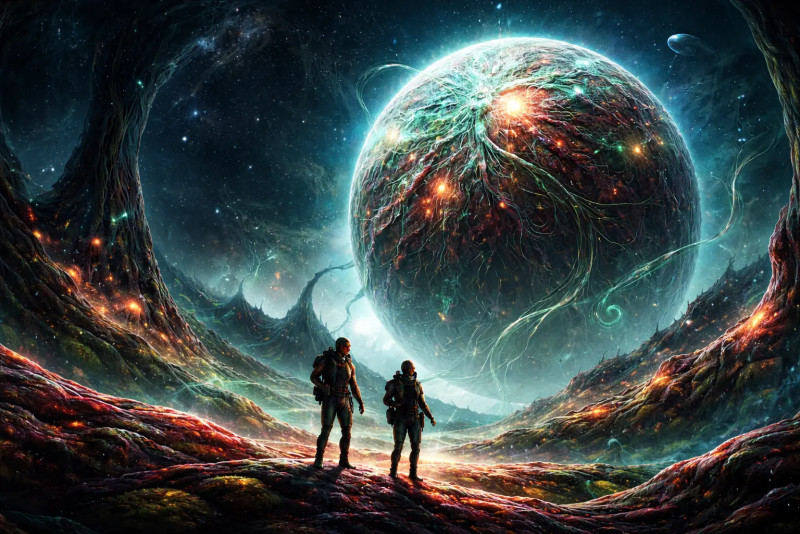
Imagine looking up at the night sky and wondering if one of those twinkling dots isn't just a ball of rock or gas, but a literal, breathing heart. It sounds like something straight out of a trippy sci-fi flick, right? But hold onto your seats, because some of the world's brightest minds are actually asking: Could there be planets made entirely of living matter?
We aren't just talking about a planet covered in grass and trees like a cosmic chia pet. We’re talking about a world where the planet is the organism. A biological engine the size of a globe. Let’s dive into this rabbit hole and see how close science is to finding a "living" world.

The "Solaris" Dream: A Planet with a Mind?
If you’re a fan of classic sci-fi, you might have heard of Solaris. In Stanislaw Lem’s famous novel, humans discover a planet covered in a vast, sentient ocean. This ocean isn't just water; it’s a biological soup that can read human thoughts and physically manifest memories.
For decades, we tucked this idea away in the "fiction" drawer. But recently, astrobiologists like Sara Walker and Adam Frank have been pushing the boundaries of what we call "life." They’ve introduced a concept called Planetary Intelligence.
The idea is simple but wild: just as your individual cells come together to make "you," could all the biological processes on a planet click together to create a collective, planetary-scale life form?

The Gaia Hypothesis: Is Earth Already Breathing?
Before we go looking for "Cellular Saturn" or "Muscle Mars," we have to look at our own backyard. Back in the 70s, scientist James Lovelock proposed the Gaia Hypothesis. He argued that Earth isn't just a rock with life on it; it’s a self-regulating system that behaves a lot like a single organism.
Think about it. Our planet keeps its temperature steady, its oxygen levels just right, and its ocean salinity perfect for life—almost like how your body maintains its own internal temperature. If Earth is "barely" alive in this way, who’s to say there isn't a planet out there that took it a step further?

How Would a Living Planet Even Form?
We usually think of planets forming from dust and gas clumping together over millions of years. For a planet to be "living matter," the process would have to be radically different.
-
The Super-Organism Colony: Imagine a world where a single species of fungi or bacteria grew so aggressively that it replaced the entire crust. Underneath a thin layer of organic "skin," you might have miles of interconnected neurons or nutrient-transporting veins.
-
The Biological Nebula: Some theorists suggest that if organic molecules in space (which we know exist!) clumped together in a high-density environment, they could theoretically form a "protocell" the size of a moon.
-
The Post-Biological World: Maybe it didn't start alive. Perhaps a highly advanced civilization "uploaded" their entire ecosystem into a planetary-scale biological computer. A living, thinking world made of engineered tissue.

What Would It Feel Like to Stand There?
If you landed on a living planet, it wouldn't be like walking on dirt. The ground might be soft and slightly warm. Instead of earthquakes, you might feel "pulses." The atmosphere might not be just gas, but a complex pheromone system used by the planet to communicate with itself.
It’s a spooky thought. You wouldn't be an explorer; you’d be more like a microbe walking across a giant’s skin.
Why Google Discover and Scientists Care Now
We are finding exoplanets (planets outside our solar system) at a record pace. We’ve found "Diamond Planets" and "Glass Rain Planets." The universe is a lot weirder than we ever gave it credit for.
As our telescopes get better, we aren't just looking for oxygen; we’re looking for "technosignatures" and "biosignatures." If we see a planet whose atmosphere changes in a way that looks like a heartbeat, we might just be looking at the first biological world ever recorded.
FAQs: Your Burning Questions Answered
- Has NASA found a living planet yet? Nope. Not yet. We’ve found planets that could host life, but a planet made of life is still in the theoretical stage.
2. Could a living planet be "evil"?
In movies, yes! In reality, "evil" is a human concept. A living planet would likely be focused on one thing: survival and homeostasis, just like any other animal.
3. What would a living planet eat?
Energy! Just like plants use photosynthesis, a biological world would probably soak up radiation from its host star or use geothermal heat from its core to keep its "cells" alive.
4. Could we live on a biological planet?
It depends on if the planet's "immune system" thinks we’re a friend or a parasite. It would be the ultimate test of human-alien relations.
The Final Verdict
Are there planets made of living matter? We don't have a "yes" yet, but the laws of physics and biology don't strictly say "no." Space is infinite, and if life can happen in a puddle on Earth, there is no reason it couldn't scale up to the size of a world.
Next time you look at the stars, don't just see rocks. See possibilities. The universe might be a lot more "awake" than we think.
Disclaimer: This article explores theoretical scientific concepts and speculative astrobiology. While based on theories like the Gaia Hypothesis and Planetary Intelligence, the existence of a purely biological planet has not been proven by current astronomical data.
References & Sources: