.png)
.png)
.png)
.png)
What If All Volcanoes Erupted at Once? — The Day Earth Turned to Fire
By Ronald Kapper
Disclaimer
This article explores a hypothetical global scenario using geological research, volcanic history, and climate science. It is not a prediction. The purpose is to understand possible outcomes if extreme volcanic activity occurred simultaneously across Earth.
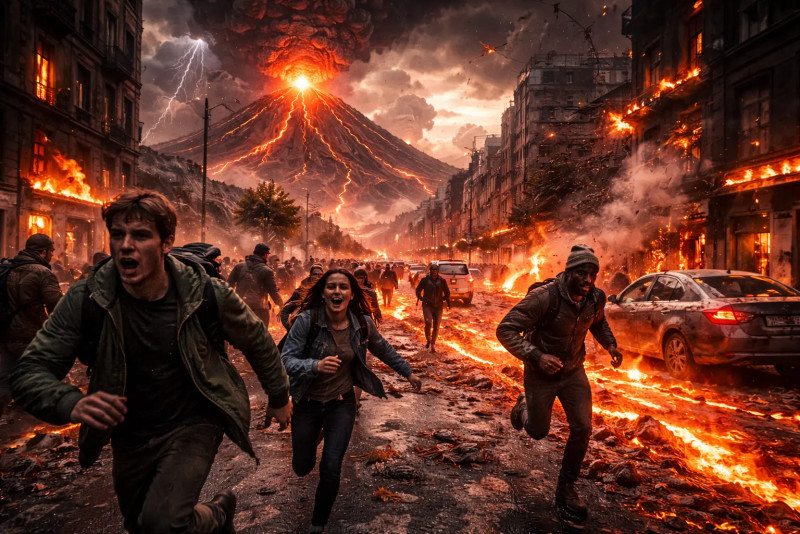
The ground trembles. A deep roar rises from beneath the planet. Then, across continents and oceans, mountains begin to explode. Fire shoots into the sky, ash darkens the sun, and rivers of molten rock spill across the land. Imagine not one volcano, not ten, but every volcano on Earth erupting at the same moment. It sounds like something from a nightmare, yet science allows us to explore what such a chain reaction might mean.
There are more than 1,500 potentially active volcanoes on Earth today, scattered across tectonic boundaries, island chains, and deep ocean ridges. Most remain quiet for centuries, but beneath them, pressure slowly builds. If somehow all of them awakened together, the result would be unlike anything in human history.

The First Hours — Fire Across the Planet
In the first hours, the world would hear a chorus of explosions echoing across continents. Volcanoes lining the Pacific Ring of Fire would send giant ash columns high into the atmosphere. Lava fountains would shoot hundreds of meters upward. Shockwaves would ripple through nearby regions, triggering earthquakes and landslides.
Cities near volcanic zones would face immediate danger. Lava flows move slowly but destroy everything in their path. Ash, however, travels fast. Within hours, thick clouds of ash would spread across skies, blocking sunlight and turning day into a dim, orange twilight.
Air travel would stop almost instantly. Ash particles damage aircraft engines, making flight impossible. Communication networks might begin to fail as ash covers infrastructure and lightning storms rage within volcanic plumes.

Ash — The Silent Global Threat
Volcanic ash is not soft like fireplace ash. It is made of tiny sharp rock fragments and glass particles. Breathing it damages lungs, contaminates water, and destroys crops. If all volcanoes erupted together, ash would circle the globe within days, carried by powerful winds in the upper atmosphere.
Sunlight would weaken. Temperatures would begin to drop. Power grids would struggle as ash weighs down lines and blocks solar energy. Rivers and lakes would fill with grey sediment. Many regions far from volcanoes would still face choking air and darkened skies.

Lava and Firestorms
While ash spreads globally, lava reshapes the land locally. Entire valleys could be buried under molten rock. Forests would ignite, creating firestorms that send additional smoke into the atmosphere. Coastal eruptions would cause steam explosions as lava meets ocean water, sending clouds of superheated vapor skyward.
In some regions, volcanic gases such as sulfur dioxide and carbon dioxide would accumulate, creating toxic air pockets. Animals and humans caught in low-lying zones could suffocate without warning.

The Sky Turns Dark — Volcanic Winter Begins
Within weeks, the most dramatic effect would appear — volcanic winter. Ash and sulfur particles high in the atmosphere would reflect sunlight back into space. Global temperatures could fall sharply. Crops would fail as sunlight weakens and growing seasons collapse.
History offers clues. When Mount Tambora erupted in 1815, the following year became known as the “Year Without a Summer.” Crops failed, snow fell during summer months in some regions, and food shortages spread widely. A global multi-volcano eruption would magnify this effect many times.
Oceans would cool slowly, altering weather patterns and possibly triggering long-lasting climate disruption.
Earthquakes and Chain Reactions
Mass eruptions could destabilize tectonic plates. Some volcanoes sit atop magma chambers connected deep underground. If pressure released globally, it might trigger additional earthquakes, landslides, and even tsunamis in volcanic island regions. Coastal populations would face double danger from both sea and fire.
Could Humanity Survive?
Humans are resilient, but survival would depend on preparation and geography. Regions far from volcanic zones might escape lava, yet ash and climate shock would still affect them. Food systems would be the greatest challenge. Without sunlight and stable weather, agriculture would struggle. Stored food, controlled environments, and technology would become essential.
Underground shelters, air filtration, and artificial lighting could help some populations endure the darkest phase. Over time, ash would settle, skies would clear, and temperatures would slowly recover. The Earth has endured massive eruptions before and life persisted, though not without hardship.

The Long-Term Planetary Impact
After years, the ash would wash into oceans and soil, eventually enriching land with minerals. New landscapes would form. Some species would vanish, while others would adapt. The planet would heal slowly, reshaped but still alive.
Geology shows that Earth has faced massive volcanic periods in the distant past, some linked to extinction events. Yet life always found a way forward.
Why This Scenario Is Nearly Impossible
Although dramatic, a simultaneous global eruption is extremely unlikely. Volcanoes operate independently, driven by local tectonic and magma conditions. The chance of every volcano erupting together is almost zero. However, studying such extreme possibilities helps scientists understand volcanic risks, climate effects, and planetary resilience.
A Reminder From the Deep Earth
Beneath our feet lies a restless planet. Volcanoes are reminders that Earth is alive, constantly reshaping itself. While a worldwide eruption remains a distant hypothetical, even a single major eruption can influence climate and civilization. Understanding these forces helps humanity prepare for real events, not just imagined ones.
The Earth may breathe fire, but it also endures — and so do we.
FAQs
Could all volcanoes erupt at the same time in reality?
No. Volcanoes are controlled by separate geological systems, making a simultaneous eruption extremely unlikely.
What is volcanic winter?
It is a period of global cooling caused by ash and sulfur particles blocking sunlight after major eruptions.
Would sunlight disappear completely?
Not entirely, but skies could remain dim for months or years depending on ash levels.
Has something similar ever happened?
Large eruptions like Mount Tambora in 1815 caused global cooling and crop failures, though not worldwide eruptions.
Would oceans boil from volcanic heat?
No. Even massive eruptions cannot heat the vast global oceans enough to boil them.
References and Source Material
US Geological Survey — Volcano Hazards Program
https://www.usgs.gov
NASA Earth Observatory — Volcanic Eruptions and Climate
https://earthobservatory.nasa.gov
Smithsonian Global Volcanism Program
https://volcano.si.edu
NOAA Climate and Atmospheric Impact Studies
https://www.noaa.gov
Historical Records — Mount Tambora 1815 Eruption