.png)
.png)
.png)
.png)
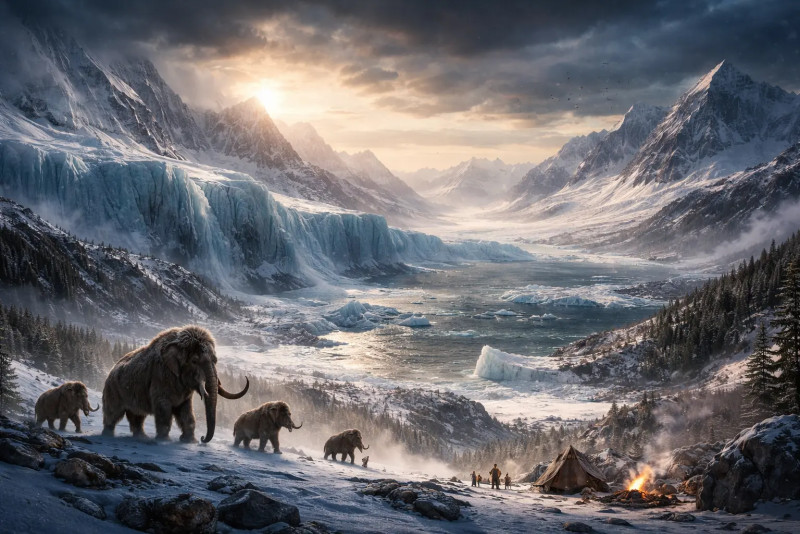
What If the Ice Age Never Ended? — The Cold World That Might Have Been
By Ronald Kapper
Disclaimer: This article explores a hypothetical prolonged glacial world using current paleoclimate research, geological data, and modern climate science. It is written to spark curiosity and frame plausible consequences, not to predict the future. For source material and studies consulted, see the reference list at the end.

The Earth we live on feels balanced: deserts, green forests, bustling cities, and ice caps tucked at the poles. But get up close to deep time and you find a wilder rhythm — long cold stretches called ice ages and shorter warm breaks called interglacials. Imagine if one of those icy chapters never closed. Picture the world with ice sheets grinding across continents, sea levels sunk low, and the map of nations redrawn by cold and time. That’s the what-if we’ll walk through: how people, plants, animals, coasts and technology would have been remade if the Ice Age never ended.
Let’s start with the frame: what do scientists mean by “Ice Age”? The most recent glacial peak — the Last Glacial Maximum (LGM) — was roughly 21,000 years ago, when ice sheets spread from Greenland across much of Canada and pushed deep into northern Europe. Huge ice sheets covered big parts of North America and Eurasia, and the world’s sea level dropped by more than a hundred meters because so much water sat frozen on land. Those changes reshaped habitats and the routes of migrating people.
Now imagine those ice sheets never retreated. Here’s what would be different — in human-scale terms — and why it matters.

1) Coasts, Cities and the New Geography of Habitation
When glaciers grow, sea level falls because water becomes locked up as ice on land. During the LGM sea level was roughly 120–130 meters lower than today; huge continental shelves were exposed land. If the ice age never ended, coastlines would stay far offshore from where we know them today. Many of the world’s major port cities would not exist in their current locations; modern metropolises built on gentle shelves — think Shanghai, Mumbai, New York — would be inland or on dry land or might never develop where they did.
Practical fallout: trade routes would be different, agriculture would cluster where land was hospitable, and human settlement would hug narrow warm corridors near the equator and in ice-free refuges. Some coastal deltas that are now fertile might instead be windswept plains. Imagine New York’s harbor replaced by low coastal plains under tundra conditions — a startling re-write of modern history.
2) Food, Farming and Human Survival
A permanently glacial world would squeeze the zones where crops grow. Agriculture hinges on suitable temperatures, growing seasons, and pollinators — all things the ice would restrict. Most of today’s grain belts exist in temperate zones that would have been hammered by colder, drier climates or overridden by tundra vegetation. Early humans in a frozen world would rely more on hardy root crops, cold-tolerant grains grown in specially sheltered valleys, and heavy dependence on animal protein from herds adapted to cold. The pace of civilizational development — cities, trade, specialization — would likely slow where food surpluses are hard to produce.
Yet humans are adaptable. Archaeological evidence shows hunter-gatherers prospered in Ice Age refuges. Where ice-free corridors existed, humans would intensify technologies: better insulation, food storage, animal domestication tailored to cold, and architectural innovations for warmth. Genetics and archaeology indicate humans survived and migrated even when ice reigned; a never-ending Ice Age would simply make those adaptations permanent and pervasive.

3) Wildlife: Winners, Losers, and Strange Ecosystems
The Ice Age hosted giant beasts — mammoths, giant deer, saber-tooth predators — adapted to cold grasslands. If the glacial world persisted, many of those specialists might remain dominant, evolving further. Tropical species would be squeezed toward equatorial refuges, while cold-adapted species radiate across vast steppe-tundra belts. Biodiversity would be rearranged: fewer tropical rainforests, more open cold grasslands, and many modern species (especially those requiring warm stable climates) either extinct or sequestered in small pockets.
Biodiversity loss would be severe in some regions but might be offset by evolution in others. The long, stable cold could produce new, specialized lineages. Paleontology and genetic studies show range shifts and extinctions during glacial maxima — a never-ending glacial phase would intensify those trends.
4) Rivers, Oceans and Global Climate Machinery
Glaciers don’t just store water — they influence ocean currents and atmospheric patterns. Large ice sheets change where winds and storms track and alter the salinity and temperature of ocean surface waters as meltwater pulses into the sea. If a permanent ice age held, ocean circulation patterns would reorganize. For instance, the strength and path of the jet stream — which governs weather across mid-latitude countries — would be substantially different, making many regions colder and drier. Coastal upwelling and marine ecosystems would shift as ocean temperatures and currents adapt to persistent cold. Studies of past glacial climates show broad reconfigurations in global circulation; a never-ending ice age would lock in those changes.

5) Sea Level and the Visible Land
Lowered sea level during glacial maxima exposed continental shelves — wide stretches of land now underwater. Economies and cultures that thrive on coastal access would instead be based on long inland seas and frozen plains. Marine-dependent civilizations wouldn’t develop in many places because main fisheries and navigable coasts would be distant. Instead, human life would concentrate where coasts and estuaries remained accessible and where ice-free pockets provided shelter.
The visual Earth would show more land at the margins and vast ice domes in higher latitudes and many mountain ranges. Mountain glaciers would merge into larger ice fields, and some lower mountain passes would be blocked by permanent ice.
6) Technology, Energy and the Path of Cities
How would human technology change? Necessity would drive innovation. Wood and peat would be prime fuels where trees survive; otherwise, societies would invest early in wind, water and geothermal sources when available. Transport technologies would differ: more overland sled systems, ice-hardened infrastructure, and perhaps earlier mastery of long-range insulation, refrigeration (ironically) and food preservation for long winters.
Urban form would pivot to compact, heated structures with covered marketplaces and underground stores for thermal stability. Trade networks would emphasize overland caravans across ice-free corridors, with coastal trade hubs located where the continental shelf still yields a usable harbor.
7) Freshwater, Lakes and Hazards
Massive ice sheets create dams and force rivers into new routes. Glacial meltwater can also form large lakes that, if suddenly released, cause catastrophic floods (glacial lake outburst floods). Those risks persist when ice remains widespread. In a permanent ice age, communities near ice-margins would live with the constant risk of changing river courses, sudden floods, and the slow rebirth and burial of valleys under ice. Historical records and geological evidence show past ice retreats triggered major river reorganizations; if ice stood still, those dynamic processes become the norm.

8) The Human Story — Culture, Migration and the Shape of Nations
Culture deepens in the niches people occupy. Where warmth is rare, ritual, art, storytelling and craft would evolve around survival strategies: seasonal harvests, animal migrations, ice navigation, and shelter building. Human identities tied to snow, ice, and cold-adapted animals might dominate cultures in the Northern and Southern high latitudes. Coexistence with megafauna would be a bigger part of human life — hunting mammoths and giant bison might be central to many societies.
Large swaths of Europe and North America might remain lightly populated or dominated by small, mobile groups rather than dense agrarian states. Political boundaries would look different: nations would be concentrated around viable climes and resources, and trade powerhouses would emerge where geography still allowed safe, year-round access to resources.
9) Could Human Activity Tip a Never-Ending Ice Age?
This is the twist. If the ice age never ended, could humans — through burning fossil fuels and greenhouse gas emissions — eventually thaw it? Modern climate science shows that atmospheric greenhouse gases strongly affect global temperature. Rapid warming today is melting long-standing glaciers and ice fields; if humans produce enough greenhouse gases, they can still drive the climate toward warmth, even reversing glacial tendencies. But flipping a planet-scale ice state depends on many slower factors (like orbital cycles) and the sheer mass of ice that would have to be melted. The technical and temporal scales are huge, but the bottom line is that concentrated, high greenhouse forcing can override long-term orbital pacing — which is one reason current warming is both rapid and profound.

Quick Scientific Notes
-
Ice sheets lower sea level. During the Last Glacial Maximum sea level fell roughly 120 meters, exposing continental shelves where people could walk today’s underwater plains.
-
Orbital cycles matter. The timing of ice ages is strongly tied to subtle shifts in Earth’s orbit and tilt (Milankovitch cycles), which change the sunlight reaching mid-latitudes.
-
Ecosystems shift, species move. Plants and animals track climate. In a frozen world, cold-adapted species expand and many warm-climate species shrink or vanish.
-
Human adaptation is powerful. Humans survived real Ice Age conditions; a never-ending Ice Age changes the paths of migration, technology and culture, it does not necessarily stop human innovation.
-
Modern changes are different. Today’s warming is driven largely by greenhouse gases from human activity and is unfolding faster than most natural shifts recorded over the last million years. That means the stakes of current change are both immediate and unlike the slow rhythms of deep time.
Frequently Asked Questions (FAQs)
Q: Would humans survive if the Ice Age never ended?
A: Yes — but lives would look different. Archaeology shows human groups survived and spread during cold periods by adapting hunting, shelter and seasonal mobility. Permanent glaciation would concentrate people into ice-free refuges with more reliance on cold-adapted agriculture, animal husbandry and stored foods.
Q: Would sea level be lower or higher?
A: Much lower. With huge amounts of water frozen on land, sea level would drop by over 100 meters versus today, exposing large shelves and changing coastlines dramatically.
Q: Would cities like London or Mumbai exist?
A: Not in their modern forms or locations. Many present-day coastal cities sit on continental shelves or river deltas shaped after ice retreated. Those cities would either be inland, differently placed, or not exist at all.
Q: Could a never-ending ice age reverse naturally?
A: If Earth’s orbital cycles favored warming or if other large forcings occurred, ice could retreat. However, processes happen on millennial scales; natural reversals are slow. Human-driven greenhouse forcing is now a faster, powerful agent that can push climates away from glacial states.
Q: Would biodiversity vanish?
A: Some species would go extinct, especially those tightly bound to warm, stable habitats. But cold-adapted species might flourish and new evolutionary paths could arise. The result would be different — not uniformly poorer.
How This Helps Us Today
Thinking about a world locked in ice sharpens how we see modern climate change. It reveals how much geography, species distributions and human history depend on climate shifts. It shows how resilient and inventive humans can be, while also reminding us that abrupt modern warming — driven by greenhouse emissions — is not the same as slowly moving out of an ice age. We shape our future; the Earth’s history shows both slow planetary rhythms and abrupt shocks. Understanding both helps us prepare.
References & Further Reading (sources consulted)
(Placed here so the article body remains link-free; these are the materials used to inform the piece.)
-
Last Glacial Maximum. Encyclopedia Britannica.
-
Milankovitch (Orbital) Cycles and Their Role in Earth’s Climate. NASA Science.
-
Evidence — Rapid Climate Change. NASA Climate Evidence.
-
The ghost of ice ages past: Impact of Last Glacial Maximum ... ScienceDirect / Research Article (examples of species range shifts and paleoecology).
-
How Melting Ice Affects People and the Planet. NRDC analysis of glacial impacts on people and infrastructure.