What If Dinosaurs Never Went Extinct?
The Moment That Changed Everything
Sixty-six million years ago, a single cosmic event reshaped life on Earth forever. A massive asteroid struck near what is now the Yucatán Peninsula, triggering firestorms, earthquakes, and years of darkness. Forests burned, oceans changed, and food chains collapsed. Nearly three quarters of all life disappeared. The age of dinosaurs ended in a violent instant.
But imagine a different story. Imagine that asteroid passing silently through space, missing Earth entirely. No global fire, no years without sunlight, and no sudden collapse of ecosystems. The dinosaurs would have survived, and history would have unfolded in a completely different direction.
In that alternate world, the planet would not belong to humans. It would still belong to giants.

A World Still Ruled by Dinosaurs
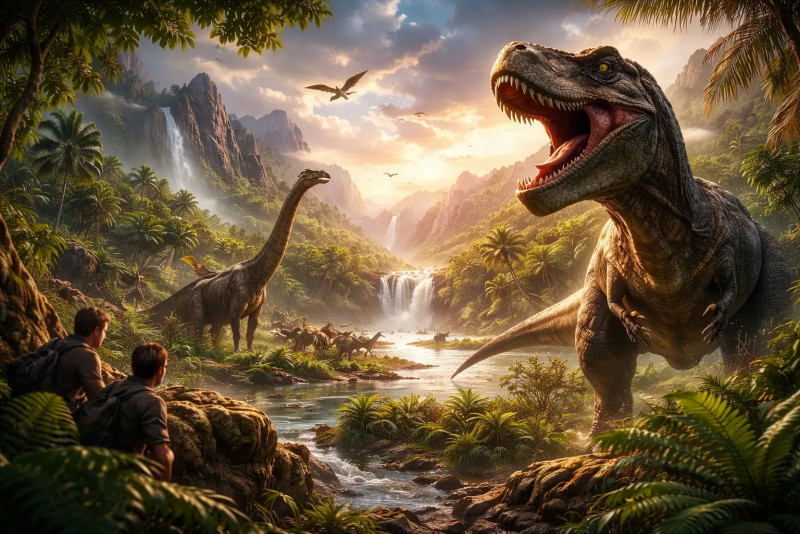
Without extinction, dinosaurs would have continued to dominate land ecosystems. Massive sauropods would still roam open plains, their towering bodies shaping forests and grasslands. Predators like tyrannosaurs would remain at the top of the food chain, evolving sharper senses and faster movements. Armored dinosaurs would grow stronger defenses, locked in an endless evolutionary race with hunters.
The Earth would feel wild and ancient, filled with thunderous footsteps and towering shadows. The presence of such giant creatures would influence vegetation, rivers, and climate itself. Entire ecosystems would revolve around their movements.
Meanwhile, mammals would remain small and hidden. The rise of humans might never happen, or if it did, it would occur in a world where survival meant living alongside giants.

Would Humans Ever Appear?
After the real extinction event, mammals expanded rapidly, eventually producing primates and humans. But in a dinosaur-dominated world, mammals would likely stay small and nocturnal, constantly avoiding predators. Evolution would move slowly, and intelligent primates might never emerge.
Yet there remains a fascinating possibility. Humans might still evolve, but in a far harsher world. Cities might be built behind protective barriers. Farms would need heavy defenses against roaming herbivores. Humans would not be rulers of Earth but clever survivors sharing space with powerful creatures.
Such a world would demand constant awareness, intelligence, and cooperation for survival.
Dinosaurs Would Continue Evolving
Dinosaurs would not remain frozen in time as we see them in fossils. Evolution never stops. Over millions of years, dinosaurs would adapt to changing environments. Some would grow smarter with larger brains, some faster and lighter, and some would develop feathers for temperature control. Others might shrink into smaller forms similar to birds.
In fact, birds today are living descendants of dinosaurs. In this alternate Earth, many dinosaur species might resemble giant feathered creatures rather than the slow reptiles people imagine. The planet would feel alive in a way both familiar and deeply prehistoric.
A Different Planet, A Different Climate
The continued presence of dinosaurs would shape Earth’s climate and vegetation. Giant herbivores would control forests and grasslands, influencing carbon cycles and plant growth. Their migration patterns would reshape ecosystems across continents.
The planet might be warmer, with dense prehistoric jungles covering large regions. Nature would not resemble the modern world but something older and more powerful, closer to the deep past of Earth’s history.

Life Under the Shadow of Predators
If humans existed in such a world, life would be dangerous. Large predators would dominate land, including tyrannosaurs and pack-hunting raptors. Rivers and swamps would hide massive reptilian hunters.
Humans would need advanced tools, group coordination, and protective settlements to survive. In this world, humans would not be the top predator. Intelligence would become their greatest weapon.
Could Dinosaurs Become Intelligent?
Some dinosaurs already showed signs of relatively advanced brain development. Over millions of years, intelligence might increase. One intriguing possibility is the evolution of a tool-using dinosaur species.
Such a development could lead to two intelligent species sharing the same planet. Earth’s history would unfold in a completely different direction, shaped by both human and dinosaur intelligence.

A Modern World With Dinosaurs
If dinosaurs survived into modern times, nearly every aspect of life would change. Transportation systems would adapt to giant animals crossing landscapes. Agriculture would require heavy protection. Scientific discovery would flourish as humans studied living prehistoric creatures. Culture, stories, and traditions would revolve around real giants instead of myths.
The planet would feel raw, powerful, and unpredictable, a world where ancient life never disappeared.
Why Dinosaurs Truly Vanished
The real asteroid impact created conditions too extreme for large animals. Darkness blocked sunlight, plants died, temperatures dropped, and food chains collapsed. Small mammals survived because they required less food and could hide underground.
Ironically, the catastrophe that destroyed dinosaurs opened the path for mammals and eventually humans. Without that event, humanity might never have existed.
Frequently Asked Questions
Did dinosaurs dominate Earth for millions of years?
Yes, dinosaurs ruled Earth for around 165 million years, far longer than humans have existed.
Could humans survive alongside dinosaurs?
Possibly, but survival would be far more difficult, requiring intelligence and cooperation.
Are birds really dinosaurs?
Yes, birds evolved from small feathered dinosaurs and are considered living descendants.
Could dinosaurs evolve human-like intelligence?
It is scientifically possible, as some species already showed advanced brain development.
What if the asteroid never hit Earth?
Dinosaurs would likely still dominate ecosystems, and mammals, including humans, might never rise to prominence.

Final Reflection
The extinction of dinosaurs was one of the most dramatic turning points in Earth’s history. It ended an ancient age but created the opportunity for mammals and humans to rise. Imagining a world where dinosaurs survived reminds us how fragile history truly is. One cosmic moment changed the direction of life forever.
In another possible world, giant footsteps might still shake the ground, ancient shadows might cross forests, and humanity, if it existed at all, would live in the presence of dinosaurs.
Disclaimer
This article explores a hypothetical scenario based on scientific theories and fossil evidence. It is intended for educational and informational purposes only. Interpretations remain speculative but grounded in current scientific understanding.
References & Sources
https://www.britannica.com/science/dinosaur-extinction
https://www.nationalgeographic.com/science/article/dinosaur-extinction
https://www.smithsonianmag.com/science-nature/what-killed-dinosaurs-10992175/
https://www.nasa.gov/mission_pages/asteroids/overview/index.html
https://www.nhm.ac.uk/discover/how-an-asteroid-caused-extinction-of-dinosaurs.html
.png)
.png)
.png)
.png)