.png)
.png)
.png)
.png)
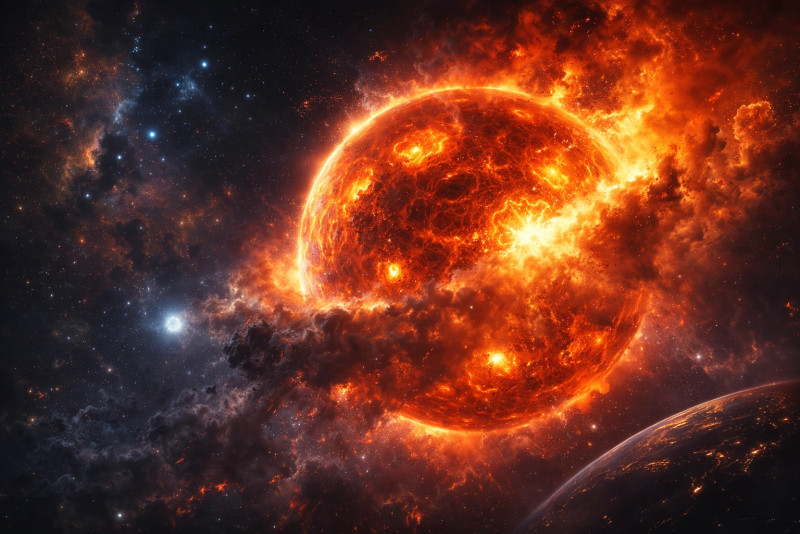
Something is very wrong with the shoulder of Orion.
If you step outside tonight and look up at the famous hunter constellation, you’ll see a steady, reddish-orange glow. That’s Betelgeuse. For centuries, it has been a reliable landmark for sailors and stargazers. But lately, this "old" friend has been acting like a ticking time bomb, and the latest reports from February 2026 suggest the drama is just getting started.
Scientists have been scratching their heads. One minute, the star is dimming so much it almost disappears from the top-ten list of brightest stars; the next, it’s screaming with energy. Is it just "stellar old age," or are we about to witness the greatest light show in human history?

The Giant is Shaking: What’s Really Happening?
Betelgeuse isn’t just a star; it’s a monster. If you dropped it into the center of our solar system, it would swallow Mercury, Venus, Earth, Mars, and even reach out toward Jupiter. It’s huge, bloated, and incredibly unstable.
Recently, astronomers using the Gemini North Telescope and the Hubble Space Telescope discovered something they didn't expect. Betelgeuse isn't alone. It has a "partner in crime"—a smaller companion star nicknamed Siwarha.
This companion isn't just sitting there. It is literally plowing through Betelgeuse’s outer atmosphere every six years. Imagine a speedboat racing through a calm lake; it leaves a wake behind it. Siwarha is doing the same thing to Betelgeuse, stirring up massive clouds of gas and dust. This "stellar bullying" explains why the star’s brightness keeps swinging wildly, but it also adds a new layer of instability to a star that is already on the verge of collapse.

The "Great Dimming" Mystery Solved
Back in 2019 and 2020, the world panicked when Betelgeuse lost 60% of its light. People thought, "This is it! It’s going supernova!" It turns out the star basically "sneezed." It ejected a massive blob of plasma that cooled down into a giant dust cloud, blocking our view. While that specific event wasn't the final explosion, it proved that the star's internal structure is becoming increasingly fragile. It is losing mass at an alarming rate—about 30 million times faster than our Sun.

What Happens When It Finally Pops?
When a red supergiant like Betelgeuse runs out of fuel, gravity wins. The core collapses in a fraction of a second, and the resulting rebound creates a Type II Supernova.
Here is what you would see from your backyard:
-
The Ghost Light: First, we wouldn't see anything with our eyes. Instead, sensitive detectors would pick up a flood of neutrinos—tiny particles that travel nearly at the speed of light. This is our "one-day warning."
-
Daytime Brilliance: A few hours later, the light hits us. Betelgeuse would suddenly brighten until it’s as bright as a half-moon.
-
Shadows at Night: You would be able to see the star clearly during the day. At night, it would be so bright it could actually cast shadows on the ground.
-
The Slow Fade: This cosmic bonfire would burn for about three to four months before slowly fading away.
Are We Safe?
The big question everyone asks: Will it kill us? The short answer is no. To hurt Earth, a supernova needs to be within about 160 light-years. Betelgeuse is safely tucked away about 650 light-years from us. We get all the beauty with none of the "extinction-level" danger.

Why the 2026 Reports are Different
The buzz in early 2026 stems from new high-resolution imaging that shows Betelgeuse’s surface is now covered in massive, boiling "convection cells." These are like giant bubbles of hot gas, but they are the size of our entire orbit around the Sun.
Scientists are warning that the interaction between these bubbles and the companion star Siwarha is creating a "perfect storm" of instability. We are watching a star in its final death throes. While "soon" in space terms could mean tomorrow or 100,000 years from now, the sheer amount of chaos happening on the star's surface right now is unprecedented.
Note: Even if the star exploded 500 years ago, we wouldn't know yet because the light takes centuries to reach us. For all we know, the "shoulder of Orion" is already gone, and the news is just traveling through the mail.
FAQs: Everything You Need to Know
Is Betelgeuse going to explode in 2026?
There is no "confirmed" date. While it is highly unstable, most astronomers believe the final collapse is still centuries or millennia away. However, its current behavior is so strange that they aren't ruling anything out.
Will the supernova cause a black hole?
Probably not. Most models suggest Betelgeuse is just the right mass to leave behind a neutron star—a city-sized ball so dense that a teaspoon of it would weigh as much as a mountain.
Can I see the companion star Siwarha?
Not with the naked eye. It’s much smaller and fainter than Betelgeuse and is currently tucked away in the star's glare. Professional telescopes like the Gemini North are needed to spot it.
Where can I see Betelgeuse?
Look for the constellation Orion. Betelgeuse is the bright, reddish star in the upper left corner (the hunter's "right shoulder" from our perspective).

The Verdict: Keep Your Eyes Up
We live in a unique moment in history. For the first time, we have the technology to watch a nearby star fall apart in real-time. Whether it blows up tonight or long after we are gone, Betelgeuse serves as a humbling reminder that nothing in the universe—not even the stars—lasts forever.
So, the next time you're out on a clear night, take a second to look at that red dot in Orion. You might be looking at a ghost, or you might be looking at the calm before the biggest storm the galaxy has seen in a thousand years.
References & Sources
-
Detection of the Expanding Wake of the Companion Star (Published Feb 2026, The Astrophysical Journal).
-
NASA Hubble Mission: The Great Dimming and Surface Mass Ejection Updates.
-
International Gemini Observatory: Direct Imaging of Siwarha (2025-2026 data).
-
Encyclopedia Britannica: Betelgeuse Star Facts and Recent History.
Disclaimer: This article is for informational and educational purposes. While based on current astronomical data and peer-reviewed studies as of early 2026, the exact timing of a supernova cannot be predicted with 100% certainty. No immediate threat to Earth is posed by the current state of Betelgeuse.