


The Science of Marvel’s What If: Can Multiverses Actually Exist?
In the Marvel Cinematic Universe, the Watcher sits in a crystalline void, peering into infinite timelines where a single choice changes everything. We watch T'Challa become Star-Lord or Peggy Carter take the Super Soldier serum, and we think, "That’s cool sci-fi." But if you talk to a theoretical physicist, they won’t laugh. In fact, many of them might tell you that Marvel's most far-fetched idea—the Multiverse—is actually the most scientifically plausible thing in the entire franchise.
While we don't have a giant bald man in a toga watching us from the "Nexus of All Realities," the math behind our universe suggests that "What If" scenarios aren't just for comic books. They might be a fundamental part of how reality works. Let's peel back the curtain on the three big scientific theories that suggest we might be living in a Marvel-style multiverse.

The Quantum "What If": The Many-Worlds Interpretation
In the What If...? series, the Watcher says, "Follow me and ponder the question... What if?" In quantum physics, this isn't just a question; it’s a calculation.
There is a famous theory called the Many-Worlds Interpretation (MWI). Proposed by Hugh Everett III in 1957, it suggests that every time a quantum event happens—like a particle moving left instead of right—the universe doesn't choose one path. Instead, it splits. One universe goes left, the other goes right.
If this is true, then every decision you've ever made, every coin flip, and every microscopic movement of an atom has created a "branch." In one reality, you ate eggs for breakfast; in another, you skipped it. In a more dramatic branch, perhaps a different sequence of events led to a world where dinosaurs never died out. This is the closest scientific match to the Marvel "Nexus Point"—a moment where the timeline fractures into two distinct, equally real worlds.

Bubble Universes and Eternal Inflation
While the Many-Worlds theory deals with "branching" timelines, there is another theory that looks more like a "cosmic bubble bath." This is called Eternal Inflation.
According to this theory, the Big Bang wasn't a one-time event. Instead, space is constantly expanding (inflating) like a giant loaf of rising bread. Occasionally, a small "pocket" of that space stops inflating and settles down into a stable universe—like ours.
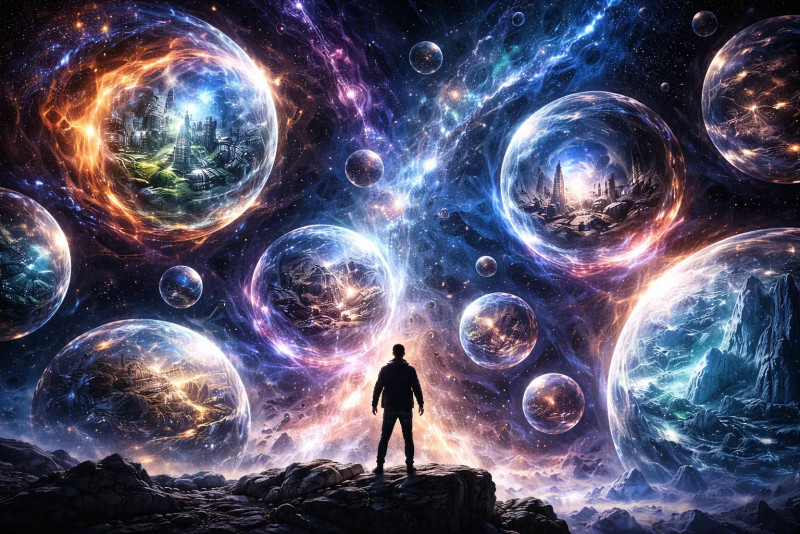
But here’s the kicker: while our "bubble" stopped inflating, the space around us kept going. This means there could be an infinite number of other bubble universes floating in the "inflationary sea." Some of these bubbles might have the exact same laws of physics as ours, but others might have gravity that works differently, or light that travels at a different speed. In the Marvel sense, this is like Dr. Strange traveling through those weird, kaleidoscopic dimensions; they aren't just "alternate Earths," they are entirely different "bubbles" of reality.

The String Theory Landscape: 10^500 Possibilities
If you want to know why there are so many versions of characters in the MCU, look at String Theory.
Physicists believe that the basic building blocks of our world aren't tiny balls of matter, but vibrating "strings" of energy. To make the math of these strings work, the universe needs at least 10 or 11 dimensions. We only experience four (up-down, left-right, forward-back, and time), so where are the others? They are "curled up" so small we can't see them.
The way these dimensions curl up determines the laws of physics. Scientists estimate there are 10^500 different ways those dimensions could be folded. Each "fold" creates a different universe in what is known as the String Theory Landscape. This is the ultimate "What If." It suggests that somewhere out there, there is a universe for every possible configuration of matter allowed by physics.
| Feature | Marvel's What If | Real Science (Theory) |
| How it starts | A "Nexus Point" (A choice or event) | Quantum decoherence / Branching |
| Number of worlds | Infinite | Infinite (or 10^500 in String Theory) |
| Can they meet? | Yes (The Guardians of the Multiverse) | Likely No (Universes are isolated) |
| Different Laws | Sometimes (Paint world, 8-bit world) | Predicted by Eternal Inflation |
| The Watcher | A sentient being | The "Universal Wave Function" (No observer needed) |
Commonly Asked Questions (FAQs)
- Can we ever visit another universe? In Marvel, you just need a "Sling Ring" or America Chavez. In real life, it’s probably impossible. Most multiverse theories suggest these worlds are millions of light-years away or exist in "mathematical spaces" that we simply cannot cross.
2. Is there really a "Evil Me" out there?
If the Many-Worlds Interpretation is correct, then yes. There is a version of you who is a billionaire, a version who is a professional athlete, and a version who made every mistake you’ve ever avoided.
3. Has science proven the multiverse exists?
Not yet. Right now, it is a "theoretical" model. We can’t see other universes, but the math we use to describe our own universe keeps pointing to their existence. It's like seeing footprints in the sand—we haven't seen the person, but the tracks suggest they are there.
4. Why do scientists even talk about this if they can't see it?
Because it explains things that are otherwise "weird." For example, why is gravity so weak compared to magnets? Some scientists think gravity might be "leaking" in from a nearby parallel universe.

The Human Verdict: Does It Matter?
Whether or not there is a universe where you are the hero of your own Marvel movie, the science of the Multiverse tells us something beautiful: possibility is infinite. Marvel uses the multiverse to tell stories about second chances and "the road not taken." Science uses the multiverse to explain the sheer scale and mystery of existence. Both suggest that we are part of something much, much bigger than our tiny blue marble. So, the next time you feel small, just remember—in some corner of the cosmic landscape, you might just be the most important person in the universe.
Disclaimer: This article explores theoretical physics and cosmology. While theories like MWI, String Theory, and Eternal Inflation are respected in the scientific community, they remain unproven by direct observation. This piece is for educational and entertainment purposes, bridging the gap between pop culture and high-level science.
References & Proof of Concept
-
Scientific American: Does the Multiverse Actually Exist?
-
Stanford Encyclopedia of Philosophy: The Many-Worlds Interpretation of Quantum Mechanics
-
MIT Technology Review: How String Theory Predicts the Multiverse
-
Quanta Magazine: Why the Multiverse Is a Science, Not Fiction