.png)
.png)
.png)
.png)
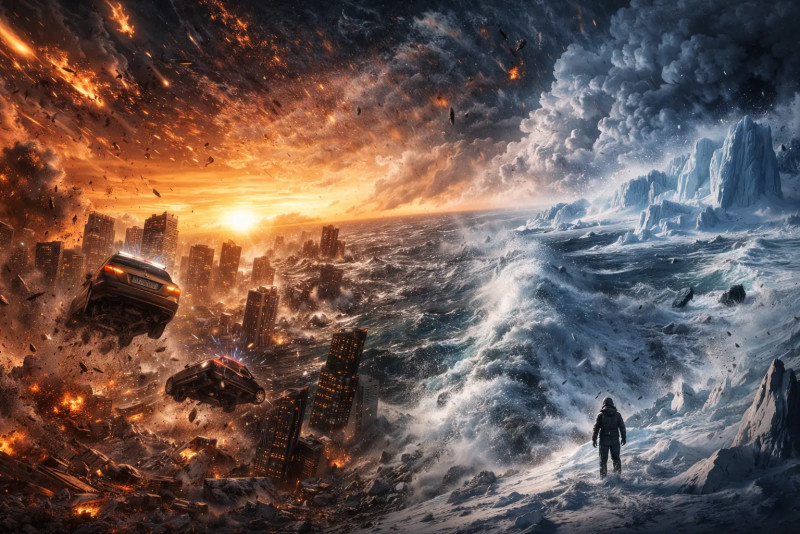
What if Earth Stopped Rotating for 1 Second? The Terrifying Physics of a Global Disaster
We often take the ground beneath our feet for granted. It feels solid, still, and reliable. But right now, as you read this sentence, you are actually hurtling through space at a staggering speed. Depending on where you live, you are spinning at up to 1,000 miles per hour. We don’t feel it because everything—the air, the water, the buildings—is moving with us.
But what if that steady spin suddenly jerked to a halt? Not forever, just for a single, solitary second. You might think, "It's just a second, how bad could it be?"
The answer: It would be the most violent second in the history of our planet.

The Law of Inertia: Why Everything Would Fly
The biggest villain in this scenario is a simple rule of physics called Inertia. According to Newton’s First Law, an object in motion stays in motion unless something stops it.
If the Earth stops rotating for one second, the "solid" planet under your feet stops. However, the atmosphere, the oceans, and everything not bolted into the deep bedrock would not stop. They would keep moving at the previous speed of rotation—roughly 1,038 mph (1,670 km/h) at the equator.
To put that in perspective, a typical commercial airplane flies at about 500 mph. You would suddenly be moving twice as fast as a jet, but without the plane. People, cars, trees, and even skyscrapers would be violently hurled eastward. If you were inside a house, you wouldn’t just fall; you would be launched through the wall at supersonic speeds.

Supersonic Winds: The Global Scraper
The air we breathe is part of the Earth’s system, and it has mass. If the Earth stops, the atmosphere keeps going. This would create winds with speeds of over 1,000 miles per hour at the equator.
These aren't just "strong winds." These are supersonic blasts. For comparison, the strongest hurricanes ever recorded have winds around 200 mph. A 1,000-mph wind would act like a giant planetary scraper. It would rip the soil right off the bedrock, flatten entire forests like they were blades of grass, and turn every loose pebble into a deadly supersonic bullet.

The Oceans: A Global Mega-Tsunami
The water in our oceans also has massive inertia. When the planet stops, the water would surge eastward in a wall of liquid destruction. We aren’t talking about a normal tsunami; we are talking about a "mega-tsunami" that would be miles high.
Coastal cities wouldn't just be flooded; they would be erased. The momentum of the Atlantic and Pacific oceans would carry them deep into the continents, scouring the land clean of any remaining structures.

The "Bulge" and Gravity Shifts
Because Earth spins, it isn't a perfect sphere. Centrifugal force causes it to bulge at the middle—the equator is about 13 miles thicker than the poles. This spin also holds a massive "bulge" of water at the equator.
If the rotation stops, even for a second, that centrifugal force vanishes. Gravity would immediately try to pull all that equatorial water toward the poles, where gravity is slightly stronger. This would cause a massive, permanent redistribution of the world's oceans once the "sloshing" settled down. Places like northern Canada and Siberia would be submerged, while new land would rise out of the ocean near the equator.

What Happens at the Poles?
If you want a tiny chance of survival, you’d need to be standing exactly on the North or South Pole. Because the rotational speed at the poles is effectively zero, you wouldn't be flung sideways.
However, you wouldn't be safe for long. Within seconds, the supersonic winds from the lower latitudes would reach you, and the tectonic plates—suddenly jolted by the massive shift in momentum—would likely trigger the largest earthquakes and volcanic eruptions the world has ever seen.
Scientific What If Analysis: The Impact Table
| Location | Rotational Speed | Immediate Result of a 1-Second Stop |
| Equator (Quito, Ecuador) | 1,038 mph | Everything flung eastward at supersonic speeds; total destruction. |
| Mid-Latitudes (New York/Paris) | ~800 mph | Violent launching of all structures; massive atmospheric friction. |
| High Latitudes (Oslo/Anchorage) | ~500 mph | Hurricane-force winds 5x stronger than Category 5 storms. |
| Poles (North/South) | 0 mph | Stationary, but hit by global winds and tectonic shifting shortly after. |
Commonly Asked Questions (FAQs)
1. Would the Earth start spinning again after the second?
In this hypothetical "What If" scenario, yes. But even if it did, the damage would be permanent. Human civilization would be wiped out in that one second, and the atmosphere would take weeks to settle back into a normal pattern.
2. Could I survive if I was in a plane?
Actually, being in the air might be your only hope—briefly. Since the plane isn't touched by the ground, you wouldn't feel the "jerk" of the Earth stopping. However, the atmosphere would suddenly be moving at 1,000 mph relative to the ground, creating unimaginable turbulence that would likely tear the aircraft apart.
3. Does the Earth ever change speed in real life?
Yes, but very slowly! Earth's rotation is slowing down due to the Moon's gravity by about 1.7 milliseconds every century. It's also affected by large earthquakes or even large dams, which can change the day's length by microseconds—not enough for us to notice.
4. Would gravity disappear?
No, gravity is based on the Earth's mass, not its spin. You would actually feel a tiny bit heavier at the equator if the Earth stopped, because the centrifugal force that slightly pushes you "outward" would be gone.

The Verdict: A Fragile Balance
This "What If" analysis shows us just how much we rely on the silent, steady mechanics of our solar system. We don't feel the Earth spinning, but that motion is the heartbeat of our planet. It regulates our weather, protects our atmosphere, and keeps our oceans in place.
Stopping that clock for even one second wouldn't just be a "glitch"—it would be the end of the world as we know it. So, the next time you feel like the world is moving too fast, just remember: you're actually lucky it is.
Disclaimer: This article explores a scientific thought experiment. A sudden stop in Earth's rotation is physically impossible under our current understanding of planetary dynamics and angular momentum. The scenarios described are based on the physical consequences of inertia and atmospheric science.
References & Sources
-
Neil deGrasse Tyson (Larry King Now): On the consequences of Earth stopping for a second
-
Esri (ArcUser Online): Modeling the Absence of Centrifugal Force
-
Britannica: Physical structure and climate impact of rotational cessation
-
WION: Atmospheric and oceanic redistribution during rotational stops