


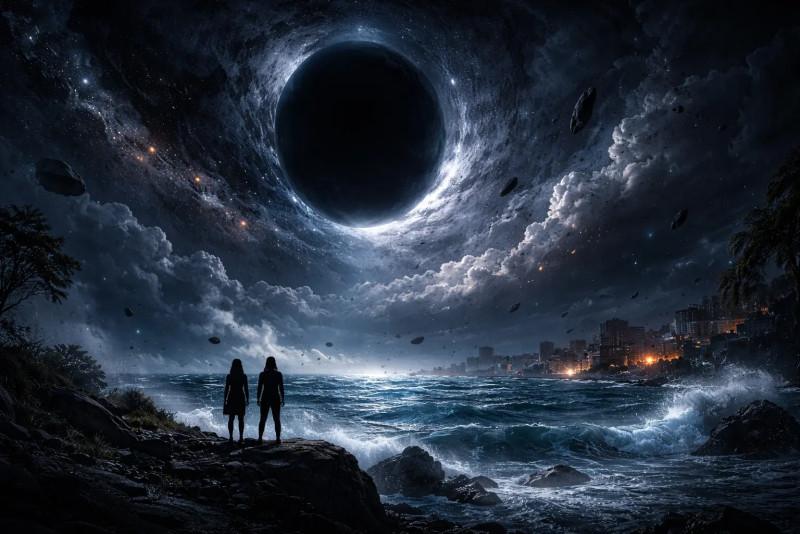
What if the Moon Disappeared? The Terrifying Scientific Reality of a Moonless Earth
Imagine stepping outside tonight, looking up at the familiar silver glow of our cosmic neighbor, and seeing... nothing. Just an empty, haunting void where the Moon used to be. It sounds like the plot of a high-budget Hollywood disaster flick, but the scientific reality of a Moonless Earth is far more chilling than any movie.
The Moon isn't just a pretty nightlight. It is Earth’s gravitational anchor, a silent guardian that has dictated the rhythm of life for over four billion years. If it vanished tomorrow, the "What If" analysis isn't just about dark nights; it’s about a planetary mid-life crisis that would change everything from the length of your workday to the very air you breathe.

The Great Tidal Collapse: Coastal Chaos
The most immediate and visible change would happen at the beach. If the Moon vanished, the massive gravitational "tug" that creates our tides would suddenly lose its primary engine.
While the Sun also exerts a pull on our oceans, it’s much farther away. Without the Moon, our tides would shrink by about 66%. The rhythmic "breathing" of the ocean—the rise and fall that coastal ecosystems depend on—would practically stop.
Coastal cities wouldn't just lose their surf breaks. Entire ecosystems like mangroves and salt marshes would collapse. These areas are the nurseries of the ocean; without tidal movement to circulate nutrients and oxygen, thousands of species of fish, crabs, and birds would face immediate extinction.

The 6-Hour Workday (But Not the Good Kind)
Ever feel like there aren't enough hours in the day? If the Moon disappeared, you’d get your wish—and you’d hate it.
Currently, the Moon’s gravity acts like a "brake" on Earth’s rotation. This "tidal friction" is why we have a 24-hour day. Without that steady braking force, Earth would start spinning much faster. Scientists estimate that a day on a Moonless Earth could shrink to just 6 to 12 hours.
Imagine a world where the sun rises and sets every three hours. The weather would turn into a nightmare. Faster rotation means faster winds. We are talking about permanent, planet-wide hurricanes with wind speeds exceeding 300 miles per hour. Buildings, trees, and topsoil would be ripped away by a relentless, high-speed atmosphere.

A World Without Seasons: The Great Wobble
This is the "silent killer" of a Moonless Earth. Earth currently sits at a comfortable 23.5-degree tilt, which gives us our predictable seasons. The Moon acts as a stabilizer, keeping that tilt steady.
Without the Moon, Earth would start to "wobble" like a dying spinning top. Over thousands of years, our tilt could vary wildly—from 0 degrees (no seasons at all) to 90 degrees (where the North Pole faces the Sun directly).
In a 90-degree tilt scenario, the equator would be covered in ice while the poles would bake in 24-hour sunlight for months. This instability would make large-scale agriculture impossible. Human civilization, built on the predictability of the seasons, would likely crumble.

The Night the Lights Stayed Out
For animals, the disappearance of the Moon would be a death sentence. Many species rely on moonlight to hunt, navigate, and mate.
-
Sea Turtles: Hatchlings use the Moon’s reflection on the water to find the ocean. Without it, they would wander aimlessly and die.
-
Dung Beetles: These tiny navigators use the polarization of moonlight to walk in straight lines.
-
Predators: Owls and lions rely on the low-light advantage to catch prey.
For humans, the "True Dark" would be a psychological shock. Without the Moon, the night sky is roughly 2,000 times dimmer than a full-moon night. It wouldn't just be dark; it would be an oppressive, total void.
Scientific What If Analysis: Quick Facts
| Feature | With the Moon | Without the Moon |
| Day Length | 24 Hours | 6–12 Hours |
| Tide Size | High/Dramatic | 1/3rd current size (Sun only) |
| Wind Speeds | 20–60 mph (Average) | 100–300 mph (Permanent) |
| Axial Tilt | Stable 23.5° | Erratic 0° to 90° |
| Nights | Reflective/Glow | Total Darkness |
Commonly Asked Questions (FAQs)
1. Would we die immediately if the Moon disappeared?
No. You wouldn't drop dead instantly. However, the long-term changes—the extreme weather, the loss of agriculture due to season shifts, and the destruction of the food chain—would make survival incredibly difficult for billions of people.
2. Could we use technology to replace the Moon?
Technically, we could launch massive "mirror satellites" to provide light at night, but we have no technology capable of replicating the Moon’s gravitational pull. We can't "fake" the gravity needed to stabilize Earth’s tilt.
3. Does the Sun cause tides too?
Yes! The Sun is responsible for about one-third of our tidal movement. So, the oceans wouldn't become perfectly still, but the "surge" we see today would disappear.
4. Is the Moon actually leaving us right now?
Yes. The Moon is currently drifting away from Earth at a rate of about 3.8 centimeters (1.5 inches) per year. Don't worry, though—it won't be "gone" for billions of years.

The Verdict: A Silent Guardian
The "What If" analysis of a Moonless Earth reminds us of how delicate our existence truly is. We often think of space as something "out there," but the Moon is an integral part of our biology, our history, and our survival. Without that big, dusty rock in the sky, Earth would be a chaotic, wind-swept, and unrecognizable wasteland.
Next time you see a full moon, take a second to say thanks. It’s doing a lot more than just looking pretty.
Disclaimer: This article is a scientific hypothesis based on current astronomical models. While the disappearance of the Moon is physically impossible under current laws of physics (barring a catastrophic cosmic event), the consequences described are based on established gravitational and climate science.
References & Sources
-
Royal Museums Greenwich: What would happen if the Moon disappeared?
-
Astronomy.com: The impact of a Moonless Earth on planetary rotation
-
NASA Solar System Exploration: The Moon's role in Earth's axial stability
-
Science in School: Speculative science on the 6-hour day