.png)
.png)
.png)
.png)
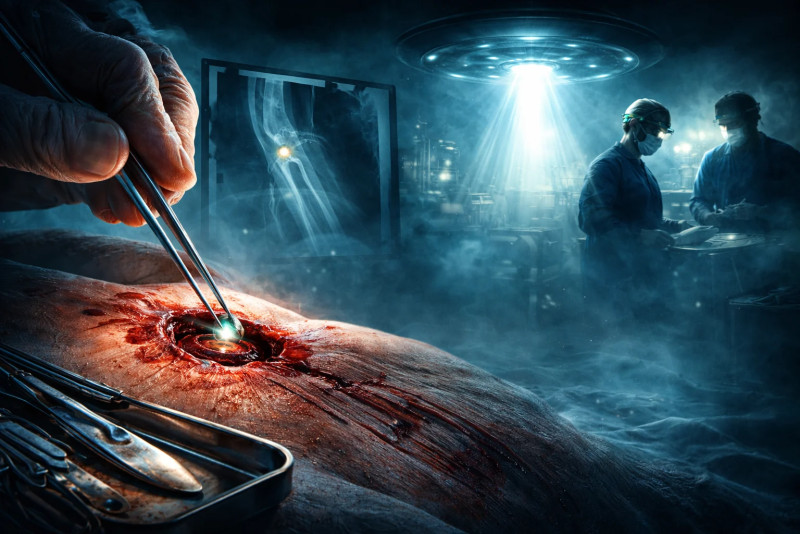
Imagine waking up with a sharp, stinging sensation in your leg. You brush it off as a scratch or a bug bite, but weeks later, you feel something hard beneath the surface—a tiny, metallic lump that wasn't there before. You haven't been in an accident, and you certainly haven't had surgery. Then, the memories start trickling back: bright lights, a hum in the air, and a clinical room that didn't feel like any hospital on Earth.
This isn’t just the plot of a sci-fi thriller. For decades, hundreds of people have claimed that they aren't just "witnesses" to the unknown—they are walking, breathing evidence. The "Implant" phenomenon is one of the most controversial and physically tangible corners of UFO lore. It moves the conversation from "I saw something" to "I have something inside me."
But what happens when these objects are actually removed? Is it a smoking gun for extraterrestrial technology, or a fascinating trick of human biology? Let’s dive into the history, the surgeries, and the baffling biological aftermath of those who claim to have been "tagged."

The Scalpel and the Strange: The Legacy of Dr. Roger Leir
If there is a patron saint of the implant movement, it was Dr. Roger Leir. A podiatric surgeon by trade, Leir became a household name in the 1990s when he began performing surgeries to remove "anomalous" objects from people who claimed to have had close encounters.
Unlike many theorists who stayed behind a desk, Leir went into the operating room. Over his career, he performed more than a dozen surgeries, documented in his famous book The Aliens and the Scalpel. What he found was, to put it mildly, bizarre.
The Findings That Defied Logic
Leir reported several anomalies that continue to fuel debates today:
-
The Missing Inflammatory Response: When your body detects a foreign object—like a splinter or a piece of glass—it attacks it. You get redness, swelling, and scar tissue. Leir claimed many of these objects were encased in a tough, dark gray membrane that the body seemingly accepted as its own. No inflammation. No rejection.
-
Radio Frequency Emissions: Some researchers claimed that while the objects were still inside the body, they emitted "deep space" radio frequencies.
-
The "Moving" Objects: In some surgical accounts, doctors reported that the objects seemed to migrate or "flee" from the scalpel during the procedure, as if they were trying to avoid being caught.

Famous Cases: From "Patient Seventeen" to the "Andreasson Affair"
One of the most modern and well-documented cases was featured in the documentary Patient Seventeen. The film follows an anonymous man who sought to have a small object removed from his leg. The surgery was real, the object was real, and the subsequent lab analysis was... complicated.
Initial tests on the object removed from "Patient Seventeen" suggested it contained rare earth elements and isotopes that were "off the charts," but as with many cases, the scientific community remains divided on whether these are truly "alien" or just highly unusual industrial byproducts.
Long before the modern era, Betty Andreasson became one of the first major public cases in the 1960s. She claimed a device was inserted through her nose—a "thin, wiry object" that many abductees have since mirrored in their own accounts. These "nasal implants" are often described as being the size of a grain of rice, supposedly designed to monitor brain activity or track the individual's location.
The Biological Aftermath: How the Body Reacts
What happens to a person after an object is removed? The "biological aftermath" isn't just about the physical hole left behind; it’s about the psychological and physiological shifts.
-
The "Phantom" Sensation: Many patients report that even after the object is gone, they can still "feel" it. This might be nerve damage, or perhaps a psychological attachment to the "proof" of their experience.
-
Psychological Relief vs. Dread: For some, removal is an exorcism—the end of a haunting. For others, it’s terrifying. If "they" put it in once, what’s stopping "them" from coming back?
-
The Laboratory Wall: This is where the mystery usually hits a snag. When these objects are sent to labs (like Los Alamos or various universities), the results often come back as:
-
Meteoric Iron: Common elements found in space but also used in Earth-based manufacturing.
-
Biological Debris: Specialized scar tissue or "keratin" plugs.
-
Industrial Slag: Small bits of metal or glass that could have been stepped on years prior without the person realizing it.
-

Science vs. The Supernatural: The Skeptic's View
Mainstream science has a much more "down-to-earth" explanation. They point to "Foreign Body Granulomas." Essentially, if you walk barefoot or work with tools, tiny shards of metal or glass can enter the skin. Over time, the body builds a protective "pod" around them. Because these areas (like the hands or shins) have fewer nerves, the initial entry might not even be felt.
Years later, when the person becomes interested in the UFO phenomenon, they find the lump and their brain "connects the dots," creating a memory to explain the physical evidence. It’s a powerful testament to how the human mind tries to make sense of the unknown.
FAQs About "Alien Implants"
- Are these objects always metallic? No. While many are described as metallic or "silvery," others have been reported as crystalline, glass-like, or even organic "slimy" fibers.
2. Can you see them on an X-ray?
Often, yes. Many people who claim to have implants first discovered them during routine medical X-rays for unrelated injuries. They appear as "radio-opaque" foreign bodies.
3. Has any lab ever definitively said an object is "Alien"?
"Definitively" is a strong word. Some labs have noted "unusual isotopic ratios" (which means the atoms are arranged differently than what is typically found on Earth), but these findings are often disputed or attributed to rare but natural geological processes.
4. Why would aliens use implants?
Theorists suggest three main reasons: Biotelemetry (tracking health and location), Mind Control (influencing thoughts or behavior), or Genetic Sampling (monitoring the human "herd" for an ongoing breeding program).
The Verdict: Proof or Paranoia?
Whether these objects are sophisticated nanotechnology from another star system or just bits of terrestrial debris encased in scar tissue, they represent a profound human experience. For the people who go under the knife, the "aftermath" is a life changed forever. They carry the physical scars of a mystery that science—so far—hasn't been able to fully close the door on.
The history of "implants" reminds us that we are always looking for a bridge between the seen and the unseen. Sometimes, that bridge is just a few millimeters long, tucked quietly beneath the skin.
Disclaimers
This article explores the history and claims of the UFO/abduction subculture. The existence of extraterrestrial implants is not recognized by mainstream medical or scientific institutions. Always consult a medical professional for any unexplained physical symptoms or foreign objects.