.png)
.png)
.png)
.png)
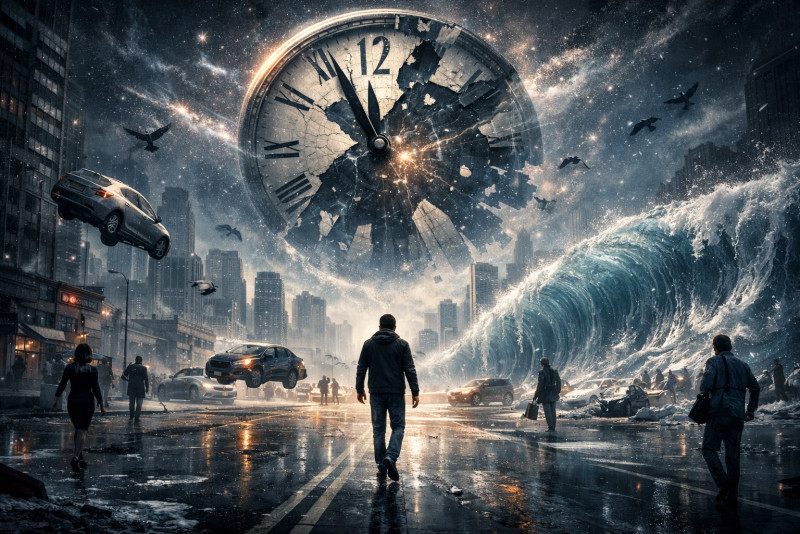
The Day the World Stood Still: What If Humans Could Pause Time—But Only Once?
We’ve all been there. You’re watching a sunset that feels too beautiful to end, or you’re staring at a "Send" button on an email you immediately regret. In those split seconds, the same desperate thought flashes through our minds: “If only I could just stop time for a second.”

But what if that wasn’t just a daydream? What if humanity actually cracked the code of the universe and handed us a "Pause" button? There’s a catch, though—and it’s a big one. We can only use it once. One collective, global freeze-frame for the entire species.
It sounds like a sci-fi blockbuster, but the implications are more than just cinematic. They are deeply, messily human. If we had one shot to halt the ticking clock, how would we decide when to pull the trigger? And more importantly, what happens when the gears start turning again?

The Science of the "Big Still"
Before we get into the "should we," let’s look at the "could we." Physics tells us that time isn't as solid as it feels. According to Einstein’s General Relativity, time is actually flexible. It stretches near massive objects (like black holes) and shrinks when you move incredibly fast.
To "pause" time, we’d essentially need to reach the speed of light or create a gravitational field so intense that the "frames per second" of our reality drop to zero. In a true pause, photons (light particles) would stop moving. You wouldn't be able to see because light wouldn't hit your retinas. You wouldn't be able to hear because sound waves require air molecules to vibrate—and they’re currently stuck in place like flies in amber.
For this to work in our "what if" scenario, we have to assume a bit of "magic physics" where humans remain conscious while the rest of the universe takes a breather.

The Global Tug-of-War: Who Gets the Remote?
If the world discovered a way to pause time, the first problem wouldn't be physical—it would be political. Imagine the chaos of 8 billion people trying to decide when to use our "one shot."
-
The Environmentalists: "Wait until the next major climate tipping point! We can use the pause to physically scrub the atmosphere or fix the ice caps without more damage occurring."
-
The Scientists: "Wait for a catastrophic asteroid impact. We can pause time when it's miles away and use the 'infinite' time to build a deflection system."
-
The Governments: "Keep it as a deterrent. The ultimate 'Mutually Assured Destruction' is the power to stop an enemy's move before it even starts."
The reality? We’d probably argue about it until a moment of pure desperation forced our hand.
The Human Experience: Living in the "In-Between"
Let’s say the button is pushed. Silence falls. The birds are statues in the sky; the ocean waves are jagged glass walls.
For the person "outside" the pause, the world becomes a surreal museum. You could walk across the surface of a lake. You could wander into the most private places on Earth. But very quickly, the novelty would wear off. Without the flow of time, there is no change. Without change, there is no life.
The psychological toll would be immense. We are creatures of rhythm—heartbeats, breaths, the cycle of day and night. Removing that rhythm, even for what feels like a year in a world where no one else moves, would lead to a profound type of loneliness. You would be the only "living" thing in a graveyard of moments.

The Ethical Minefield
If we pause time to "fix" things, are we playing God? If a surgeon pauses time to finish a 20-hour operation in a blink, that’s heroic. But what if a nation pauses time to reposition its armies?
The "Only Once" rule adds a layer of tragic irony. If we use it to save a city from a flood today, we don't have it when a solar flare threatens the electrical grid tomorrow. We would be living in constant fear of "wasting" our greatest miracle.
The Aftermath: When the Clock Starts Ticking Again
The most terrifying part of pausing time isn't the freeze—it's the thaw.
When you hit play, all that stored kinetic energy returns. If you moved objects around during the pause, the sudden re-entry into the flow of physics could be explosive. On a deeper level, the world would wake up to a "new" reality they didn't see coming. We would have to reckon with the fact that our greatest power was spent, and we are once again at the mercy of the relentless forward march of the seconds.

Final Thoughts: Why the Tick-Tock Matters
Maybe the reason we haven't found a pause button is that time's value comes from its scarcity. If we could stop it, we’d stop living. We’d wait for the "perfect" moment that never comes.
In the end, the "Once Only" pause button is a mirror. It shows us what we value most. Is it safety? Is it progress? Or is it simply the ability to hold onto a loved one for just a few seconds longer?
Until that day comes, the best we can do is "pause" in the small ways—taking a breath, puting down the phone, and actually being present in the moments we have. Because once a second is gone, no amount of physics can bring it back.
Frequently Asked Questions (FAQs)
- Is it scientifically possible to pause time? In the absolute sense, no. According to our current understanding of physics, time is an integral part of the space-time fabric. While we can slow time down through high speeds or gravity (time dilation), stopping it entirely would break the laws of physics.
2. What would happen to light if time stopped?
Light travels at a constant speed. If time paused, light would stop moving. This means you would effectively be blind because light wouldn't reach your eyes to be processed by your brain.
3. Could we "un-pause" time?
In this "what if" scenario, the pause is a one-time event. Presumably, there would be a set duration or a secondary trigger to restart the flow. Without a restart, the universe would remain a static, unchanging snapshot forever.
4. How does time dilation differ from pausing time?
Time dilation is a proven phenomenon where time passes at different rates for different observers. For example, astronauts on the ISS age slightly slower than people on Earth. Pausing time is a theoretical complete cessation of all movement and change.
Disclaimer: This article explores theoretical concepts and "what-if" scenarios based on current scientific theories like General Relativity. It is intended for educational and entertainment purposes and does not claim that time-pausing technology currently exists.
References and Sources for Further Reading: