.png)
.png)
.png)
.png)
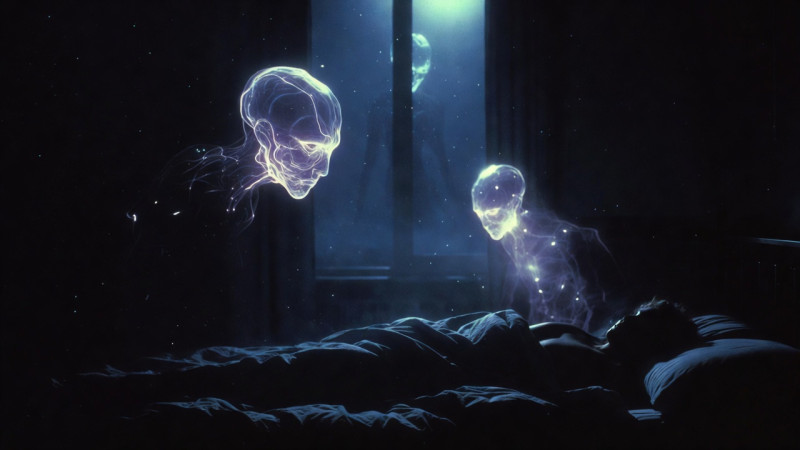
The Blindfold We Didn’t Know We Were Wearing
Have you ever walked into a room and felt a sudden chill, or got that prickly feeling on the back of your neck that someone—or something—was watching you? Usually, we brush it off. We tell ourselves it’s just the wind or a tired mind. But what if your gut was right? What if the room wasn't empty at all, but filled with life forms that your eyes simply aren't built to see?
Welcome to the Invisible Visitors Theory. It sounds like the plot of a late-night horror flick, but it’s a concept that’s gaining serious traction among fringe scientists, physicists, and even some open-minded biologists. The core idea is simple: Humans are effectively blind to 99% of what’s happening in the universe. We are living in a tiny sliver of reality, and the "Invisible Visitors" might be living in the rest of it.

The Prison of the Human Eye
To understand how something could be "invisible," we have to talk about light. Think of the entire electromagnetic spectrum like a piano keyboard that stretches for miles. The "visible light" that humans can see—from red to violet—is only about one single key in the middle of that massive keyboard.
Bees can see ultraviolet patterns on flowers that look like landing strips. Pit vipers can "see" the heat coming off a mouse in total darkness. We know, for a fact, that there is an entire world of color and movement happening right in front of us that we can't see without special cameras.
If a life form evolved to exist primarily in the infrared or ultraviolet spectrum, it could be standing right in front of you, waving its hands, and you wouldn't have a clue. It wouldn't be "ghostly" or "magical"—it would just be vibrationally different.

The Plasma Life Form Mystery: Visitors in the Clouds?
One of the most exciting branches of this theory involves "plasma life." For a long time, we thought life needed carbon and water to exist. But back in 2007, a team of researchers found that inorganic dust in a plasma state could actually form double-helix shapes, mimic DNA, and even "reproduce."
This led to a wild realization: the upper atmosphere of Earth is packed with plasma. In recent years, pilots have reported "UAPs" (Unidentified Anomalous Phenomena) that don't look like metal ships. Instead, they look like living, glowing blobs that move with intent. Some researchers, like Dr. Ruggero Santilli, have even claimed to use special "concave lens" telescopes to photograph entities in our atmosphere that are completely invisible to the naked eye. He calls them "Entities of the First and Second Kind."

Shadow People or Optical Glitches?
We’ve all heard the stories of "shadow people"—dark figures seen out of the corner of the eye that vanish the moment you look directly at them. While skeptics call this "peripheral drift" or a trick of the light, proponents of the Invisible Visitors Theory think there’s more to it.
The edges of our vision are actually more sensitive to motion and low light than the center. It’s possible that our peripheral vision occasionally "catches" a glimpse of something that our central focus filters out as "noise." If these visitors occupy a space just on the edge of our perception, they would appear as fleeting shadows or distortions.

The Dark Matter Connection
Then there's the "Big Boy" of physics: Dark Matter. We know that about 85% of the matter in the universe is "dark." We can't see it, touch it, or measure it directly, but we know it’s there because its gravity pulls on the stars.
If there is five times more "dark" stuff than "normal" stuff, why wouldn't there be "dark" life? Imagine an entire ecosystem—plants, animals, and maybe even intelligent beings—made of matter that passes right through us like we’re made of smoke. They could be walking through your house right now, and to them, you are the invisible ghost.
Why Haven't They Said Hello?
A common argument against this theory is: "If they’re here, why don't they interact with us?"
But think about it from their perspective. Do you try to have a deep conversation with an ant when you walk through the park? Probably not. You just step over them. To an entity that lives for thousands of years or exists across multiple dimensions, humans might look like slow-moving, simple creatures.
Or, perhaps more chillingly, they are interacting with us, but we don't recognize it. We call it "luck," "intuition," or "synchronicities." Maybe they are the silent observers of the human experiment, watching us from the ultraviolet bleachers.

Technological Breakthroughs: Peering Through the Veil
We are finally getting the tech to test this theory. Infrared cameras on drones are picking up objects that aren't visible on standard video. Satellite sensors are detecting "fast movers" in the atmosphere that defy physics.
In 2024 and 2025, there was a surge in "multispectral" photography among amateur researchers. People are hacking cameras to remove the "IR filter," allowing them to see into the infrared. The results? Some very strange, non-random shapes moving through the sky that don't show up on radar or in the visible light spectrum.
The Psychological Impact: Are We Ready to See?
If the Invisible Visitors Theory is proven true tomorrow, it would be the biggest shock to the human ego in history. We like to think we are the masters of our domain. To realize we share our bedrooms, our cities, and our skies with a hidden population would change everything from architecture to philosophy.
Would we feel crowded? Protected? Hunted? It’s a lot to process. But as our science gets better, the "empty" space around us is starting to look very crowded indeed.
FAQs: Everything You Want to Know
- Is there any scientific proof for invisible life? While we don't have a "captured" invisible being, there is proof of "plasma life" (inorganic dust behaving like DNA) and thousands of multispectral photos showing unexplained objects. The science of "Dark Matter" also proves that most of the universe's mass is invisible to us.
2. How can I see these "visitors"?
You can't see them with the naked eye if they live outside the visible spectrum. However, some people use infrared-modified cameras or "Full Spectrum" cameras (often used in ghost hunting) to try and catch anomalies.
3. Are they dangerous?
There’s no evidence to suggest they are harmful. If they’ve been here for thousands of years, they seem content to just watch or exist alongside us. Most "interactions" reported are subtle, like a feeling of being watched.
4. Is this just another word for ghosts?
Not quite. While "ghosts" are usually thought of as spirits of the dead, Invisible Visitors are thought to be biological or energy-based life forms that simply evolved differently than we did.
5. Why would they stay hidden?
They might not be "hiding" on purpose. A fish doesn't "hide" from a bird; they just live in different worlds. It’s possible our biology and their biology simply don't overlap enough for easy communication.
Disclaimers: The "Invisible Visitors Theory" is a speculative framework that combines elements of theoretical physics, atmospheric science, and ufology. While the limits of human perception and the existence of plasma-based life-like structures are scientifically grounded, the existence of intelligent "hidden" entities remains an unproven hypothesis. This article is intended for informational and entertainment purposes.
References and Sources for Further Reading:
-
Dr. Ruggero Santilli’s Research on Invisible Entities: Santilli, R. M. (2016). "Apparent Detection of Invisible Terrestrial Entities (ITE) with Revolutionary Concave Lens Telescopes." American Journal of Modern Physics. http://www.santilli-foundation.org/docs/ITE-paper-2016.pdf
-
Plasma Life Form Study (2007): Tsytovich, V. N., et al. "From plasma crystals and helical structures towards inorganic living matter." New Journal of Physics. https://iopscience.iop.org/article/10.1088/1367-2630/9/8/263
-
The VASCO Project - Vanishing and Appearing Sources: Exploring anomalies in the sky that disappear. https://vascoproject.org/
-
NASA - The Electromagnetic Spectrum: Understanding why we can't see most of the universe. https://science.nasa.gov/ems/01_intro
-
Harvard-Smithsonian Center for Astrophysics - Dark Matter: https://pweb.cfa.harvard.edu/research/topic/dark-matter