.png)
.png)
.png)
.png)
The Mystery of the Empty Seat at the Table
Imagine you’re hosting a dinner party. You’ve set the table for ten people. You walk into the kitchen to grab the roast, and when you come back, three chairs are empty. No coats left behind, no front door clicking shut, no footprints in the hall. They are just... gone.
That is exactly what is happening in our universe right now, and astronomers are losing sleep over it.
For a long time, we thought we had the "budget" of the universe figured out. We knew how much stuff should be out there based on how gravity pulls on things. But lately, the math isn't mathing. Stars are blinking out of existence without a supernova. Entire chunks of "normal" matter are missing from our cosmic neighborhood.
Welcome to the Missing Mass Event. It’s the ultimate cosmic magic trick, but nobody knows how the magician is pulling it off.

Where Did All the Stuff Go?
When we talk about "matter," we’re talking about the good stuff—the atoms that make up your morning coffee, the screen you’re reading this on, and the stars burning in the sky. Scientists call this "baryonic matter."
Back in the day, we looked at the early universe and calculated how much of this matter was created during the Big Bang. Then, we looked at our current universe to count it up. The problem? About half of it was missing. For years, we chalked this up to "it’s probably just hiding in hot gas between galaxies."
But in the last few years, particularly through the VASCO (Vanishing and Appearing Sources during a Century of Observations) project, we’ve noticed something even creepier. It’s not just that the matter is "hidden"—some of it seems to be actively leaving the building.
The Case of the Vanishing Stars
In a normal universe, stars don't just "turn off." They go out with a bang (supernova) or fade into a white dwarf over billions of years. It’s a messy, loud, and very bright process.
However, when researchers compared star maps from the 1950s to modern satellite data, they found something chilling. Hundreds of stars that were there 70 years ago have simply vanished. No explosion. No leftover dust. Just an empty patch of black sky where a sun used to be.
Is something "eating" them? Are they slipping into another dimension? Or is there a fundamental law of physics we’ve totally misunderstood? This isn't just a tiny glitch; it's a massive hole in our understanding of how reality works.
The "Dark Flow" and the Great Tug-of-War
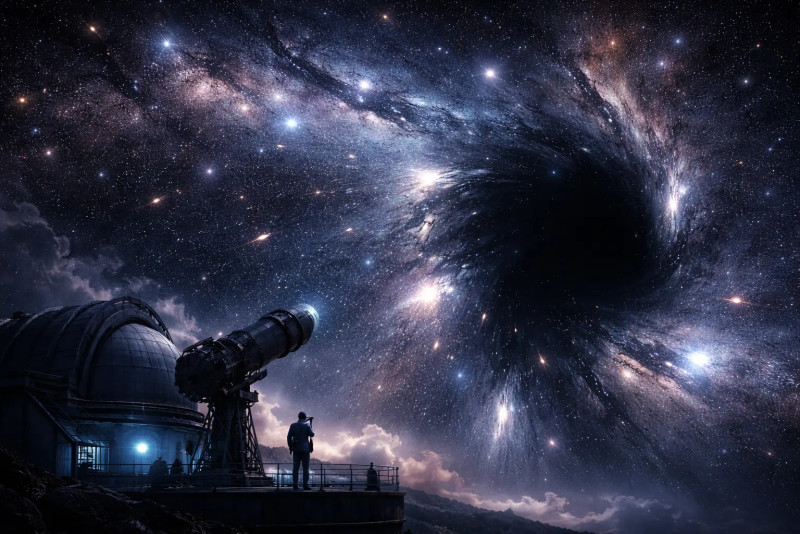
If you’ve ever sat in a bathtub and pulled the plug, you know how the water starts to swirl toward that one point. Some astronomers believe our entire section of the universe is doing something similar.
There’s a phenomenon called "Dark Flow." It’s a mysterious movement where clusters of galaxies seem to be rushing toward a specific point in space at millions of miles per hour. They aren't just expanding with the universe; they are being pulled toward something outside our visible horizon.
If matter is being pulled out of our "bubble" and into something else, it would explain why things seem to be disappearing. We aren't losing mass; we’re losing it to a bigger neighbor we can't see yet.
Could It Be "The Big Rip"?
There’s a scary theory in physics called the Big Rip. It suggests that Dark Energy—the mysterious force pushing the universe apart—is getting stronger. Eventually, it will get so strong that it will rip apart galaxies, then solar systems, then stars, and finally, the atoms in your own body.
Some theorists argue that the "Missing Mass Event" is just the beginning of this process. Tiny "bubbles" of space might be expanding so fast that the matter inside them is being shoved out of our reach forever. It’s like the universe is unzipping itself, one star at a time.

Why This Isn't Just "Science Stuff"
You might be thinking, "Cool, some stars 10,000 light-years away are gone. Why do I care?"
Well, the Missing Mass Event tells us that our "stable" reality might be a bit more fragile than we thought. If matter can disappear—or if the laws of gravity are changing—it changes how we calculate everything from satellite orbits to the future of our own sun.
It also touches on the most human question of all: Is this it? If our universe is leaking matter, where is it going? Could there be "leakage" between parallel universes? Are we part of a giant cosmic ecosystem where matter is recycled into other dimensions?
The Hunt for the "Missing" Half
In the last year, new tools like the Euclid telescope and the Vera C. Rubin Observatory have started scanning the sky with unprecedented detail. They aren't just looking for what’s there; they are looking for the "shadows" of what’s gone.
By measuring how light bends around "nothing," we can map out where this missing mass might be hiding. We’ve found some of it in "filaments"—giant bridges of gas connecting galaxies. But the "vanishing star" problem remains unsolved. It’s the smoking gun that suggests something much more active and strange is happening.

What Happens Next?
The next decade will be the "Era of the Dark." We are finally moving past just looking at bright things like stars and planets. We are starting to look at the gaps in between.
If we find out that matter is truly disappearing, it will be the biggest shake-up to physics since Einstein. We might have to admit that we only see 5% of what’s actually happening, and the other 95% is playing a game we don't have the rules for yet.
Common Questions About the Missing Mass Event
- Are stars really just vanishing? Yes. The VASCO project has identified about 100 "red transients"—objects that appeared in old photographic plates but are totally gone in modern surveys. No supernovas were recorded for these objects.
2. Is the Earth going to disappear?
Probably not anytime soon! The "Missing Mass" usually refers to stuff on a galactic scale or in deep space. Our local neighborhood (the Solar System) is very "sticky" thanks to the Sun's gravity.
3. What is Dark Matter's role in this?
Dark Matter is the "invisible glue" that holds galaxies together. The "Missing Mass Event" is slightly different—it’s about the "normal" matter (atoms) that we should be able to see but can't find, or that seems to be vanishing.
4. Could black holes be responsible?
Black holes eat matter, but they usually leave a "mess"—a bright disk of glowing gas. The vanishing stars we are seeing are leaving no trace at all, which is why it's so weird.
5. Is this related to the "Big Bang"?
Indirectly. By looking at the Big Bang's "echo," we know how much matter should exist. The fact that we can't find it all today is what started this whole mystery.
Disclaimers: This article discusses ongoing astronomical research and theoretical physics. While the "Missing Baryonic Matter" problem is a well-documented scientific challenge, and the VASCO project's findings of disappearing stars are peer-reviewed, the interpretations (such as the "Big Rip" or "Parallel Universe Leakage") remain theoretical and are subjects of active debate in the scientific community.
References and Evidence of Incident:
-
The VASCO Project (Vanishing and Appearing Sources during a Century of Observations): A major study published in The Astronomical Journal investigating 100,000 vanishing candidates. https://vascoproject.org/
-
The "Missing Baryon" Problem - Nature Research: Detailed breakdown of why half the universe's normal matter was missing for decades. https://www.nature.com/articles/d41586-020-01458-z
-
ESA - The Euclid Mission: Europe's new "Dark Universe" detective launched to map the missing mass. https://www.esa.int/Science_Exploration/Space_Science/Euclid
-
The "Dark Flow" Mystery - NASA/Goddard Space Flight Center: Research into galaxy clusters moving toward an unknown point. https://www.nasa.gov/centers/goddard/news/releases/2010/10-023.html
-
Scientific American - The Vanishing Star Mystery: A deep dive into why stars might be blinking out without a supernova. https://www.scientificamerican.com/article/vanishing-stars-could-be-clues-to-aliens-or-new-physics/