.png)
.png)


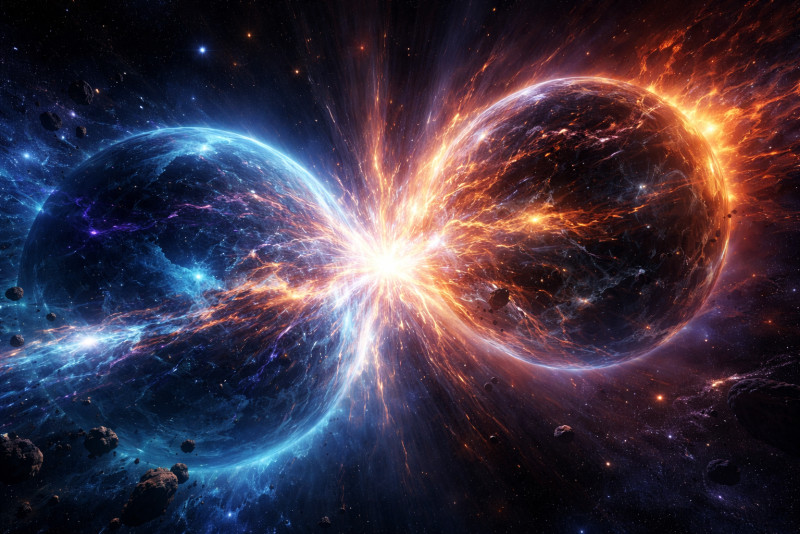
What Happens If Two Different Universes Touch?
A Cosmic Thought That Changes Everything

Imagine waking up one morning and the sky looks… wrong. The stars feel slightly shifted. Physics behaves strangely. Time itself feels uneven. Something enormous has taken place — not inside our universe, but outside it.
What if another universe brushed against ours?
This is not fantasy alone. Some physicists quietly study a possibility called universe collision — the idea that our universe may be only one bubble in a much larger cosmic ocean.
And sometimes, bubbles touch.
If that ever happens, reality may never be the same.
Let’s explore what science suggests could truly occur.
First, What Is Another Universe?

Scientists studying cosmic inflation believe our universe expanded extremely fast right after birth. Some theories suggest inflation never stopped — instead, it created many separate universes, each like a bubble forming in boiling water.
Each universe could have:
-
Different laws of physics
-
Different forces
-
Different particles
-
Different dimensions
-
Or maybe no life at all
Most of these universes would never meet. They drift apart faster than light can travel.
But under rare conditions, two could touch.
What Would Happen at the Moment of Contact?
If two universes made contact, the event would not look like two objects crashing. It would be far stranger.
Scientists describe it as a boundary collision of reality itself.
Possible effects:
1. Shockwaves Through Space-Time
The contact zone could create ripples in space-time stronger than any known cosmic event. These waves might travel across our universe, slightly bending distances and time.
2. Sudden Energy Release
Where universes meet, energy conditions may not match. The difference could produce an enormous burst — possibly stronger than billions of supernovas combined.
3. Physics May Behave Differently
If the other universe has different physical rules, the contact zone could create unstable regions where:
-
Gravity shifts
-
Light bends strangely
-
Matter behaves unpredictably
In simple terms — reality becomes unstable near the boundary.
Could This Destroy Our Universe?
This is the big fear — but not the most likely outcome.
There are several possibilities:
Scenario A — Gentle Contact
The universes touch softly, like soap bubbles. The interaction leaves only faint marks, detectable only through deep-space measurements.
We might notice:
-
Strange patterns in cosmic radiation
-
Slight temperature differences across the universe
-
Unusual gravitational signals
No destruction — only clues.
Scenario B — Localized Distortion
The collision affects only a region of space. Galaxies near the contact zone could experience:
-
Warped gravity
-
Altered time flow
-
Strange cosmic radiation
Faraway observers might see a “scar” in the universe.
Scenario C — Expanding Cosmic Change
If the other universe has lower energy stability, its physics might spread into ours, slowly rewriting reality.
Atoms could behave differently. Forces could shift.
This would be slow — but profound.
Scenario D — Vacuum Collapse (Extreme Case)

Some physicists warn of a rare possibility called vacuum decay.
If the other universe has a more stable energy state, a bubble of new reality could expand at near light speed — replacing our physics completely.
Inside that bubble:
-
Atoms may not exist
-
Stars may not form
-
Life could be impossible
This would not be an explosion — but a silent rewriting of existence.
Important note: There is no evidence this is happening.
Has Something Like This Ever Happened?
There is a mysterious region in space known as the Cold Spot in cosmic background radiation. Some scientists once wondered if it could be a scar from a universe collision.
The idea remains debated. No confirmed proof exists — but the possibility keeps the discussion alive.
Science is still searching.
What Would Humans Notice First?
If a universe collision happened far away, the first signs might be subtle:
-
Strange radiation patterns in deep space
-
Unexpected gravitational waves
-
Tiny temperature differences across the sky
-
Unusual particle behavior in detectors
Ordinary people would not notice immediately. Only advanced instruments would detect early clues.
If the collision occurred closer, effects could include:
-
Light behaving oddly
-
Time distortion in extreme cases
-
Radiation changes
Still, most scenarios would unfold slowly.
Could Another Universe Contain Life?

If another universe touched ours, one fascinating question arises:
Could it contain life?
Possibly — but very unlikely to resemble anything familiar.
Different physics could mean:
-
No chemistry like ours
-
No atoms like ours
-
No stars like ours
If life existed, it might be completely unrecognizable — perhaps not even based on matter as we know it.
This remains speculation, not evidence.
Could We Ever See the Boundary?
If a collision occurred close enough, astronomers might observe:
-
A circular distortion in deep space
-
A region where cosmic radiation behaves differently
-
A moving boundary of altered physics
But distances between universes are beyond ordinary measurement. Detection is extremely difficult.
Why Scientists Take This Idea Seriously
The concept comes from real physics research:
-
Cosmic inflation theory
-
Multiverse models
-
Quantum vacuum energy
-
Cosmic background radiation studies
While unproven, these ideas are explored in serious scientific work — not science fiction.
The Most Fascinating Possibility
If universes can touch, it means:
-
Reality is not alone
-
Our universe may be one of many
-
Physics may not be universal
-
Existence could be far larger than imagined
It changes our place in the cosmos forever.
Important Scientific Disclaimer
-
There is no confirmed evidence of a universe collision.
-
The multiverse remains theoretical.
-
Observations like the Cold Spot are not proven signs of another universe.
-
These scenarios are based on current physics models and hypotheses, not confirmed events.
Science continues searching.
FAQ — Universe Collision Questions
Could two universes really collide?
Some cosmological theories suggest it is possible, but no confirmed observation exists yet.
Would we survive a universe collision?
Most models suggest distant collisions would have little effect. Extreme scenarios could be dangerous known as vacuum decay, but this remains theoretical.
Has NASA detected another universe?
No confirmed detection exists.
What is the Cold Spot in space?
It is a large, unusually cold region in cosmic background radiation. One hypothesis suggested a universe collision, but it is not proven.
Could physics change if universes touched?
If the other universe has different energy stability, local physics could change — but this remains speculative.
Is the multiverse real?
The multiverse is a scientific hypothesis supported by some models, but not yet proven.
Final Thoughts — A Quiet Possibility in a Vast Cosmos
The universe already feels infinite. Yet the idea that other universes may exist beyond ours expands the mystery even further.
If two universes ever touched, it would not just be a cosmic event — it would be a moment that changes the meaning of reality itself.
For now, the sky remains silent.
But science keeps listening.
References & Scientific Sources
-
https://science.nasa.gov/astrophysics/focus-areas/what-powered-the-big-bang
-
https://arxiv.org/abs/astro-ph/0604089 (Cosmic Cold Spot research)
-
https://arxiv.org/abs/0712.0571 (Eternal inflation & multiverse theory)