.png)
.png)
.png)
.png)
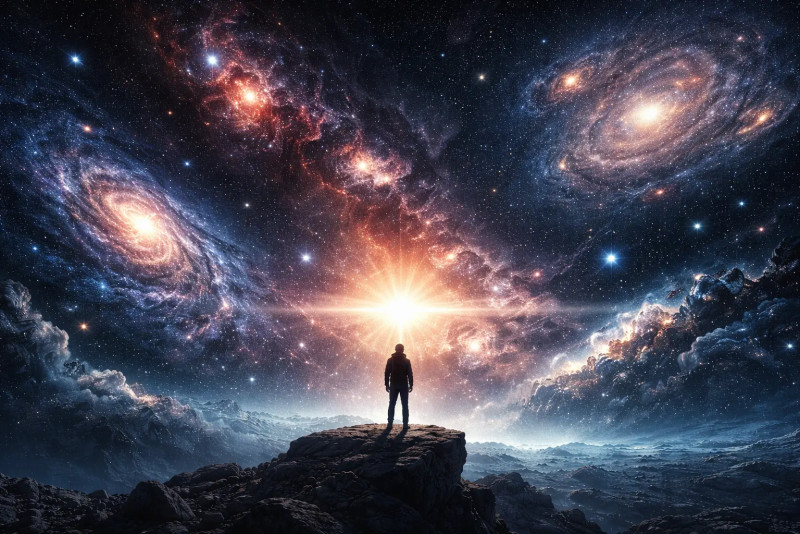
Have you ever found an old photograph in your attic that shouldn't exist? Maybe a picture of your great-grandfather holding a smartphone? That feeling of "wait, this doesn't fit" is exactly what astronomers are feeling right now.

For decades, we’ve been pretty confident about the age of everything. According to the best math we have, the Big Bang happened roughly 13.8 billion years ago. That is the ultimate hard cap. Nothing in our universe should be older than the universe itself. It’s like trying to find a child who was born before their mother.
And yet, our telescopes are starting to find things—stars, galaxies, and weird "ghostly" imprints—that seem to have birthdays predating the beginning of time.

The "Methuselah" Star: The Galactic Rule-Breaker
The first big "uh-oh" moment came from a star located just 190 light-years away from Earth. Formally known as HD 140283, it earned the nickname Methuselah after the biblical figure who lived for 969 years.
When scientists first calculated its age, the number that came back was staggering: 16 billion years.
Wait a minute. If the universe is only 13.8 billion years old, how can a star be 2 billion years older? At first, everyone assumed the math was just wrong. They checked the distance, the brightness, and the oxygen levels of the star. After refining the numbers, they got the age down to about 14.4 billion years.
Still too old.
To make it fit, scientists have to rely on "error bars"—basically saying, "Well, if we're slightly off on the distance and slightly off on the star's composition, it might just barely fit into the 13.8 billion-year window." But it's a tight squeeze, and it leaves a lot of people wondering if our "hard cap" for the universe's age is actually a moving target.

The James Webb "Universe Breakers"
Just as we were getting used to the Methuselah star, the James Webb Space Telescope (JWST) started sending back data that threw a giant wrench into the gears of cosmology.
In 2023 and 2024, Webb spotted galaxies that existed only 500 to 700 million years after the Big Bang. That sounds fine, except these weren't "baby" galaxies. They were massive. They had as many stars as our Milky Way, which took billions of years to grow.
Think of it like walking into a nursery and finding a newborn baby that already has a full beard and a mortgage. It just shouldn't be possible in that timeframe. These "Universe Breakers" suggest that either:
-
Stars form way faster than we ever dreamed.
-
The Universe is much older than 13.8 billion years.
-
Something existed before the Big Bang that gave these galaxies a "head start."

Could Something Have Survived the Big Bang?
This brings us to the most mind-bending theory of all. What if the Big Bang wasn't the beginning of everything, but just a Big Bounce?
Some physicists, including Nobel Prize winner Sir Roger Penrose, believe we live in a cyclic universe. In this model, an old universe collapses in on itself (the Big Crunch) and then explodes outward again (the Big Bang).
Penrose claims to have found "Hawking Points"—weird, swirling circles of radiation in the sky that could be the "bruises" left over from black holes that existed in the universe before ours. If he’s right, then "structures older than the universe" aren't a mistake. They are survivors from a previous age.
Frequently Asked Questions
Is the Big Bang theory being replaced?
Not exactly. Most scientists still believe the Big Bang happened, but we might have to adjust the "when" and "how." We might be looking at a "Big Bounce" or simply a universe that is closer to 26 billion years old rather than 13.8.
How do we even measure a star's age?
It’s a mix of chemistry and brightness. Older stars have very little "metal" (elements heavier than helium) because those elements hadn't been created yet when the star was born. By checking the iron-to-hydrogen ratio, we can tell how early in the cosmic timeline a star appeared.
Could it all just be a measuring error?
Absolutely. Distances in space are incredibly hard to measure. If a star is just a little bit further away than we think, its brightness changes, and its calculated age drops. However, the more "impossible" objects we find, the harder it is to blame it all on simple mistakes.

Why This Matters to You
It’s easy to think of this as just "nerd stuff," but it actually changes how we view our place in existence. If there are structures older than our universe, it means we aren't living in a one-time explosion of luck. We might be part of an infinite, ancient cycle that has been breathing in and out for trillions of years.
The next few years of space discovery are going to be wild. As the James Webb Telescope looks deeper into the "dark ages" of the cosmos, we might have to rewrite every textbook on the shelf.
Source References & Evidence:
Disclaimer: Scientific consensus currently holds the age of the universe at approximately 13.8 billion years. Theories regarding objects "older" than this are based on ongoing research, anomalies in data, and alternative cosmological models that are still being debated in the scientific community.