.png)
.png)
.png)
.png)
The Big Gasp: What Happens if Earth Hits the Mute Button on Oxygen?
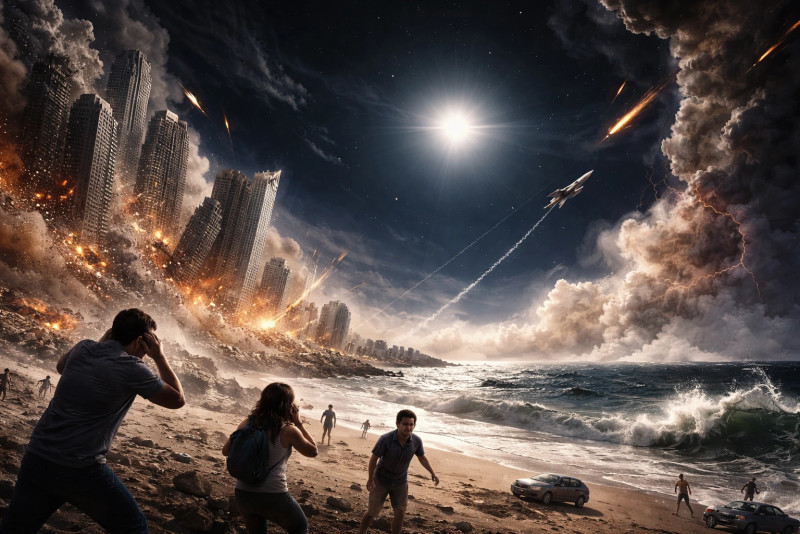
Imagine you’re standing on a beach. The sun is warming your shoulders, the kids are screaming happily in the surf, and you’re about to take a refreshing sip of an iced coffee. You take a breath. It’s effortless. You don’t even think about it.
But then, the universe decides to play a cruel prank. For exactly five seconds—the time it takes to read this sentence—every single molecule of oxygen on Earth simply vanishes.
You might think, "Big deal. I can hold my breath for a minute!"
But this isn't about your lungs. This is about the fundamental chemistry of our reality. If oxygen took a five-second coffee break, the world wouldn't just hold its breath; it would fundamentally come unglued. We’re talking about a transformation so violent and chaotic that "apocalyptic" feels like an understatement.

1. The Sky Turns Pitch Black
The first thing you’d notice isn't a struggle for air—it’s the light. Or rather, the lack of it.
Our sky is blue because of Rayleigh scattering. Sunlight hits the molecules in our atmosphere (mostly nitrogen and oxygen) and scatters the blue light in every direction. Without oxygen to bounce off of, the sky would lose its ability to scatter that light.
In a heartbeat, the bright blue midday sky would turn into a void of pure, abyssal black. You’d still see the sun—a blinding, white-hot disc—but it would be hanging in a midnight sky. It would feel like the world just ended before you even realized you couldn't breathe.
2. Every Concrete Structure Becomes Dust
This is where things get truly terrifying. If you’re inside a building, a bridge, or a tunnel made of concrete, you’re in trouble.
Oxygen isn't just a gas we breathe; it’s a critical binding agent for concrete (specifically CO2). Without oxygen acting as a molecular "glue," concrete loses its structural integrity instantly. Every dam, every skyscraper, and every suburban driveway would lose its cohesion and turn into a fine, gray powder.
If you were driving over the Golden Gate Bridge, the concrete deck would vanish beneath your tires, leaving you falling toward a sea that is undergoing its own nightmare.
3. Your Inner Ear Would Explode
Usually, we talk about "pressure" in terms of deadlines at work. But atmospheric pressure is what keeps your body from popping. Oxygen makes up about 21% of our air pressure. If that 21% disappears in an instant, it’s the equivalent of being teleported from sea level to the top of a high mountain in a fraction of a second.
Your inner ear, which maintains a delicate balance of pressure, wouldn't have time to adapt. For everyone on the planet, their eardrums would likely rupture or explode instantly. The "silence" of the world would be punctuated by the sound of billions of ears popping at once.
4. The Earth’s Crust Crumbles
Forget the buildings for a second; let's talk about the ground beneath your feet. The Earth’s crust is composed of roughly 45% oxygen. It is the literal foundation of the soil, rocks, and minerals we live on.
If that oxygen disappears, the crust loses its density. The ground would effectively liquefy or crumble into a freefall. People wouldn't just be standing on a crumbling street; they would be falling through a disintegrating planet as the very dirt turns into a vacuum of nothingness.
5. Every Internal Combustion Engine Stalls
If you’re in a plane, a car, or a bus, things just got a lot more complicated. Fire requires three things: heat, fuel, and oxygen.
Without oxygen, the tiny explosions inside a car’s engine stop. Every car on the highway would suddenly lose power. Airplanes would stop generating thrust and become massive, metal gliders. While five seconds isn't long enough for a plane to fall out of the sky, the sudden loss of power at 30,000 feet would cause a global aviation crisis the likes of which we’ve never seen.
The Ocean: A Massive Explosion
Water is $H_2O$—two parts hydrogen, one part oxygen. If the oxygen disappears, the ocean becomes a massive cloud of pure hydrogen gas.
Hydrogen is the lightest element, and without the oxygen to hold it down in liquid form, it would immediately expand in volume. The oceans would essentially "boil" and turn into gas instantly. Since hydrogen is also highly flammable, any spark after those five seconds are up would turn the entire atmosphere into a giant fireball.
What Happens When the Oxygen Comes Back?
Let’s say you survive the falling buildings, the exploding ears, and the crumbling crust. At the 5.01-second mark, the oxygen snaps back into existence.
It’s not a "phew" moment. The sudden re-entry of 21% of the atmosphere would create a massive, planet-wide pressure wave. It would be an atmospheric "implosion" that would likely level whatever structures were still miraculously standing.
Summary Table: The 5-Second Chaos
| Element | Immediate Effect | Long-term Consequence |
| The Sky | Turns black instantly. | Loss of UV protection (instant sunburn). |
| Buildings | Concrete turns to dust. | Total collapse of global infrastructure. |
| The Body | Inner ears rupture. | Permanent hearing loss for the population. |
| The Oceans | Turn into hydrogen gas. | Massive expansion and potential explosion. |
| The Crust | Crumbles/disintegrates. | Global earthquakes and "sinkholes." |
Frequently Asked Questions (FAQs)
Could I survive by holding my breath?
Technically, your lungs wouldn't fail in five seconds. However, the lack of air pressure would make it feel like your lungs were being sucked out of your chest. The real danger isn't suffocation; it's the collapsing buildings and exploding eardrums.
Would the sun burn us instantly?
Yes. Oxygen in the form of Ozone ($O_3$) protects us from UV rays. Without it, you would get a severe sunburn in seconds.
Would plants die?
Most plants would survive the five-second gap itself, but because the soil (the crust) would have crumbled away from their roots, they wouldn’t have much to hold onto.
The Verdict: Don't Take That Next Breath for Granted
We often think of the environment as something "out there"—trees, whales, and melting ice caps. But this hypothetical scenario reminds us that we are chemically bonded to our planet. We aren't just living on Earth; we are a functional part of its chemistry.
Five seconds is nothing—it's a yawn, a blink, a pause in a song. But without oxygen, those five seconds are the difference between a thriving civilization and a cloud of dust floating in a black sky.
So, the next time you take a deep breath of crisp morning air, maybe give a little "thank you" to the molecules. They’re doing a lot more than just keeping your lungs moving; they’re holding the entire world together.
References & Scientific Basis
-
Rayleigh Scattering: National Oceanic and Atmospheric Administration (NOAA) - Explaining why the sky is blue.
-
Concrete Composition: Portland Cement Association - Details on the chemical bonds of Calcium Silicate Hydrate.
-
Crust Composition: USGS (U.S. Geological Survey) - Elemental breakdown of the Earth’s lithosphere.
-
Atmospheric Pressure: NASA Earth Data - The role of oxygen in maintaining sea-level pressure.
Disclaimer: This is a hypothetical scientific thought experiment based on the laws of physics and chemistry. No actual oxygen was harmed in the making of this article.