.png)
.png)
.png)
.png)
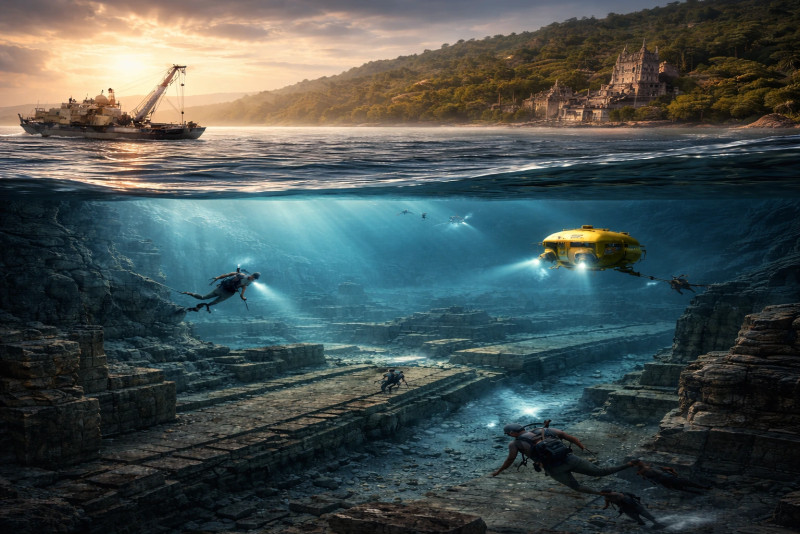
Have you ever wondered if everything we know about the "start" of human history is wrong? For decades, history books have told us that civilization began in Mesopotamia about 6,000 years ago. But in early 2026, a storm of renewed interest has hit a mysterious site off the coast of India that might just push that date back by thousands of years.
Deep beneath the murky, turbulent waters of the Gulf of Khambhat (formerly known as the Gulf of Cambay), lies a sprawling complex of geometric structures that science is still struggling to explain. If the theories are correct, this isn't just a lost city—it’s the "Mother Culture" that birthed the ancient world.

The Discovery: A Routine Scan Turned History-Maker
The story began by complete accident. Researchers from the National Institute of Ocean Technology (NIOT) were conducting a routine pollution survey when their side-scan sonar picked up something that didn't look like nature.
Instead of the jagged, random rocks of the seafloor, they saw massive, five-mile-long stretches of perfectly rectangular foundations, grid-like streets, and structures the size of Olympic swimming pools. Located 120 feet underwater, this submerged "megacity" spans an area larger than many modern towns.

The 9,500-Year-Old Artifacts
What makes the Gulf of Khambhat truly "scary" to mainstream historians is the dating. During dredging operations, scientists recovered more than just sonar images. They pulled up:
-
Pottery shards and beads.
-
Polished stone tools.
-
Human teeth and bones.
-
A piece of fossilized wood.
When that wood was sent for carbon dating, the results came back with a staggering age: nearly 9,500 years old. To put that in perspective, this city would have been thriving while the rest of humanity was still arguably in the Stone Age, thousands of years before the first brick was laid in Egypt or Sumer.

The "Mother Culture" Theory
In February 2026, leading geologists and fringe historians are leaning into the "Mother Culture" hypothesis. The idea is that at the end of the last Ice Age, around 10,000 years ago, sea levels rose rapidly as the glaciers melted.
This advanced coastal civilization—which likely had sophisticated urban planning and maritime trade—was swallowed by the ocean in a matter of decades. The survivors would have fled inland, eventually becoming the ancestors of the famous Indus Valley (Harappan) Civilization. If this is true, the Harappans weren't the "first" advanced culture in India; they were just the refugees of a much older, greater empire.

Why the Controversy?
If the evidence is so strong, why isn't this in every textbook? The Gulf of Khambhat is one of the most difficult places on Earth to explore.
-
Extreme Tides: The gulf has some of the highest and fastest tides in the world, making diving nearly impossible.
-
Zero Visibility: The water is thick with silt and mud from the Narmada and Tapti rivers. You can't even see your hand in front of your face down there.
-
The "Dredging" Debate: Because researchers can't easily dive, they use "grabs" to scoop up items from the floor. Skeptics argue that these items could have been washed into the gulf by ancient rivers, rather than belonging to a submerged city.
However, the 2026 sonar re-mapping has shown that the "buildings" are firmly attached to the bedrock. They aren't random piles of trash; they are foundations.
FAQs: The Mystery of the Sunken City
- Is this the legendary city of Dwarka? While the "Lost City of Dwarka" is located nearby off the coast of Gujarat, the Khambhat site is much older. Dwarka is usually dated to around 3,000–5,000 years ago, while Khambhat is nearly double that age.
2. Could it be a natural rock formation?
Some skeptics say the "rectangles" are just natural fractures in the sandstone. However, the discovery of handmade pottery, hearth material (burnt wood), and wattle-and-daub wall remains suggests a very human presence.
3. Why would they build a city there?
9,500 years ago, the Gulf of Khambhat was dry land. It was a fertile river valley. It would have been a "prime real estate" location for a growing civilization until the sea levels rose at the end of the Pleistocene.
4. Has anyone found "Treasure"?
No "gold" in the traditional sense has been found, but for archaeologists, a 9,500-year-old bead with a hole drilled through it is more valuable than gold—it proves high-level technology and artistry existed far earlier than we thought.
5. What is happening at the site in 2026?
New remote-operated vehicles (ROVs) equipped with 2026-grade sensors are being prepared for a summer expedition to get high-definition 3D scans of the foundations, bypassing the "blindness" caused by the murky water.
The Final Word: Re-Writing the Timeline
The Gulf of Khambhat is a challenge to our pride. It suggests that our ancestors were much smarter and much more organized than we give them credit for. As we move through 2026, the silence from the deep is getting louder. We may soon have to admit that the "cradle of civilization" isn't in a desert in the Middle East, but beneath the waves of the Arabian Sea.
Disclaimer: The Gulf of Khambhat Cultural Complex (GKCC) remains a subject of intense academic debate. While carbon dating of recovered wood suggests an age of 9,500 years, many archaeologists argue that more "in-situ" (on-site) evidence is needed to confirm the age of the structures themselves. This article explores both the scientific findings and the popular theories surrounding the site.
Reference Links & Sources
-
Indy100: Lost Underwater 'City' in India Could Rewrite History (Jan 2026)
-
Times of India: Submerged City Older Than Harappa Discovered in Gulf of Khambhat
-
BBC News: The Lost City That Could Rewrite History (Original Report & Updates)
-
National Institute of Ocean Technology (NIOT): [suspicious link removed]
-
Zee News India: 95-Century-Old City Found Beneath the Ocean