.png)
.png)


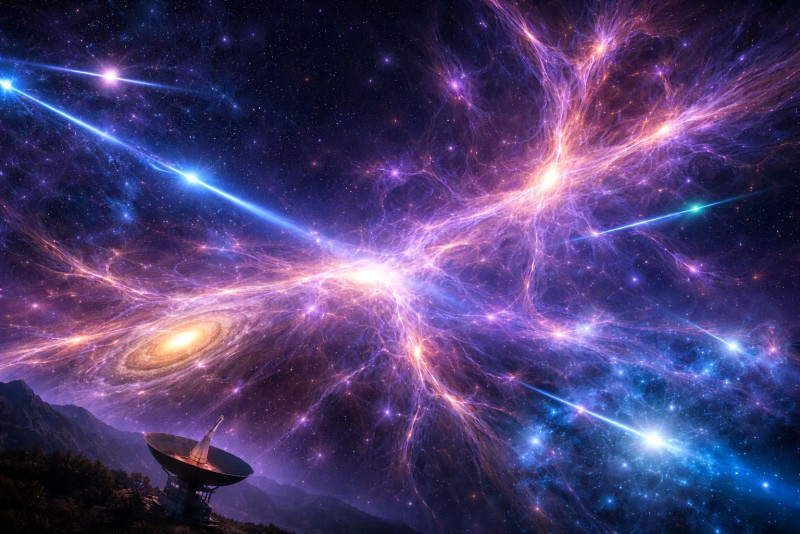
The Missing 5%: Where did half of the universe's visible matter go? Exploring the "Baryonic Void
Have you ever looked at a bank statement and realized a chunk of money was missing, but you have no idea where it went? Astronomers have been having that exact same mini-heart attack for the last thirty years—except instead of twenty bucks, they’re missing half of the entire visible universe.

When we talk about "visible" matter (scientific name: baryonic matter), we’re talking about the stuff that makes up everything you’ve ever touched. Your phone, the air you breathe, the coffee in your mug, and the stars in the sky.
According to the laws of physics and our "baby photos" of the early universe, there should be a specific amount of this stuff. But when we actually count the stars and galaxies, the math doesn't add up. Nearly 50% of the matter that should be there is simply gone. This is the mystery of the Baryonic Void.

The Cosmic Land of Lost Socks
Imagine you’re building a Lego set. You have the instruction manual, which clearly says there are 1,000 bricks in the box. You carefully count them out, but you only find 500. You haven't lost the box, and you haven't even started building yet. The bricks are just... not there.
That is exactly where scientists found themselves. By looking at the Cosmic Microwave Background (the afterglow of the Big Bang), we know exactly how much "normal" matter was created at the start of time. But when we point our telescopes at the modern sky, we only find about half of it.
The universe is essentially a cosmic house where half the furniture has been moved into a secret room we can’t see into.
What is the Baryonic Void?
First, let's clear one thing up: this isn't about Dark Matter. Dark Matter is a whole other beast that makes up about 25% of the universe and doesn't interact with light at all.
The "Missing Baryon Problem" is about normal matter. Protons, neutrons, and electrons. The stuff that should be glowing, reflecting light, or at least blocking it. For decades, it seemed like this matter had just evaporated into a "Baryonic Void."

The Search for the "Lost" Matter
For a long time, scientists thought maybe the matter was just in really dim stars or cold gas clouds we couldn't see. But as our telescopes got better, those spots stayed empty. It wasn't until very recently that we realized the matter wasn't "gone"—it was just spread so thin that it became invisible.
Found: The Warm-Hot Intergalactic Medium (WHIM)
The breakthrough came when astronomers stopped looking inside galaxies and started looking between them. It turns out the missing matter is hiding in the "cosmic web"—vast, wispy bridges of gas that connect galaxies like invisible silk threads.
Scientists call this the WHIM (Warm-Hot Intergalactic Medium).
Why the WHIM is so Hard to Spot:
-
It’s Too Hot: It’s roughly 100,000 to 10 million degrees Celsius. At that temperature, atoms lose their electrons, making them transparent to most telescopes.
-
It’s Too Thin: Imagine taking a single grain of sand and spreading it across an entire football stadium. That’s how diffuse this gas is.
-
The "Shadow" Problem: Because it's so thin, it doesn't emit much light. We can only find it when it casts a "shadow" against a brighter background object, like a distant Quasar.

How Fast Radio Bursts (FRBs) Solved the Mystery
The "smoking gun" for the missing 5% actually came from one of the weirdest phenomena in space: Fast Radio Bursts. These are intense, millisecond-long flashes of radio waves coming from billions of light-years away.
As these radio waves travel toward Earth, they have to pass through all that "missing" gas in the intergalactic void. Every time a wave hits a stray electron in the WHIM, it slows down just a tiny bit.
By measuring how much these signals "smeared" out by the time they reached our sensors, scientists were finally able to "weigh" the empty space between galaxies. The result? The missing matter was exactly where the math said it should be. The "Baryonic Void" wasn't empty; it was just incredibly well-hidden.
The Current Scientific Consensus
As of 2026, the scientific community is largely in agreement. While we haven't mapped every single atom, we now know that about 90% of the missing baryons are likely floating in the intergalactic medium as ionized gas.
Missions like the James Webb Space Telescope (JWST) and the Euclid mission are currently helping to refine these maps. We are moving from a "Missing Matter" problem to a "Mapping Matter" project. We’ve found the lost Lego bricks; now we’re just trying to see how they’re all connected.

FAQs: Your Quick Guide to the Missing 5%
Q: Is the missing matter dangerous?
A: Not at all. It's just very hot, very thin gas floating in the middle of nowhere. It has no effect on our daily lives, other than making astronomers sleep better at night.
Q: Does this explain Dark Matter?
A: No. Dark matter is a different mystery. The "Missing Baryons" are normal atoms. Dark matter is a mysterious substance that we still can't identify.
Q: Can we ever "visit" the missing matter?
A: Probably not. It's located in the vast voids between galaxies. Even at the speed of light, it would take millions of years to reach the nearest "filament" of the WHIM.
Community Question
If the universe is held together by an invisible web of "ghost gas," does that change how you look at the "empty" space between the stars? Do you think there are other things hiding in that void that we haven't found yet?
Tell us your wildest theories in the comments! We love a good cosmic mystery.
Important Disclaimer
This article discusses current astrophysical theories and findings related to the "Missing Baryon Problem." While the detection of matter in the WHIM is a major scientific milestone, research is ongoing, and exact percentages may shift as more data from missions like Euclid and JWST becomes available.