


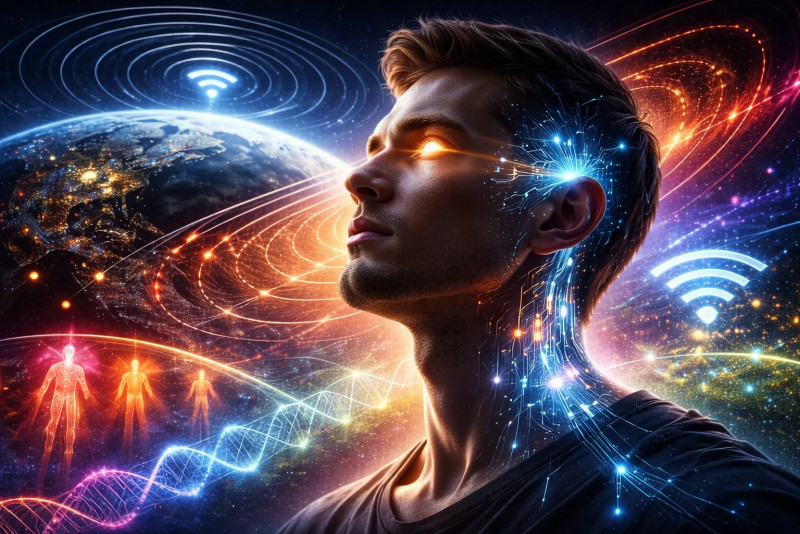
We’ve all been told since kindergarten that humans have five senses: sight, smell, taste, touch, and hearing. But if you’ve ever felt "off-balance" on a spinning ride or known exactly where your hand was in a pitch-black room, you already know that’s not the whole story.
Modern science suggests we actually have up to 33 distinct senses, and thanks to the rapid rise of gene-editing technologies like CRISPR, we might be on the verge of adding even more.

Imagine being able to "feel" the Earth’s magnetic field like a homing pigeon, or seeing heat signatures in the dark like a predator. This isn't just a plot for the next Marvel movie; it's a conversation happening in high-level labs right now.
The World You’re Missing
What if I told you that you are currently standing in a sea of information that you are completely "blind" to?
Right now, invisible magnetic ley lines are crisscrossing your living room. Wi-Fi signals are pulsing through your body. Heat is radiating off your coffee cup in waves of infrared light. To us, the world is silent and dark in these spectrums. But to certain animals—and potentially to a future version of you—this data is as clear as a neon sign.
The question isn't whether these "alien" senses exist. The question is: are you ready to edit your DNA to turn them on?

The "Secret" 33 Senses You Already Have
Before we talk about "upgrading" our bodies, we have to recognize that we are already more "alien" than we think. While Aristotle stuck with five senses, modern neurologists argue we have dozens more.
-
Proprioception: Your "body awareness." It’s how you can touch your nose with your eyes closed.
-
Equilibrioception: Your sense of balance, managed by the tiny canals in your inner ear.
-
Thermoception: The ability to sense heat and cold without actually touching an object.
-
Interoception: Your brain’s internal "dashboard" that tells you when you're hungry, thirsty, or when your heart rate is spiking.
When we talk about the "33 senses," we are breaking down these complex systems into their individual parts. For example, "touch" isn't just one sense; it's a combination of pressure, vibration, itch, and pain receptors working in harmony.

Magnetoreception: Becoming a Human Compass
Have you ever wondered how a bird flies thousands of miles and lands on the exact same branch every year? They have a sense called magnetoreception.
Research has shown that humans actually have a protein in our eyes called cryptochrome that is sensitive to magnetic fields. The problem? It’s "turned off" or vastly underpowered in our species.
How Gene Editing Changes the Game
Biohackers and geneticists are looking at ways to "boost" this protein or introduce "Magneto-genes" (similar to those found in certain bacteria) into human neural pathways.
-
The Goal: To give humans a literal "gut feeling" for North.
-
The Result: You would never need a GPS again. You would "feel" the direction of your home as a subtle tug in your peripheral awareness.

Infrared Vision: Seeing the Invisible
While snakes can "see" heat through pit organs, humans are limited to the visible light spectrum. However, the difference between "visible" and "infrared" is just a matter of wavelength.
In recent lab trials with mice, scientists were able to give them "night vision" by injecting nanoparticles that converted infrared light into visible green light. But gene editing offers a more permanent solution. By tweaking the opsin proteins in our cone cells, we could theoretically expand the range of light our eyes can process.

The "Biohacking" Reality: Is it Safe?
This is where we have to pause and look at the ethics. Gene editing in 2026 has moved from the "wild west" of experimental labs into serious clinical discussions.
The Current Scientific Consensus
Right now, the scientific community is largely focused on using gene editing to restore lost senses—like curing hereditary blindness or deafness—rather than "enhancing" healthy people.
"We are at a crossroads," says a leading researcher in CRISPR medicine. "The technology to add 'extra' senses exists, but the neurological impact of flooding the human brain with new types of data is a total mystery. Could it lead to 'sensory overload' or even psychosis?"
FAQs: Your Future Senses Explained
Q: Can I get gene editing for extra senses today?
A: No. While some "biohackers" use DIY kits, official medical gene editing for enhancement is currently prohibited in almost every country due to safety concerns.
Q: Will these changes be passed down to my children?
A: It depends. If the editing is done on "somatic cells" (like your eyes), it stays with you. If it's done on "germline cells" (embryos), the "alien" sense could become a permanent part of your family tree.
Q: Does it hurt to have your senses edited?
A: Most gene therapies are delivered via a simple injection of a modified virus that "rewrites" the target cells. It’s no more painful than a standard flu shot.
The Community Question
If you could choose one "super-sense" to unlock today, would you pick the ability to see heat (Infrared), the ability to sense the Earth's magnetic field (Magnetoreception), or the ability to hear frequencies far beyond human range?
Let us know in the comments—we want to hear your "What If" scenarios!
Important Disclaimer
This article discusses theoretical and experimental applications of gene editing and sensory science. Genetic modification of humans for enhancement purposes is currently subject to strict legal and ethical regulations worldwide. Always consult with medical professionals regarding genetic health.