.png)
.png)


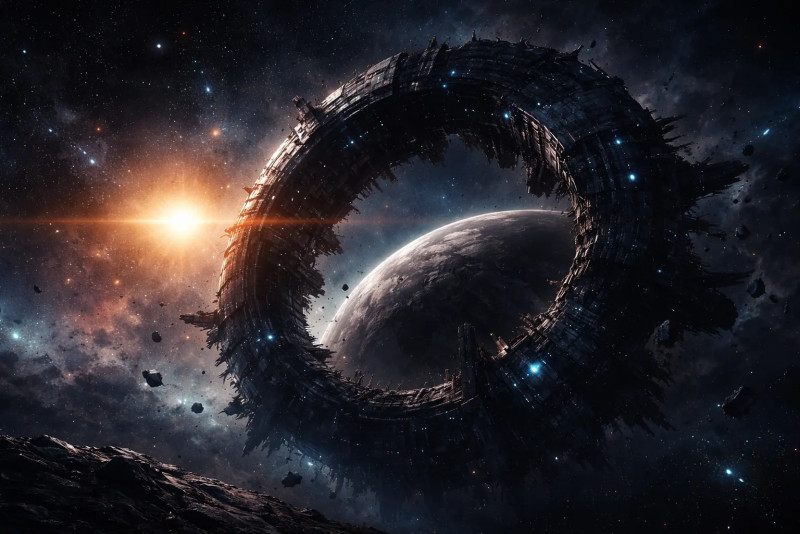
The night sky feels alive. Millions of stars burn across the darkness, and somewhere out there—many believe—intelligent life must exist. For decades, scientists have pointed radio telescopes into the void, hoping to catch a whisper from another world. A signal. A message. A sign we are not alone.
But what if we have been listening for the wrong thing all along?

A growing number of researchers now think the universe may not be silent because life is rare—but because most civilizations do not last. Instead of hearing living voices, we might be staring at the quiet remains of civilizations that once thrived and vanished. Not signals from the living, but technosignatures of the dead.
This idea is both haunting and fascinating. It changes the way we look at space—and maybe the way we think about our own future.

The Shift in Thinking: From Voices to Ruins
For much of modern science, the search for alien life focused on communication. The famous SETI programs scanned the sky for radio signals, hoping to detect intentional transmissions from advanced beings. The expectation was simple: if a civilization becomes intelligent and technological, it will broadcast.
Yet decades passed with no confirmed signal.
The silence forced scientists to rethink their assumptions. What if advanced civilizations are not long-lived? What if technology spreads, rises, and collapses—like ancient empires on Earth?
Instead of searching for active signals, researchers began searching for technosignatures—physical or measurable traces left behind by technology, whether or not the creators still exist.
And suddenly, the universe did not feel empty anymore. It felt quiet… like an abandoned city after midnight.
What Are Technosignatures?
A technosignature is any detectable sign of technology beyond Earth. It does not have to be a message. It could be a structure, energy pattern, or chemical trace that cannot easily be explained by nature alone.
Examples scientists consider include:
-
Artificial light from distant planets
-
Massive structures orbiting stars
-
Industrial pollution in alien atmospheres
-
Unnatural radio bursts or repeating signals
-
Energy patterns from advanced power sources
These clues would not prove living beings are present—but they could reveal that intelligent life once existed.
In other words, we may be looking for footprints… not footsteps.

The Concept of “Ghost Civilizations”
The term “ghost civilizations” refers to intelligent species that rose, built technology, and disappeared—leaving behind silent evidence of their existence.
On Earth, civilizations vanish all the time. Cities sink into jungles. Empires collapse. Ruins remain long after people are gone. Now imagine this happening on a cosmic scale.
A civilization might:
-
Destroy itself through war
-
Exhaust its planet’s resources
-
Be wiped out by cosmic events
-
Transition into non-physical or undetectable forms
-
Or simply fade into silence
If such events are common, the galaxy could be filled with abandoned megastructures, drifting probes, or long-cold machines orbiting distant stars.
We may already be seeing them… without realizing what they are.
The Fermi Paradox Revisited
The famous question—“Where is everybody?”—was asked by physicist Enrico Fermi. If life is common, why have we not found it?
The ghost civilization theory offers a chilling answer: they were here… but they did not survive.
In this view, intelligence may not be rare. Longevity is.
Civilizations might flare into existence, expand, and vanish quickly compared to cosmic time. A technological society lasting even 10,000 years would be a blink in the age of the universe.
This means two civilizations might rarely overlap in time. One could vanish millions of years before another evolves.
The universe would not be empty—just out of sync.

Strange Clues That Sparked the Idea
Several mysterious observations have pushed scientists toward this new direction of thinking.
The “Wow!” Signal (1977)
A powerful radio signal detected for 72 seconds stunned astronomers. It appeared artificial but never repeated. Some speculate it may have been a remnant broadcast or automated transmission from a long-gone civilization.
Tabby’s Star (KIC 8462852)
This star showed unusual dimming patterns that could not be easily explained at first. While natural explanations are now favored, some scientists briefly considered the possibility of alien megastructures—perhaps relics of a past technological society.
Fast Radio Bursts (FRBs)
These powerful bursts of radio waves from deep space remain partly mysterious. While many are natural, some researchers once wondered whether they could be technological or even remnants of extinct civilizations’ energy systems.
None of these prove alien ruins exist. But they widened scientific curiosity and forced researchers to consider broader possibilities.

Searching for Alien Ruins Instead of Alien Voices
If ghost civilizations are real, how would we detect them?
Scientists are exploring new strategies:
1. Looking for Megastructures
Gigantic constructs—like Dyson spheres—could surround stars to harvest energy. Even abandoned, they might leave unusual light patterns detectable from Earth.
2. Atmospheric Archaeology
Future telescopes may detect chemical pollution in exoplanet atmospheres—signs of past industry, even if life is now gone.
3. Dead Probes and Ancient Machines
Some scientists speculate that ancient robotic probes could drift through space long after their creators disappeared. These could be silent witnesses of lost civilizations.
4. Energy Echoes
Advanced technology may leave long-lasting energy signatures, similar to how radio waves from Earth continue traveling outward even today.
In this new search, silence does not mean absence—it may mean extinction.

A Mirror to Humanity
The idea of ghost civilizations is not just about aliens. It reflects us.
Human civilization is young in cosmic terms. Our technology has grown rapidly, but so have risks—climate change, nuclear weapons, artificial intelligence, ecological collapse.
If civilizations tend to destroy themselves, we may be looking at our own possible future written across the stars.
The ruins we seek might be warnings.
Why This Idea Is Gaining Scientific Attention
The ghost civilization concept is not science fiction. It is grounded in probability and observation.
Key reasons scientists consider it seriously:
-
The universe is extremely old—much older than human civilization
-
Stars and planets form and die constantly
-
Intelligence may arise, but survival may be rare
-
Technological traces can outlast civilizations by millions of years
Even on Earth, we still discover ancient structures thousands of years old. Now imagine technology lasting millions of years in space, preserved in vacuum.
The cosmos may be a graveyard of forgotten intelligence.

Skepticism and Scientific Balance
It is important to remain careful. No confirmed technosignature of alien origin has been detected. Most strange observations eventually receive natural explanations.
Scientists approach this topic cautiously, guided by evidence—not imagination.
The ghost civilization theory is a possibility, not a proven reality.
But exploring it expands the way we search—and keeps science open to unexpected discoveries.
The Emotional Weight of a Silent Universe
There is something deeply moving about this idea.
If civilizations rise and fall across the universe, space is not empty—it is filled with stories. Triumph. Collapse. Survival. Loss.
Every star could hold a forgotten history.
The silence may not be loneliness. It may be memory.
Could We One Day Find a Cosmic Ruin?
Future telescopes like advanced space observatories may detect:
-
Artificial structures around distant stars
-
Industrial chemical traces on dead planets
-
Non-natural energy emissions
-
Long-inactive alien probes
Even a single confirmed technosignature would change humanity forever.
It would mean we are not the first.
And perhaps… not the last.
A Quiet Warning from the Stars
If ghost civilizations exist, their silence carries a message: intelligence does not guarantee survival.
Technology is power—but also responsibility.
The real question may not be “Where are they?”
It may be “Will we last longer than they did?”
Disclaimer
This article discusses scientific hypotheses and ongoing research in astrophysics and astrobiology. The concept of “ghost civilizations” is speculative and not confirmed by current scientific evidence. Observations mentioned have natural explanations under study. Readers should view this topic as an exploration of scientific possibilities rather than established fact.
Frequently Asked Questions (FAQs)
What is a technosignature?
- A technosignature is any detectable sign of technology from beyond Earth, such as artificial signals, structures, or chemical traces.
2. Have we found proof of alien civilizations?
No confirmed evidence exists yet. Scientists continue searching using advanced telescopes and instruments.
3. What is a ghost civilization?
It refers to a civilization that once existed but disappeared, leaving behind technological traces.
4. Why might civilizations not last long?
Possible reasons include self-destruction, environmental collapse, cosmic disasters, or technological risks.
5. Could humans leave technosignatures?
Yes. Our radio signals, satellites, and atmospheric changes could be detectable from space in the future.
6. Is the universe really silent?
Not necessarily. It may be full of signals we have not yet learned to recognize.
7. What is the Fermi Paradox?
It asks why we have not detected alien life despite the vast number of stars and planets.
8. Are scientists seriously studying this idea?
Yes. Astrobiology and SETI research now include searching for long-lasting technological traces.
References and Scientific Sources
NASA Technosignatures Research:
https://science.nasa.gov/astrophysics/focus-areas/search-for-technosignatures
SETI Institute – Search for Extraterrestrial Intelligence:
https://www.seti.org
The Fermi Paradox Overview (Scientific American):
https://www.scientificamerican.com/article/the-fermi-paradox/
Tabby’s Star Research Papers (NASA Exoplanet Archive):
https://exoplanetarchive.ipac.caltech.edu
Fast Radio Burst Studies (Nature Astronomy):
https://www.nature.com/subjects/fast-radio-bursts
The Wow! Signal Historical Record (Ohio State University):
http://www.bigear.org/wow.htm
Astrobiology and Civilizational Lifespan Studies (NASA Astrobiology):
https://astrobiology.nasa.gov