.png)
.png)


A World of Invisible Visitors
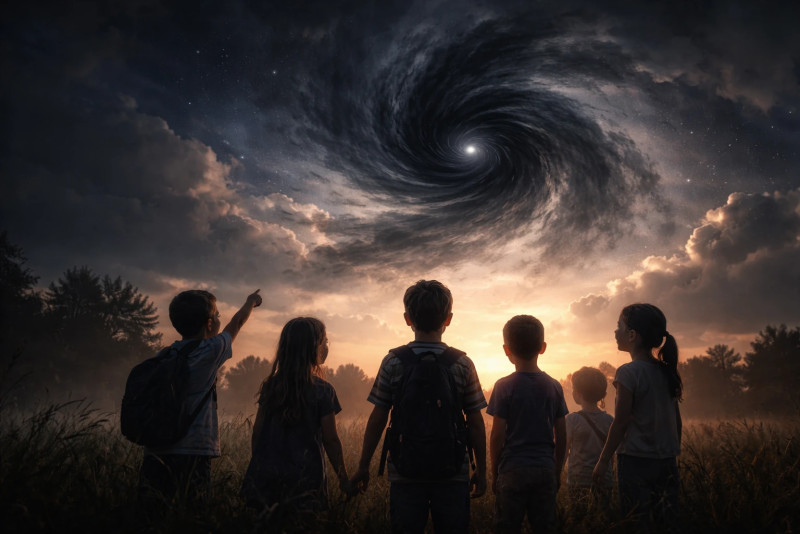
Imagine a playground in a remote village where children suddenly stop playing, their eyes fixed on a point in the sky. They describe a "black spiral" or a "shimmering tear" in the air, humming with a low vibration.
Nearby, their teachers and parents look up and see nothing but a clear, blue sky. They dismiss it as a game, until they see the drawings.
Across different continents, languages, and cultures, children who have never met are sketching the exact same craft. What if the human eye "filters out" reality as we age? What if children aren't imagining things, but are the only ones capable of seeing what is actually there?

The Global Phenomenon of Identical Sketches
From the famous 1994 Ariel School encounter in Zimbabwe to lesser-known cases in Australia and the UK, a chilling pattern emerges. Children often report "black, oily spirals" or "craft that looks like static."
In many of these cases, the children were in isolated areas with zero access to Western UFO media. Yet, their descriptions of the craft’s movement—described as "teleporting" rather than flying—are identical.
The "Filter" Theory: Do Adults Go Blind to the Strange?
As we grow, our brains undergo a process called synaptic pruning. This is the brain’s way of becoming more efficient by "deleting" connections it deems unnecessary for survival in the physical world.
Some theorists suggest that children possess a wider "perceptual bandwidth." They may be seeing light frequencies or "glitches" in the atmosphere that the adult brain has learned to ignore or "auto-correct" into a standard blue sky.

Neurological Reasons Children See UAPs Adults Don't
Why would a young mind be more sensitive to unidentified aerial phenomena (UAP)? Science offers a few compelling, albeit strange, possibilities.
-
Higher Theta Wave Activity: Children spend more time in Theta brainwave states, often associated with deep creativity and "hypnagogic" imagery.
-
Less "Top-Down" Processing: Adults use "top-down" processing, where the brain tells the eyes what they should see based on past experience. Children use "bottom-up" processing, seeing raw data before the brain can censor it.
-
UV Sensitivity: Human lenses yellow with age. Children can often see closer to the ultraviolet spectrum, where some believe "stealth" craft may operate.
The Black Spiral: A Universal Archetype?
The "Black Spiral" is not a typical "flying saucer." Children often describe it as looking like a "hole in the world" or "spinning smoke."
If these aren't physical nuts-and-bolts ships, could they be interdimensional? A spiral is a mathematical constant in our universe (the Fibonacci sequence). If a craft were entering our 3D space from a 4th dimension, it might appear to our eyes as a distorted, spinning vortex.
Mass Hallucination vs. Collective Reality
Skeptics often point to "Mass Sociogenic Illness" (mass hysteria). However, this rarely explains how children in 1960s England and 2020s India—who have no connection—describe the same "humming" sound and "stuttering" movement.

The Current Scientific Consensus
To remain grounded, we must look at what mainstream science says about these events. While science does not officially recognize "invisible UFOs," it does recognize the following:
-
Eidetic Imagery: Children have a much higher rate of "photographic" or "eidetic" memory, which can lead to vivid externalized projections.
-
The Power of Suggestion: In a group setting, one child’s shout of "Look!" can cause others to subconsciously "fill in" the image to fit in with their peers.
-
Atmospheric Optics: Phenomena like "sun dogs," "fata morgana," or "entoptic phenomena" (flashes inside the eye) can be interpreted by a child's imaginative brain as a structured craft.
Despite these explanations, science struggles to account for the high-trace physical evidence (like radiation or flattened grass) often found at the sites where only children saw the craft.

Is the "Socialization" of Science Blinding Us?
By the time we reach adulthood, we are taught that "aliens aren't real" and "ghosts are for stories." We develop a "cognitive shield."
When an adult sees something unexplainable, the brain often labels it as "a bird," "a drone," or "a trick of the light" within milliseconds. We literally refuse to see what we cannot explain. Children have no such shield. To them, the impossible is just another part of the world.
Community Question:
What Did You See?
Did you ever see something in the sky as a child that the adults around you ignored? Or do your children talk about "spinning stars" or "black holes" in the backyard?
Tell us your story in the comments below. We read every one, and your experience might be the key to the next scientific breakthrough!