.png)
.png)


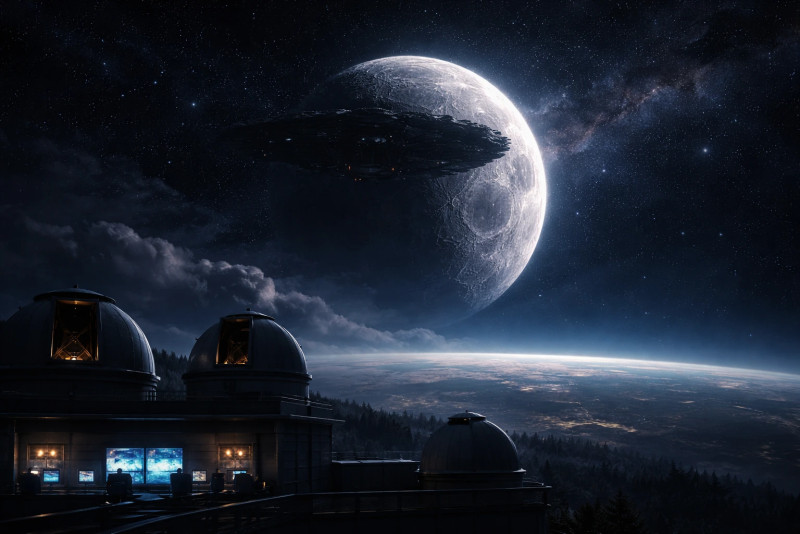
The Moment the Sky Went Quiet
For most of us, space is something we check casually — a photo from a telescope, a meteor shower, maybe a bright planet glowing in the night sky. But imagine this: one ordinary night, sky-watching livestreams across the world suddenly go dark. Telescopes that usually broadcast the Moon and deep space simply stop. The official message appears — “Temporary technical maintenance.”
Nothing unusual, right?

Except the blackout didn’t last minutes. It lasted hours. And during that silence, something strange had already been recorded — something massive, something moving, and something that stopped just beyond the Moon.
This moment is now quietly discussed in astronomy circles as The “Do Not Look Up” Event.
The Discovery That Wasn’t Meant for the Public
According to internal chatter among astronomers and sky-tracking enthusiasts, automated sky-monitoring systems detected a large, slow-moving object approaching the Earth-Moon system. It was not behaving like a comet. It wasn’t moving like a satellite. And it didn’t match any known asteroid path.
What made the situation unusual was not just the object — but what happened next.
Before the public observatory feeds went offline, a faint moving silhouette was reportedly captured near the far side of the Moon. Then, according to tracking logs shared in private astronomy forums, the object slowed… and stopped.
Not orbiting. Not passing by. Just holding position.
Hours later, the livestreams returned. The message stayed simple — routine maintenance completed.
No mention of the object.
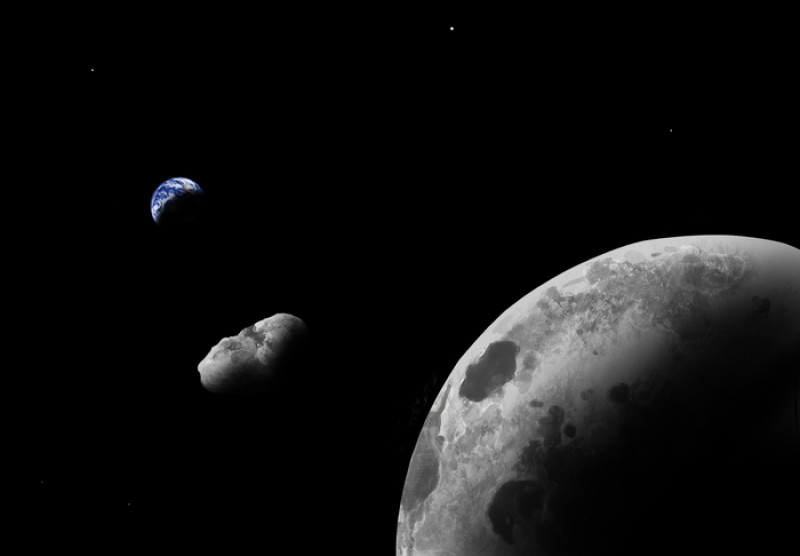
Why This Was Different From Normal Space Events
Space agencies track thousands of objects daily — asteroids, debris, comets, satellites. Most pass quietly without anyone noticing. But this case stood out for several reasons:
-
The object showed controlled deceleration, not natural motion.
-
It appeared to halt beyond lunar orbit, which is unusual for natural bodies.
-
Multiple public telescope feeds shut down at the same time.
-
No official catalog entry was released afterward.
In astronomy, silence can sometimes be louder than announcements.

The Size Question
One detail that caused concern was scale. Amateur analysts who examined early tracking data estimated the object could be several kilometers wide — far larger than typical satellites or space debris.
To put that into perspective:
-
Larger than the International Space Station
-
Comparable to a small asteroid
-
Too large to ignore, yet never publicly acknowledged
If confirmed, such an object would normally trigger global scientific discussion. But this time, nothing.
The “Technical Maintenance” Explanation
Observatories occasionally pause feeds for calibration, weather interference, or equipment checks. That is normal. But experts noted three unusual factors:
-
Multiple observatories paused simultaneously
-
The outage lasted longer than standard recalibration windows
-
The shutdown happened right when tracking systems flagged an unknown object
This timing sparked speculation — coincidence, precaution, or something else?

Could It Have Been a Natural Object?
Scientists who later reviewed orbital behavior proposed several possibilities:
A Dormant Asteroid
Some asteroids move slowly and may appear to pause due to orbital geometry. However, natural bodies do not intentionally slow down relative to Earth in short timeframes.
A Fragment of Space Debris
Large debris sometimes drifts unpredictably. But debris cannot maintain stable position without propulsion.
A Shadow Illusion
Some astronomers suggested the “object” could be a shadow effect caused by light reflection or sensor noise. Yet multiple independent detections weaken this explanation.
In science, uncertainty does not equal confirmation — but it also does not equal dismissal.
The Quiet Reaction Among Scientists
Unlike dramatic movie scenes, real scientists rarely panic. Instead, they observe, record, and verify. After the event, no emergency announcements were made. No asteroid warnings were issued. No collision risk was declared.
But one thing did happen — more telescopes quietly began scanning the Moon’s outer region.
That shift suggested the event, while unexplained, was not entirely ignored.

The Public Speculation Wave
Once skywatch communities noticed the synchronized blackout, discussions spread online. Theories ranged widely:
-
A classified satellite test
-
A misidentified asteroid
-
A sensor glitch
-
A shadow artifact
-
A hidden observation target
Some called it overblown curiosity. Others called it an unexplained anomaly.
What made the conversation persist was simple — no official clarification ever addressed the object directly.
Why Silence Sometimes Happens in Space Science
Space agencies often avoid premature announcements. Reasons include:
-
Avoiding public panic from unverified data
-
Preventing misinformation spread
-
Waiting for confirmed orbital calculations
-
Filtering false detections from sensor noise
Many “mysterious” objects in history later turned out to be harmless natural bodies.
Still, the combination of shutdown timing and object behavior keeps this case unusual.

The Psychological Impact: When the Sky Feels Watched
Humans have always looked upward with curiosity and fear. Events like this trigger deeper questions:
-
What did observatories actually detect?
-
Why stop the feeds at that exact moment?
-
Was it simply caution — or concealment?
-
Are we always told everything about space monitoring?
Even without dramatic answers, uncertainty alone can be unsettling.
The Scientific Possibility That Few Discuss
Some astronomers quietly note a less dramatic explanation:
Certain objects entering Earth-Moon space can become temporarily captured by gravity, creating the illusion of stopping. These are called Transient Lunar Objects or temporarily bound bodies.
However, such objects usually follow predictable patterns — and are openly documented.
Which returns us to the core question: Why no public report?

The Reality Check
As of now:
-
No confirmed threat was recorded
-
No collision risk was identified
-
No official declaration confirmed a controlled object
-
No evidence proves artificial origin
But equally:
-
No full explanation was publicly detailed
-
The shutdown timing remains unusual
-
The object’s motion remains debated
In science, unresolved questions often stay open for years.
FAQ — The “Do Not Look Up” Event
Was a real object detected near the Moon?
Yes, tracking systems reportedly flagged an unknown moving body, though its nature remains unconfirmed.
Did observatories actually shut down?
Yes, multiple public sky livestreams paused temporarily, officially cited as routine maintenance.
Was Earth ever in danger?
No confirmed threat or collision risk was reported.
Could it have been a secret satellite?
Possible, but large classified objects are usually tracked by global radar systems.
Why didn’t scientists explain publicly?
Space agencies often wait for confirmed data before releasing information, especially when observations are uncertain.
Has the object been seen again?
No publicly confirmed repeat observation has been released.

The Lasting Mystery
Most space events eventually receive clear explanations. Comets are named. Asteroids are cataloged. Objects are tracked.
But sometimes, a moment slips through — recorded briefly, questioned quietly, and never fully resolved.
The “Do Not Look Up” Event remains one such moment — not proven, not dismissed, but remembered.
And perhaps the most haunting part is not what was seen… but what wasn’t said.
Disclaimer
This article discusses reported astronomical observations, scientific interpretations, and publicly debated space anomalies. No confirmed extraterrestrial or artificial object has been officially verified in connection with this event. The content is presented for informational and educational purposes based on available discussions and observational reports.
References & Sources
NASA Near-Earth Object Program — https://neo.jpl.nasa.gov
Minor Planet Center Object Tracking — https://minorplanetcenter.net
SETI Institute Publications on Transient Space Signals — https://www.seti.org
European Space Agency Space Situational Awareness — https://www.esa.int
International Astronomical Union Object Classification — https://www.iau.org