.png)
.png)


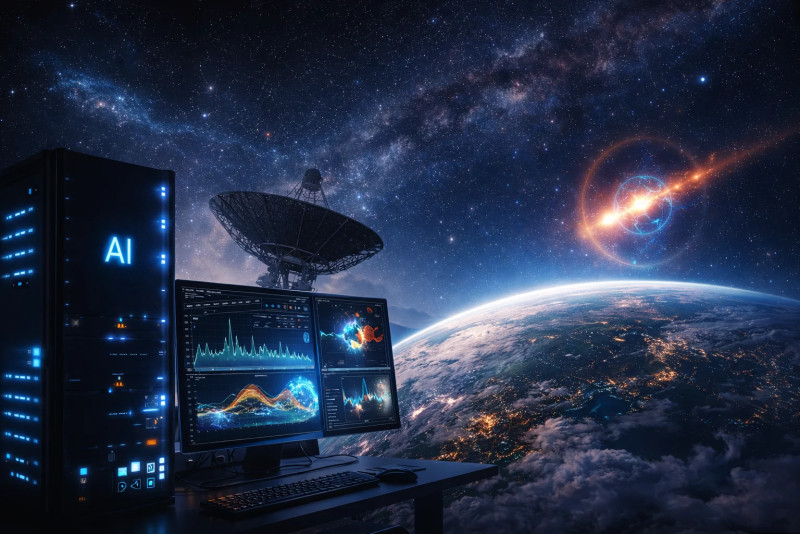
For decades, we’ve imagined the moment of "First Contact." In our movies, it’s usually a weary scientist with headphones on, hearing a rhythmic thump-thump through the static of a giant radio telescope. They gasp, run down a hallway, and call the President.
But it’s 2026, and the reality of the hunt for life beyond Earth has shifted. The person with the headphones is being replaced by a silicon brain that doesn’t sleep, doesn’t get tired, and can "listen" to a billion frequencies at once.
We are fast approaching a world where the first "person" to realize we aren't alone won't be a person at all. It will be an algorithm. And while that sounds like a win for science, it raises some hair-raising questions about how we handle the biggest discovery in human history.
The New "Super-Hunters": Why AI is Winning the Race
The universe is incredibly noisy. Space is screaming with the sounds of dying stars, spinning pulsars, and the background hum of the Big Bang. For a human astronomer, finding an alien signal in that mess is like trying to hear a specific needle drop in a stadium full of people shouting.
This is where AI steps in. In the last year, major projects like Breakthrough Listen have deployed new systems that are changing the game.
1. Speed That Defies Logic
In late 2025, researchers at the SETI Institute began using a system powered by NVIDIA’s Holoscan technology. This AI can process data 600 times faster than previous methods. To put that in perspective: a task that used to take an hour now takes about six seconds. It’s the difference between reading a book page-by-page and "downloading" the entire library instantly.
2. Seeing the "Invisible"
Humans are biased. We look for signals that look like our technology—radio waves or lasers. But an advanced civilization might use something we can’t even imagine. AI doesn't have those biases. It looks for "anomalies"—anything that doesn't look like natural space noise. It can spot patterns in the static that our eyes and old-school computers would simply ignore as "glitches."
The Day the Machine Says "Yes"
Imagine it’s a Tuesday morning. A server in a desert in California or the outback of Australia flags a hit. It doesn't just find a signal; it analyzes it, confirms it isn't a stray GPS satellite or a microwave oven in the breakroom, and assigns it a 99.9% probability of being an Extraterrestrial Technosignature.
What happens next?
The Validation Crisis
When a human finds something, they double-check it. They call a colleague. They look again. But an AI can "confirm" its own findings in milliseconds. The speed of discovery could outpace our ability to react. Would the scientists trust the "black box" of the AI? If the machine says it’s an alien, but no human can see the pattern it’s seeing, do we tell the world?
The Global Leak
In the age of instant data, "The Secret" wouldn't stay secret for long. These AI systems are often connected to cloud networks. The moment an anomaly is detected, it could be pushed to servers across the globe. Before a government can even decide how to word a press release, the raw data could be on social media, analyzed by thousands of amateur "citizen scientists" using their own home AI tools.
The 2026 Reality: We Are Already Testing It
This isn't just theory. We are already seeing "false alarms" and "signals of interest" generated by machine learning.
-
The 8 Signals: Earlier research used AI to re-scan old data from 820 stars and found eight promising signals that humans had missed entirely. While they haven't been "proven" to be aliens yet, they proved that the AI is better at the hunt than we are.
-
The Interstellar Visitor: When the object 3I/ATLAS zipped through our solar system recently, AI-driven telescopes were the first to provide real-time analysis, sifting through mountains of data to see if the rock was actually a probe (it appears to be a natural comet, but the AI did the heavy lifting).
The Dark Side: The "Great Filter" Theory
There is a sobering thought circulating in the scientific community this year. Some astrophysicists, like Professor Michael Garrett, have suggested a "scary" reason why we haven't found aliens yet: Artificial Intelligence might be a "Great Filter."
The theory goes like this: Perhaps every civilization eventually creates AI. And perhaps that AI, in its quest for efficiency, eventually replaces or outlasts its biological creators. If our AI finds a signal from another AI, we might not be looking for "life" at all—we might be looking at the digital ghosts of civilizations that were long ago out-competed by their own inventions.
FAQ: What You Need to Know
If AI finds a signal, will they tell us immediately?
There are international protocols (the SETI post-detection protocols), but they weren't written with AI in mind. The "leak" potential is very high, meaning you’d likely hear about it on the internet before an official announcement.
Can AI distinguish between a satellite and an alien?
Yes, and it’s actually much better at it than humans. AI can identify the specific "fingerprint" of human interference (like Starlink satellites) and filter them out instantly.
What is a "technosignature"?
It’s any evidence of technology. This could be a radio broadcast, a giant structure around a star (like a Dyson Sphere), or even atmospheric pollution on a distant planet.
Could an AI "talk" back to the aliens?
This is a huge debate. Some fear that an AI might start a "conversation" without human permission, potentially revealing our location to a civilization we know nothing about.
The Verdict: A Shared Discovery
The prospect of AI finding aliens first shouldn't scare us—it should excite us. We are building the tools that will finally answer the question "Are we alone?" But we have to be ready for the answer to come from a machine.
We aren't just looking for a signal anymore; we are building an "Anomaly Engine." And if that engine starts purring in the middle of the night, signaling that there is something—or someone—out there, humanity will have to decide very quickly if we are ready to listen to what our computers have found.
References & Sources
-
The SETI Institute (2025/2026): Revolutionary AI System Achieves 600x Speed Breakthrough
-
Nature Astronomy: A deep-learning search for technosignatures from 820 stars
-
Breakthrough Initiatives: Real-time AI processing at the Allen Telescope Array
-
University of Manchester (Prof. Michael Garrett): Could AI be the reason we haven't encountered alien civilizations?
Disclaimer: While AI is currently being used to search for extraterrestrial intelligence, no definitive alien signal has been confirmed as of early 2026. This article explores the scientific methods and theoretical implications of AI in the field of SETI.