.png)
.png)
.png)
.png)
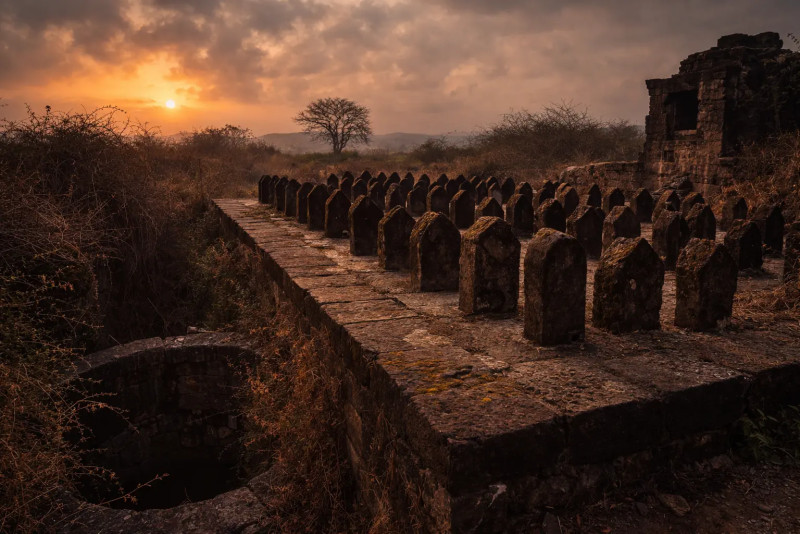
History is often written by the victors, but sometimes, the most chilling stories are carved into the very earth by the victims. If you travel to the outskirts of Vijayapura (formerly Bijapur) in Karnataka, you won’t find just gold-domed palaces or grand forts. Instead, hidden behind thorny bushes and winding, dusty paths, lies a place that feels like it’s holding its breath.

It is called Saath Kabra, which literally translates to "Sixty Graves." But these aren't the graves of fallen soldiers or great kings. These are the graves of 63 women—wives of a single man—who were allegedly murdered in a single afternoon of cold-blooded paranoia.
This is the story of the Silent Massacre, a dark chapter of the 17th century that remains one of India's most haunting mysteries.

The Man Behind the Legend: Afzal Khan
To understand the massacre, we have to look at the man who ordered it: Afzal Khan. He was the powerhouse general of the Adil Shahi dynasty. Standing over six feet tall and built like a mountain, he was a formidable warrior and a master strategist.
In 1659, the Sultan of Bijapur gave Afzal Khan a mission that would define his legacy: stop the rising tide of the Maratha empire led by Chhatrapati Shivaji Maharaj.
But Afzal Khan had a weakness. He wasn't just a soldier; he was deeply superstitious. Before he set out for the fateful meeting at Pratapgarh, he consulted his court astrologers and Sufi peers. Their prediction was devastating: You will not return alive.

The Panic: "If I Can't Have Them, No One Can"
Most men would have focused on their military strategy after hearing such a prophecy. Afzal Khan, however, was consumed by a different kind of dread. He had a harem of 63 beautiful wives. His obsession wasn't just with his life, but with his "possessions."
He became convinced that once he was killed in battle, his wives would be captured by his enemies or, perhaps worse in his eyes, they would remarry. In a fit of jealous madness and extreme possessiveness, he decided that if he couldn't return to them, they wouldn't belong to anyone else.
The legend says he led his wives to a secluded spot near a deep well on the outskirts of the city. One by one, he had them pushed into the dark waters or executed on the spot.
The One Who Ran: A Glimmer of Defiance
As the story goes, the massacre wasn't entirely silent. One of the wives, realizing the horror unfolding, managed to break away. She ran through the fields, desperate to reach the safety of the city.
But Afzal Khan’s guards were ordered to leave no one alive. They chased her down and killed her before she could escape the perimeter. Today, if you count the graves at Saath Kabra, you will find 63. The symmetry of the headstones is perfect, standing in neat rows as a grim reminder of a life cut short by a husband’s insecurity.

The Reality Today: Visiting the "Grave" Destination
Walking into Saath Kabra today is an eerie experience. Unlike the famous Gol Gumbaz which is bustling with tourists, Saath Kabra is isolated.
-
The Atmosphere: The air feels heavy. Because it's not a primary tourist spot, the site is overgrown with wild foliage and thorny scrubs.
-
The Graves: The tombstones are made of dark, weathered stone. They are all identical in size and shape, which is historically unusual. Usually, graves in a family plot vary, but here, the uniformity screams that these people died at the exact same time.
-
The Well: Near the platform of graves lies the silted-up remains of the well. Locals still point to it as the "Bloody Well" where the massacre began.
Fact or Folklore? What Historians Say
While the story of the 63 wives is a staple of local folklore and travelogues, some historians urge caution. There is very little "official" paperwork from the Adil Shahi court that details this massacre.
However, the physical evidence is hard to ignore. Why are there 63 identical female graves in a private, secluded area belonging to Afzal Khan?
Some scholars suggest the deaths might have been a "Jauhar-like" act where the women chose death over capture, while others believe it was a calculated mass execution. Regardless of the "why," the 63 stones stand as proof that something tragic happened on that ground.
FAQs: The Mystery of Saath Kabra
Q: Where exactly is Saath Kabra located?
A: It is situated about 5-6 kilometers from the main city of Vijayapura (Bijapur) in Karnataka, near the village of Torvi. It’s a bit hard to find, so you usually need a local guide or a very patient rickshaw driver.
Q: Can you actually see the graves?
A: Yes, the site is under the protection of the Archaeological Survey of India (ASI). There is a raised masonry platform with seven rows of graves.
Q: Did Afzal Khan really kill them himself?
A: The legend says he either pushed them into a well or ordered his soldiers to execute them. Most versions of the story emphasize that he watched or orchestrated the event to ensure his "possessions" were secured before his death.
Q: Is the site haunted?
A: Many locals believe the area is cursed or haunted by the spirits of the wives. It is rarely visited after sunset due to its isolated location and the heavy "vibe" of the place.
Why Saath Kabra Matters
Saath Kabra is more than just a spooky story for travelers. It’s a reminder of the human cost of ego and superstition. While we celebrate the grand architecture of the past, we often forget the silent victims of the same era.
Those 63 graves represent women whose names have been lost to time, known only by the tragedy that ended their lives. If you ever find yourself in Karnataka, take a detour. Stand among the "Sixty Graves" and give a moment of silence to the 63 voices that were silenced 400 years ago.
Disclaimer: This article is based on historical legends, local folklore, and archaeological observations in Vijayapura. While the site of "Saath Kabra" is a verified historical monument, the specific details of the massacre are based on oral traditions and historical accounts that are still debated by scholars.
References and Sources:
-
Times of India Travel: The Murdered Wives of Adil Shah
-
The New Indian Express (Feb 2026): Mystery Still Shrouds Saath Kabra
-
Henry Cousens (1916): "Bijapur: Its Architectural Remains" (Historical reference to the site).
-
Lakshmi Sharath - Travel Blog: The Story of Saat Kabar