.png)
.png)
.png)
.png)
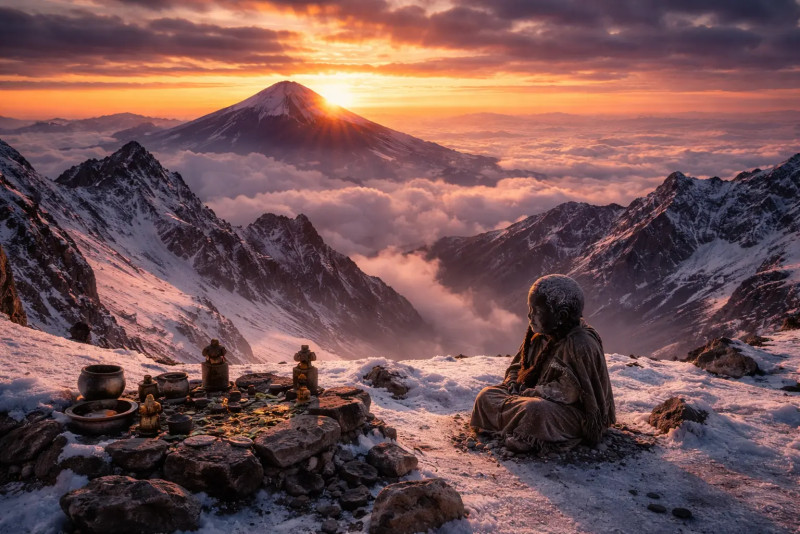
Imagine standing atop a mountain peak so high that the air feels like glass and the clouds are merely carpets beneath your feet. For the Inca Empire, these weren't just scenic viewpoints; they were the doorsteps of the gods. And on these summits, 500 years ago, a ritual took place that still haunts and fascinates us today: the Capacocha.

While the word "sacrifice" often conjures images of chaotic violence, the Inca viewed it differently. It was a cold, calculated, and deeply spiritual "modification" of reality. They believed that by placing a "Frozen Oracle" on the highest peaks, they could bridge the gap between the mortal world and the divine.

The Selection: Choosing the Perfect Messenger
The ritual didn’t start on the mountain. It started in the heart of the empire, often in the capital city of Cusco. The Inca didn’t just pick anyone for this role. The victims—usually children between the ages of 6 and 15—were chosen for their "perfection."
In the eyes of the Inca, these children were the best humanity had to offer. They had to be physically unblemished, beautiful, and often came from noble families. For a parent, having a child chosen for Capacocha was seen as the ultimate honor, a way to elevate their entire family’s status to a semi-divine level.

The Modification: Preparing the Oracle
Archaeologists have discovered something startling in the remains of these children, such as the famous "Maiden of Llullaillaco" found in Argentina. Their bodies weren't just left there; they were "modified" through a year-long process of preparation.
-
Dietary Transformation: Isotope analysis of the mummies' hair shows that about a year before the ritual, their diet changed dramatically. They went from eating common vegetables and potatoes to "elite" foods like maize and dried llama meat (charqui).
-
The Chemical Journey: In the months leading up to the ascent, the children were given steady amounts of coca leaves and chicha (maize alcohol).
-
The Final Sedation: By the time they reached the summit—sometimes after trekking hundreds of miles—the children were in a high-altitude, drug-induced stupor. This wasn't necessarily to be cruel; it was likely to keep them calm, or perhaps to help them survive the grueling climb before the end.

The Frozen Oracle: Why the Peaks?
To the Inca, the mountains (known as Apus) were living deities. They controlled the rain, the sun, and the fertility of the earth. When a drought hit, or a new Emperor took the throne, a Capacocha was performed to "pay" the mountains and ensure the empire’s survival.
The child wasn't just "dying." In the Inca worldview, they were becoming a "Frozen Oracle." Once they succumbed to the cold or were entombed, they were believed to remain "alive" in a different state, acting as an eternal bridge between the people and the gods. Priests would even return to these high-altitude shrines years later to "consult" with the mummies, believing they still held the power to influence the weather and the future.

The Discovery: A Window into 1500
In 1999, when Johan Reinhard and his team reached the 22,000-foot summit of Mount Llullaillaco, they found something that stopped them in their tracks. Because of the extreme cold and dry air, the "Maiden" and two other children looked as if they had fallen asleep just yesterday.
Their skin was soft. Their hair was still perfectly braided. Even the internal organs and blood were preserved. This "natural mummification" is why we call them the Frozen Oracles—they are perhaps the most well-preserved human beings from antiquity ever found.

The Ethical Dilemma
Today, these mummies sit in museums, like the High Mountain Archaeological Museum (MAAM) in Salta, Argentina. This brings up a heavy question: Should we be looking at them?
Many indigenous groups in the Andes consider these sites sacred and believe the children should be left in peace on their mountains. Scientists, on the other hand, argue that the mummies provide vital information about Inca medicine, diet, and history that would otherwise be lost. It’s a delicate balance between honoring a sacred ritual and pursuing historical truth.
FAQs: Understanding Capacocha
Q: Did the children suffer during the ritual?
A: Science suggests that many were heavily sedated with alcohol and coca. While some mummies show signs of a blunt blow to the head (a quick death), others, like the Llullaillaco Maiden, appear to have simply fallen asleep in a drug-induced state and died of hypothermia.
Q: Why was it called a "modification"?
A: Because the Inca weren't just killing a person; they were "modifying" that person’s status from a human to a huaca (a sacred object or spirit). The year-long preparation was designed to transform them into a divine messenger.
Q: Are there more "Frozen Oracles" out there?
A: Highly likely. The Andes have thousands of peaks, many of which were sacred to the Inca. Only a handful of these high-altitude sites have been professionally excavated.
Q: Was this practice common?
A: No. Capacocha was a "state-level" ritual, reserved for the most important events, like the death of a Sapa Inca (Emperor) or extreme natural disasters. It wasn't an everyday occurrence.

The Legacy of the Ice
The Capacocha ritual reminds us that the past is often more complex—and more chilling—than we imagine. These children weren't victims of a random act; they were the center of a massive, imperial effort to control the very elements of nature.
When we look into the face of the "Maiden," we aren't just looking at a mummy. We are looking at the face of someone who was sent on a mission to save her world, 500 years ago, and who is still standing watch over the Andes today.
Disclaimer: This article discusses archaeological findings and historical religious practices involving human sacrifice. The descriptions are intended for educational and historical purposes. The topic involves sensitive cultural heritage; respect for the indigenous communities of the Andes and the sacred nature of these finds is encouraged.
References and Proof of Incident:
-
The Discovery of the Llullaillaco Mummies (National Geographic): The Children of Llullaillaco
-
Scientific Study on Diet and Drugs (PNAS): Archaeological, radiological, and biological evidence offer insight into Inca child sacrifice
-
High Mountain Archaeological Museum (MAAM): Official site of the Llullaillaco Mummies
-
Recent Findings on Deliberate Mummification (2026 Archaeological Reports): Paleoradiology opens new insights into frozen mummified children