.png)
.png)


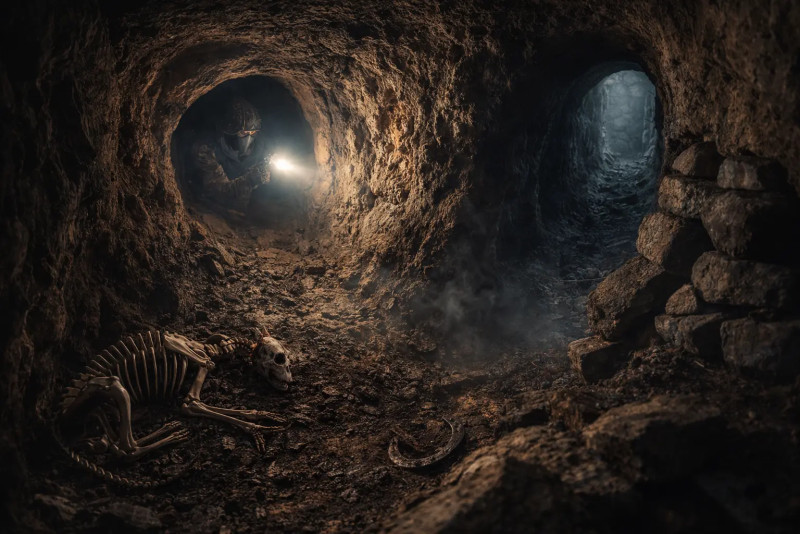
Imagine walking across a peaceful meadow in the heart of Bavaria when the ground suddenly gives way. Beneath your feet isn't a simple sinkhole, but a dark, hand-carved throat of earth leading into a labyrinth so tight you have to squeeze through it like a worm. There is no light, almost no air, and—most terrifyingly—no second exit.
Welcome to the world of the Erdstall.
Across Central Europe, over 2,000 of these mysterious tunnel systems have been found. They aren't mines, they aren't basements, and they certainly aren't meant for living. In early February 2026, a groundbreaking discovery near Reinstedt, Germany, has reignited a global obsession with these "Tunnels of No Return." Archaeologists found a medieval Erdstall dug directly into a 6,000-year-old pagan burial site.
Why would someone in the Middle Ages spend years carving a claustrophobic nightmare beneath a field of ancient graves? The answer might be more unsettling than we ever imagined.

The 2026 Discovery: A Layered Horror
The Reinstedt find is what archaeologists call a "special discovery." While preparing the ground for wind turbines, teams from the State Office for Monument Preservation and Archaeology (LDA) uncovered a trapezoidal ditch used by the Neolithic Baalberge people around 4,000 BC.
But as they dug deeper, they found something that shouldn't be there: a narrow, curving tunnel from the 10th to 13th century slicing right through the ancient monument. Inside this "Erdstall," they found a bizarre collection of items:
-
An iron horseshoe.
-
A complete fox skeleton.
-
Layers of charcoal from a brief, intense fire.
-
Large stones stacked at the entrance, suggesting the tunnel was deliberately sealed from the outside.
The "Soul Hole" Theory: A Spiritual Prison?
For decades, the leading theory was that these were "hideouts" from raiding Hungarians or Vikings. But recent science is poking massive holes in that idea. Erdstalls have only one entrance. If an enemy found you, they wouldn't even need to come in—they could just build a fire at the mouth and turn the tunnel into a communal oven.
This has led to the rise of the "Soul Hole" (Seelengänge) theory. Medieval folklore is thick with stories of "Schratzlloch" (goblin holes) and "Zwergloch" (dwarf holes). Many researchers now believe these tunnels weren't built for the living, but for the dead.
The theory suggests that these passages were physical manifestations of Purgatory. In the Middle Ages, people were terrified that the "unclean" souls of the deceased—or even demons—would wander the surface. By building these tight, winding labyrinths, they may have been creating "traps" or "way-stations" to keep spirits underground and away from the village.

The Physics of the "Schlupf"
One of the most terrifying features of an Erdstall is the Schlupf (slip-hole). These are incredibly narrow vertical or horizontal openings—often only 40cm wide—that connect different levels of the tunnel.
To get through a Schlupf, an adult has to exhale completely, reach their arms forward, and "slither" through the rock. There is no room to turn around. If you get stuck, you stay stuck.
In 2026, some fringe theorists are drawing parallels between these "slip-holes" and the Missing 411 phenomenon, suggesting these tight spaces might have served as ritualistic "portals" where participants attempted to "slough off" bad luck or disease through the physical act of rebirth.
FAQs: Decoding the Erdstall Mystery
- How old are these tunnels really? While most radiocarbon dating of charcoal found inside points to the High Middle Ages (950–1250 AD), some researchers like Dr. Heinrich Kusch argue they are actually Neolithic (5,000+ years old) and were simply reused by medieval people.
2. Could they be animal burrows?
While "paleo-burrows" made by giant sloths exist in South America, Erdstalls show clear marks of iron tools and gabled ceilings, proving they are 100% human-made.
3. Why are they so small?
The average Erdstall is only 1 to 1.25 meters high. Even for medieval people, who were slightly shorter on average, this required a constant, agonizing crouch. This supports the idea that they were meant for symbolic or ritual use rather than daily activity.
4. Are they dangerous to visit?
Extremely. Most Erdstalls are on private property and are prone to sudden flooding or oxygen depletion. Many have been sealed by the government to prevent "cow mishaps" or amateur explorers from becoming permanent residents.
5. What’s with the fox skeleton in the 2026 find?
The fox is a "liminal" animal in folklore—a creature that moves between the worlds of the living and the dead. Its presence, along with the horseshoe, suggests a ritual "closing" of the tunnel to seal whatever (or whoever) was inside.

The Final Verdict: A Mystery That Refuses to Die
The Erdstall Enigma reminds us that the ground beneath our feet is rarely "solid." It is a honeycomb of forgotten fears and ancient intentions. Whether they were hideouts for a terrified peasantry or spiritual prisons for the restless dead, the "Tunnels of No Return" stand as a silent, claustrophobic monument to a time when the boundary between the physical and the supernatural was as thin as a 40cm slip-hole.
Next time you're hiking in the European countryside and you see a strange, oval hole in a hillside—just remember: some doors are meant to stay closed.
Disclaimer: Erdstall exploration is highly dangerous and often illegal without archaeological permits. This article discusses historical and speculative theories. Official scientific consensus leans toward medieval short-term refuge or ritualistic use.
Reference Links & Sources
-
404 Media: Scientists Keep Discovering Mysterious Ancient Tunnels Across Europe (2026)
-
Heritage Daily: Mysterious Tunnel Found in Neolithic Ditch Enclosure near Reinstedt
-
Archaeology Magazine: Medieval Tunnel inside 6,000-year-old Neolithic Ditch in Germany
-
Der Spiegel: Hideouts or Sacred Spaces? Experts Baffled by Underground Chambers
-
Atlas Obscura: The Mystery of Europe's Erdstall Tunnels