


For decades, we thought we had the universe figured out. We had a "Standard Model" of cosmology that acted like a perfect recipe for the cosmos. You take a bit of gravity, a dash of dark matter, and a heavy helping of dark energy, and you get the expanding universe we see today. But lately, that recipe has started to taste a little off.
Astronomers have hit a massive wall. When they measure how fast the universe is growing, they get two different answers depending on where they look. It’s as if you measured your height with a ruler and got 5’10”, but your shadow insisted you were 6’2”. This isn't just a tiny math error; it’s a full-blown "Hubble Crisis" that suggests our understanding of reality might be missing a giant piece of the puzzle.
The Great Cosmic Tug-of-War
To understand why the universe is "breaking," we have to look at the Hubble Constant ($H_0$). This is the number that describes the expansion rate. If the universe were a balloon being blown up, $H_0$ would be the speed at which the rubber is stretching.
For years, we’ve had two main ways to measure this:
-
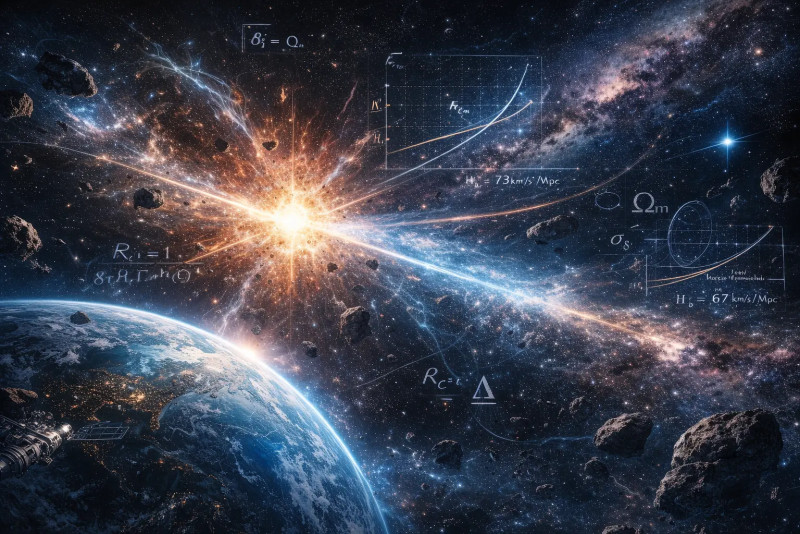
The "Local" Yardstick: Using the James Webb Space Telescope (JWST) and Hubble, scientists look at "standard candles"—exploding stars (supernovae) and pulsating stars (Cepheids) in nearby galaxies. This method says the universe is expanding at roughly 73 km/s/Mpc.
-
The "Ancient" Map: Scientists look at the Cosmic Microwave Background (CMB), which is essentially the "afterglow" of the Big Bang from 13.8 billion years ago. By mapping this ancient light, they predict the universe should be expanding at about 67 km/s/Mpc.
That 8% difference is the "Hubble Tension." In the world of physics, 8% is a canyon. It’s the difference between a universe we understand and a universe that requires a brand-new set of laws.
Dark Energy: The Invisible Gas Pedal
So, what is pushing the universe apart? The leading suspect is Dark Energy. It makes up about 68% of everything in existence, yet we can't see it, touch it, or measure it directly. We only know it’s there because we can see it pushing galaxies away from each other at ever-increasing speeds.
Until recently, we thought Dark Energy was a "constant"—a steady force that never changed. But new data from the Dark Energy Spectroscopic Instrument (DESI) in early 2026 has sent shockwaves through the community. The data suggests that Dark Energy might actually be evolving or even weakening over time.
"If dark energy isn't a constant, it changes everything," says one researcher. "It means the 'gas pedal' of the universe has a mind of its own."
New Contenders: Magnetic Fields and Early Dark Energy
If Dark Energy isn't the only culprit, what else could be "kicking" the universe into high gear?
-
Primordial Magnetic Fields: Recent studies from January 2026 suggest that tiny magnetic fields created at the dawn of time might have messed with how atoms formed. This would change our "Ancient Map" readings and potentially bridge the gap between the two expansion speeds.
-
Early Dark Energy: Some theorists propose a "wild" version of dark energy that existed only for a moment right after the Big Bang, giving the universe an extra push before disappearing.
-
New Physics: Some radical theories suggest that gravity itself might behave differently across massive cosmic distances than it does here on Earth.
What Happens Next? The Big Crunch or The Big Freeze?
The speed of expansion determines how the story ends. If the universe keeps accelerating, we are headed for the "Big Freeze," where galaxies fly so far apart they become invisible to each other, and the universe fades into a cold, dark void.
However, some physicists, like Henry Tye from Cornell, have recently proposed a different ending. Using new 2025 data, they suggest the expansion might eventually stop and reverse, leading to a "Big Crunch" about 20 billion years from now. In this scenario, the universe snaps back like a rubber band, collapsing into a single point again.
Why This Matters to You
It’s easy to feel like this is just "science talk," but the Hubble Tension represents the frontier of human knowledge. Solving this doesn't just give us a better number; it tells us what the universe is made of and where we are going. We are living through a "Copernican moment" where the old maps no longer work, and a new one is being drawn in real-time.
FAQ: Breaking Down the Cosmic Mystery
1. Is the universe really "breaking"?
Not literally, but our theories about it are. The fact that our two best ways of measuring expansion don't match means there is something fundamental about space-time that we don't understand yet.
2. What is the Hubble Constant?
It is the unit of measurement for the expansion of the universe. It tells us how much faster a galaxy is moving away from us for every extra million light-years of distance.
3. Does this affect life on Earth?
No. On a local scale—like our solar system—gravity is much stronger than expansion. The Earth isn't getting further from the Sun, and you aren't getting further from your couch. This only happens on the scale of massive gaps between galaxies.
4. Can we see Dark Energy?
No. It doesn't interact with light. We only see its effects on the movement of galaxies, acting like a sort of "anti-gravity."
5. What is the JWST's role in this?
The James Webb Space Telescope has the resolution to see through cosmic dust and pick out individual stars in distant galaxies. By doing this, it has confirmed that the "local" measurements were not a mistake, making the Hubble Tension even more certain.
References & Sources
-
NASA: Webb and Hubble Telescopes Affirm Universe Expansion Rate
-
UChicago News: New Measure of Expansion Suggests Resolution of Conflict
-
Simon Fraser University: Magnetic Fields and the Hubble Tension Mystery
-
Cornell Chronicle: Physicist Predicts the Big Crunch Using New Dark Energy Data
-
UK Research and Innovation (UKRI): Dark Energy Survey Releases Most Detailed Analysis of Expanding Universe
Disclaimer: The field of cosmology is rapidly evolving. The theories and data points mentioned, including specific findings from 2025 and 2026, are part of ongoing peer-reviewed debates and may be refined as more data from instruments like DESI and the Vera C. Rubin Observatory becomes available.