.png)
.png)
.png)
.png)
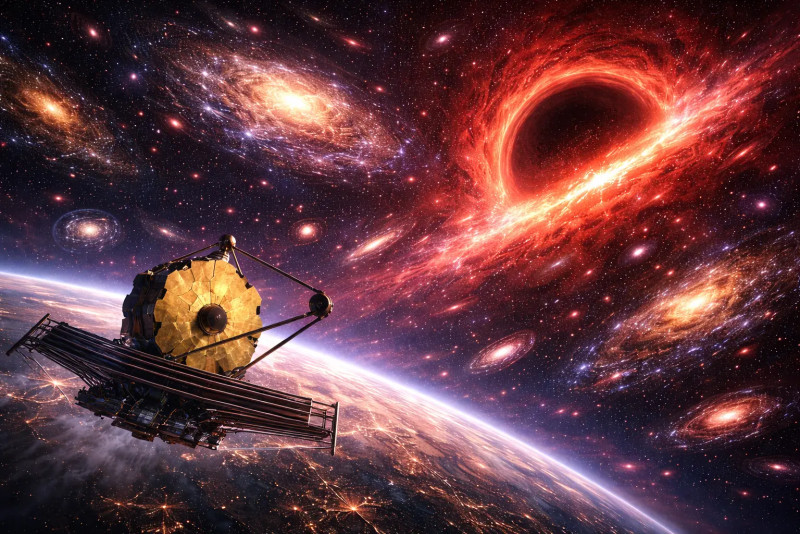
The James Webb Discovery That Is Scaring Scientists: Is Our History a Lie?
Space is usually beautiful, but sometimes it’s just plain haunting. When NASA launched the James Webb Space Telescope (JWST), we expected to see the "First Light"—the very beginning of everything. We wanted answers. Instead, what we found has sent a literal chill through the scientific community.
The most frightening discovery isn't an alien fleet or a planet-killing asteroid. It’s something much deeper: the realization that our entire timeline of the universe might be wrong. For decades, we thought we understood how the cosmos grew. Now, Webb is showing us "impossible" monsters lurking in the dark, and they shouldn't even exist.
The "Universe Breakers"
In 2024 and early 2025, Webb peered back to the "Cosmic Dawn," just a few hundred million years after the Big Bang. According to the rulebook of physics, this era should have been a quiet nursery—tiny, dim, baby galaxies slowly pulling themselves together.
Instead, Webb found JADES-GS-z14-0 and a group of objects nicknamed "The Universe Breakers." These are massive, mature galaxies that are 100 times more luminous than anyone predicted. They aren't just big; they are chemically "mature," filled with heavy elements like oxygen and nitrogen that take generations of stars to create.
Imagine finding a fully built, bustling skyscraper in a photo of a construction site from day one. It shouldn't be there. Scientists are now grappling with a terrifying possibility: The Big Bang theory as we know it is missing a massive, fundamental piece.
The Horror of the "Little Red Dots"
While the big galaxies are confusing, the "Little Red Dots" are where things get truly spooky. Webb has spotted thousands of these tiny, blood-red pinpricks of light in the early universe. At first, astronomers thought they were just dusty galaxies.
They were wrong.
Recent data suggests these dots are actually supermassive black holes that are growing at a rate that defies the laws of physics. They are "overmassive"—meaning the black hole is far larger than the galaxy it lives in. In our modern universe, a black hole is usually a tiny fraction of its galaxy's mass. In the early universe, these monsters seem to be eating everything in sight before the galaxies even have a chance to grow. It’s like finding a giant heart beating inside a body that hasn't even formed limbs yet.
Why This Is Actually Frightening
If these discoveries are confirmed, it means we don't know the age of the universe. It means "Dark Matter" might be doing things we can't even calculate. It means the "Cosmic Dark Ages"—the period we thought was a pitch-black void—was actually a chaotic, violent explosion of star-birth and black-hole feeding frenzies that we didn't see coming.
For a scientist, there is nothing scarier than looking at the most advanced data in human history and realizing your textbooks might be fiction.
FAQs: The Questions Keeping Astronomers Awake
- Is the Big Bang debunked? Not exactly. The Big Bang still happened, but the timeline is under fire. It's like knowing a race started, but realizing the runners are somehow at the finish line before the starting gun even finished smoking.
2. Could these "impossible" galaxies just be an illusion?
Some scientists hope so. There’s a theory they could be "Dark Stars"—massive clouds of hydrogen powered by dark matter rather than nuclear fusion. If that’s true, it’s arguably even weirder than the galaxies themselves.
3. Does this mean the universe is older than 13.8 billion years?
Some researchers, like those at the University of Ottawa, have proposed the universe could be twice as old—closer to 26 billion years. This would give those "mature" galaxies the time they need to grow, but it would completely break our current maps of space-time.
4. What are the "Little Red Dots"?
They appear to be extremely dense, rapidly growing black holes. Their sheer abundance suggests the early universe was far more crowded and violent than we ever imagined.
Final Thoughts: The Mystery Deepens
We used to think we were the masters of cosmic history. We had the charts, the dates, and the math. But James Webb has pulled back the curtain on a reality that is far more complex and intimidating than we bargained for. As we head into 2026, the question isn't just "What will Webb find next?" but "Are we ready for the answer?"
Disclaimer: This article discusses ongoing astronomical research and peer-reviewed observations from the James Webb Space Telescope. Cosmological theories are subject to change as more data is analyzed.
References and Sources
-
NASA: Webb Pushes Boundaries of Observable Universe Closer to Big Bang
-
Nature: A signature of cosmic-ray increase in AD 774–775 (Contextual study on early universe anomalies)
-
ESA: Webb spots greedy supermassive black hole in early Universe
-
The Astrophysical Journal: Spectroscopic confirmation of JADES-GS-z14-0 at redshift 14
-
Space.com: Is our universe trapped inside a black hole?