


A Night Brighter Than Day
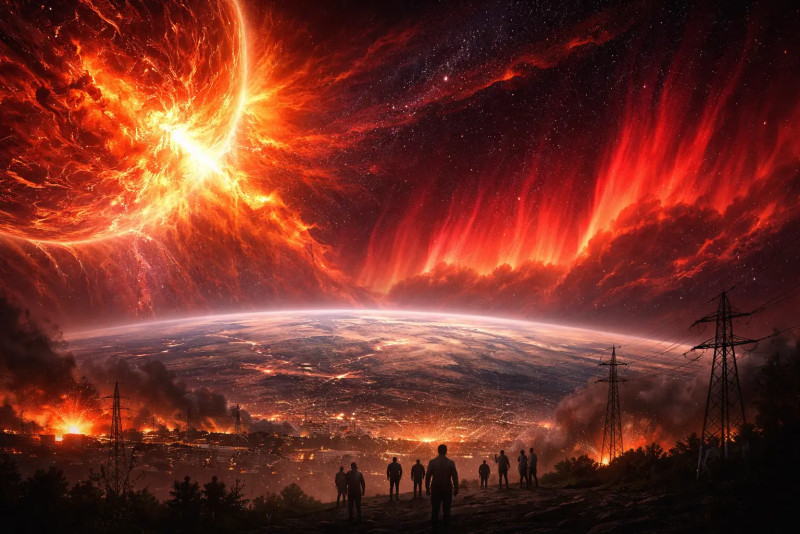
Imagine waking up to a sky so bright it looks like high noon at midnight. The horizon glows red. The air hums with invisible energy. Your electronics aren't just glitching — they’re literally smoking.
This isn’t science fiction.
It already happened.
While we often fear asteroids, comets, or black holes, the real cosmic monster may be much closer — our own Sun.
The most terrifying radiation event ever recorded was not a distant explosion in deep space. It was a massive solar super-storm that slammed into Earth with unimaginable force. Scientists call it the Miyake Event of 774 AD, and it was so powerful it changed the chemistry of our planet itself.

The Mystery Hidden Inside Trees
For over a thousand years, nobody knew this event had occurred.
Ancient chronicles described strange signs — glowing red crosses in the sky, blood-colored auroras, and unusual celestial lights — but their true meaning was lost to time.
Then, in 2012, Japanese physicist Fusa Miyake made a shocking discovery while studying ancient cedar tree rings.
Tree rings act like natural time capsules. Each ring stores chemical traces from the year it formed. Miyake found a sudden and massive spike in Carbon-14, a radioactive isotope produced when high-energy cosmic rays strike Earth’s atmosphere.
The spike was 20 times higher than normal variation — something never seen before.
It was as if Earth had been blasted by a cosmic radiation wave so intense it permanently altered atmospheric chemistry.

What Actually Happened?
Scientists believe a Miyake Event is caused by an extreme solar proton storm — a burst of high-energy particles launched from the Sun at near-light speed.
If such an event struck today, the consequences would be catastrophic.
Satellite Death
Thousands of satellites would fail instantly. GPS, communications, navigation, banking networks, weather systems — all gone within hours.
The Dark Ages 2.0
Power grids act like giant antennas during solar storms. A Miyake-level event could destroy transformers across continents, leaving billions without electricity for months or even years.
Radiation Exposure
While Earth’s atmosphere shields people on the ground, airline passengers and crew at high altitude would receive dangerous radiation doses — comparable to hundreds of X-rays in a single flight.
Modern civilization, built on fragile electronics, would struggle to function.

The Carrington Event vs The Miyake Event
You may have heard of the Carrington Event of 1859, the largest solar storm in recorded human history.
Telegraph systems sparked and caught fire. Auroras were seen near the equator. People in the Caribbean reportedly read newspapers at night under glowing skies.
But here’s the terrifying truth:
The Miyake Event was about ten times stronger.
If Carrington was a powerful flood, Miyake was a planet-wide radiation tsunami.

Could It Happen Again?
The short answer: Yes.
Evidence from tree rings shows similar extreme radiation spikes in:
-
Around 660 BC
-
774 AD (Miyake Event)
-
993 AD
Research suggests these super-storms may occur roughly once every 1,000 years.
And since the last one was over a millennium ago…
Statistically, Earth may be overdue.
FAQs — The Cosmic Threat Explained
Can cosmic radiation kill instantly?
On Earth’s surface, no. The atmosphere and magnetic field shield us. But astronauts, airline crews, and high-altitude flights could face dangerous radiation exposure.
How would we know it’s happening?
Massive red auroras would appear across the sky, even near the equator. Soon after, satellites, power, internet, and phones would begin failing globally.
Can we stop it?
No — we cannot stop the Sun. But scientists are developing early warning systems and strengthening infrastructure to reduce damage.
Is this related to climate change?
No. Miyake Events are purely solar phenomena and unrelated to human activity.
Final Thoughts: The Fragility of Civilization
The universe is not quiet. It is filled with invisible storms, radiation waves, and cosmic violence.
The Miyake Event is a reminder that modern civilization — with all its satellites, power grids, and digital networks — rests on a delicate foundation beneath a volatile star.
Right now, we live in a calm period of solar history.
But somewhere on the surface of the Sun, the next great storm may already be forming.
And when it comes…
The sky may turn to fire once again.