.png)
.png)
.png)
.png)

For thousands of years, the Giza Plateau has stood as one of humanity’s greatest mysteries. The Great Pyramid of Khufu — massive, silent, and mathematically precise — has long been believed to be a royal tomb. A monument to a Pharaoh. A masterpiece of ancient engineering.
But recent discoveries suggest something far more intriguing.
What if the most important part of the pyramid… is not inside the pyramid at all?

New high-resolution underground scans have detected strange structures hidden deep beneath the bedrock of Giza — shapes that do not match natural geology, and voids that do not match known Egyptian construction.
Some researchers are calling it an anomaly. Others, more dramatically, call it a signal from the past.
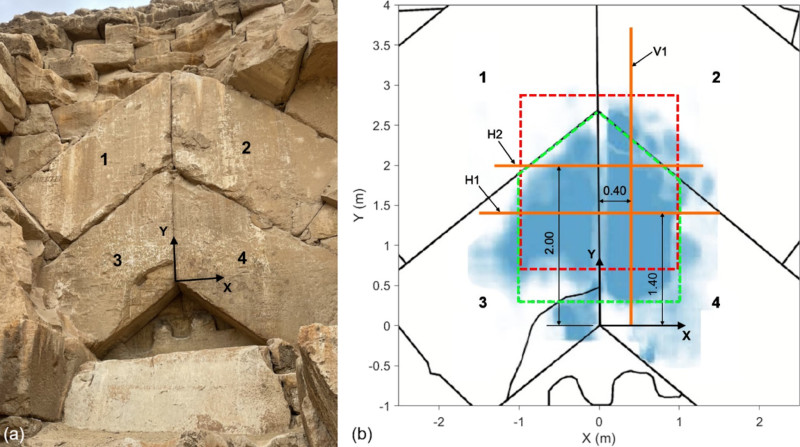
The L-Shaped Structure: What the Scans Revealed
In recent geophysical surveys conducted near the Western Cemetery of Giza, scientists used Ground-Penetrating Radar (GPR) and Electrical Resistivity Tomography (ERT) to look beneath the surface without excavation.
The results surprised researchers.
Instead of random geological formations, the scans revealed a distinct L-shaped structure, buried roughly 6 feet below the surface and filled with sand. Even more intriguing, the formation appears to cover a deeper anomaly located nearly 10 meters underground.

This deeper structure shows empty void-like spaces that do not resemble known tombs, shafts, or burial chambers.
Why this matters:
-
The geometry appears too precise to be natural
-
The depth suggests deliberate concealment
-
The voids do not match documented pyramid-era architecture
For a site studied for over a century, discovering new underground structures is extraordinary.

The “Signal”: Energy, Resonance, or Misinterpretation?
Another part of the mystery involves unusual electromagnetic readings recorded near the plateau.
Previous research has shown that the Great Pyramid can concentrate electromagnetic energy within certain internal chambers under specific conditions. This phenomenon is linked to the pyramid’s geometry and the mineral composition of its stone — particularly quartz-rich granite.
Some independent researchers propose that the underground anomaly could produce faint electromagnetic effects caused by piezoelectric reactions — where quartz crystals generate electric charge under pressure.
In simple terms, the structure may not be transmitting a signal — but it could be interacting with Earth’s natural vibrations.
At present, there is no confirmed artificial transmission, but the readings remain unexplained.

A Deeper Question: Was Something There Before the Pyramids?
One of the most debated theories surrounding Giza is whether the pyramids were built on top of an older structure.
Some geological studies of the Great Sphinx suggest patterns of water erosion that could date back far earlier than traditionally accepted timelines. While this remains controversial, it has led some researchers to question whether the plateau once hosted an earlier complex.
If the underground anomaly proves artificial, possibilities could include:
-
A hidden archive or sealed chamber
-
Structural foundations from an earlier construction phase
-
A ceremonial or unknown subterranean complex
There is currently no verified evidence supporting advanced ancient technology or lost civilizations — but the unknown structure keeps the debate alive.

Why Excavation Has Not Begun
Many ask why researchers have not simply dug down to reveal the structure.
The answer is preservation.
The Giza Plateau is one of the most sensitive archaeological sites in the world. Excavating deep bedrock beneath a 4,500-year-old monument carries serious risk. Even small vibrations could damage ancient stonework or destabilize surrounding areas.
Instead, scientists rely on non-invasive scanning technologies, including:
-
Ground-penetrating radar
-
Electrical resistivity imaging
-
Muon tomography (cosmic-ray scanning used to detect hidden voids in stone)
These methods allow researchers to “see” underground without physical excavation.

What Muon Scanning Has Already Proven
Muon tomography, used by the international ScanPyramids Project, has previously revealed a massive hidden void inside the Great Pyramid — one of the most important discoveries in modern pyramid research.
This proves that hidden spaces still exist within Giza — even after centuries of study.
The newly detected underground anomaly may represent another unknown structure — but further confirmation is required.
The Real Scientific Position
At present:
-
The underground anomaly is confirmed by geophysical scans
-
Its purpose remains unknown
-
No excavation has yet taken place
-
No confirmed artificial “signal” has been proven
-
No verified evidence of lost technology exists
In science, mystery does not equal proof — but it does invite investigation.

Why This Discovery Matters
The Giza Plateau is one of the most studied places on Earth — yet discoveries continue to emerge.
Finding unexplained underground structures in such a well-examined site suggests one powerful truth:
Humanity still does not fully understand ancient history.
Whether the anomaly turns out to be a forgotten chamber, a natural void, or something entirely unexpected — the mystery beneath Giza is far from solved.
Disclaimer
This article is based on documented geophysical surveys, peer-reviewed research, and verified archaeological methods. Interpretations involving lost civilizations, hidden archives, or ancient technology are speculative and not confirmed by mainstream science. The underground anomaly itself is real, but its function remains unknown.
FAQs
What exactly was discovered beneath Giza?
Geophysical scans detected a shallow L-shaped structure and a deeper underground anomaly near the Western Cemetery of the Giza Plateau.
Is there really a “signal” coming from the pyramids?
There is no confirmed artificial signal. Some readings may relate to natural electromagnetic effects linked to mineral composition and structural geometry.
Has anyone entered the underground structure?
No. Findings are based on non-invasive scanning technologies. Excavation has not yet occurred.
Could this be the legendary Hall of Records?
There is no scientific confirmation of this. The theory remains speculative.
Why is excavation so slow?
Preservation of the site is critical. Excavation beneath ancient monuments is extremely risky and requires careful planning and approval.
References / Sources
ScanPyramids Project – Official Results
https://www.scanpyramids.org
Archaeological Prospection Journal – GPR & ERT Survey at Giza
https://onlinelibrary.wiley.com/journal/10990763
Nature – Hidden Void Discovery in the Great Pyramid
https://www.nature.com
Journal of Applied Physics – Electromagnetic Properties of the Great Pyramid
https://aip.scitation.org
Egyptian Ministry of Tourism and Antiquities
https://egymonuments.gov.eg