


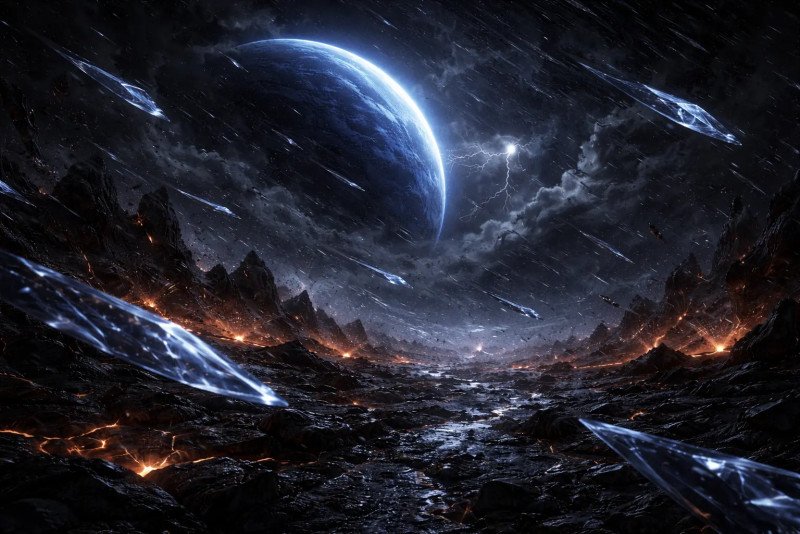
The Planet Where It Rains Glass Sideways — Could Alien Life Survive There?
Imagine looking up at a sky so blue it reminds you of a calm summer day in the Mediterranean. You think you’ve found an Earth twin, a peaceful oasis 64 light-years away. But the moment you step out of your ship, the "air"—which is a blistering 2,000 degrees Fahrenheit—vaporizes your suit. Before you can even scream, the wind hits you at seven times the speed of sound, carrying millions of jagged shards of molten glass.
This isn’t a scene from a low-budget horror movie. This is a real place.

Meet HD 189733b, the "Blue Marble" of the deep cosmos that would quite literally shred you to pieces in seconds. While it looks like a serene water world from a distance, it is actually one of the most violent environments ever discovered by NASA.
But as we peel back the layers of this "blow-torched" atmosphere, a deeper question emerges: In a universe this vast, could something—anything—actually live in such a nightmare?

A Cobalt Blue Trap: Why It Looks Like Earth
When the Hubble Space Telescope first captured the color of HD 189733b, scientists were stunned. It was a deep, rich cobalt blue. On Earth, that color means deep oceans and life-giving water.
On this planet, the blue is a lie.
The color doesn't come from water; it comes from a high-altitude haze filled with silicate particles. Silicates are the primary component of glass. Because the planet is so close to its sun—orbiting in just 2.2 Earth days—the heat is intense enough to turn these silicates into a vapor. When that vapor rises and cools slightly, it condenses into tiny grains of solid glass. These grains scatter blue light, giving the planet its deceptive, "Earth-like" glow.

Sideways Rain and 5,400 MPH Winds
The most famous (and terrifying) feature of HD 189733b is its weather. On Earth, rain falls down because of gravity. On HD 189733b, gravity has a rival: the wind.
Because one side of the planet always faces its star (tidal locking) and the other is in perpetual darkness, the temperature difference is massive. This creates a global "heat engine" that drives winds up to 5,400 mph (roughly 2 kilometers per second).
When it "rains," the liquid or solid glass particles are caught in these supersonic winds. Instead of falling to the ground, they are whipped around the planet horizontally. It is a never-ending storm of shards traveling faster than a bullet. NASA scientists have aptly described it as "death by a thousand cuts."

Could Anything Actually Live There?
If we are talking about life "as we know it"—cows, trees, or even the toughest tardigrades—the answer is a hard no. The heat alone would break down the complex carbon molecules that make up Earth-based biology.
However, astrobiologists like to think outside the box. Could "life as we don't know it" exist?
1. The Case for Extremophiles
On Earth, we find life in volcanic vents and acid lakes. But HD 189733b is a gas giant; it has no solid surface to stand on. Any potential life would have to be "atmospheric," perhaps tiny organisms that float in the cooler, upper layers of the clouds.
2. Silicate-Based Life?
Since the planet is rich in silica (the stuff of glass), some theorists wonder if life could ever be based on silicon rather than carbon. Silicon life is a staple of science fiction, but the chemical bonds required are much harder to maintain at these temperatures.
3. The Stench of Life's Building Blocks
Interestingly, the James Webb Space Telescope (JWST) recently detected hydrogen sulfide on the planet. To us, that’s the smell of rotten eggs. While it’s a toxic gas, sulfur is a key biological element. We’ve also found water vapor and carbon dioxide there. The "ingredients" are present, but the "oven" is turned up way too high.
Note: Most astronomers believe HD 189733b is a "Great Filter" planet—a place where the conditions are so hostile that the transition from chemistry to biology is virtually impossible.

The Recent "Rotten Egg" Discovery
In late 2024 and early 2026, data from the James Webb Space Telescope added a new layer to the mystery. Not only is it raining glass, but the planet also "stinks." The detection of hydrogen sulfide helps scientists understand how these "Hot Jupiters" form. It turns out HD 189733b likely grew by gobbling up smaller, icy rocks (planetesimals) early in its life, which packed it with heavy elements and stinky gases.
Why Do We Care About This Death Trap?
You might wonder why we spend billions of dollars looking at a planet that wants to kill us. The reason is simple: Atmospheric Physics.
By studying the extreme weather on HD 189733b, we learn how to read the "fingerprints" of atmospheres on other, smaller planets. If we can map the winds and the "glass rain" on a giant 60 light-years away, we are one step closer to finding the signature of oxygen or chlorophyll on a rocky, Earth-sized world in the future.

FAQ: Everything You Want to Know
How far away is HD 189733b?
It is about 64.5 light-years away in the constellation Vulpecula. That’s about 380 trillion miles. Even with our fastest current spacecraft, it would take hundreds of thousands of years to get there.
Can we see it with a backyard telescope?
You can see the star it orbits (HD 189733) with a good pair of binoculars or a small telescope, but the planet itself is too small and close to the star to be seen directly. We "see" it by watching the star's light dim as the planet passes in front.
Is it the only planet with weird rain?
Not at all! There is WASP-76b, where it likely rains molten iron, and researchers believe it may rain diamonds on Neptune and Uranus.
Why is the rain sideways?
The wind speeds are so high (over 5,000 mph) that the horizontal force far outweighs the vertical pull of gravity on the small glass particles.
Final Thoughts: A Beautiful Nightmare
HD 189733b serves as a humbling reminder of how diverse—and terrifying—the universe can be. It wears a mask of Earth-like blue but hides a heart of fire and glass. While we probably won't find aliens surfing the sideways glass storms anytime soon, the planet remains one of our best laboratories for understanding the wild world of exoplanets.
Disclaimer: The findings discussed in this article are based on spectroscopic data from NASA’s Hubble, Spitzer, and James Webb Space Telescopes. As with all exoplanetary science, these are "best-fit" models based on light analysis and are subject to update as telescope technology improves.
References & Sources: