.png)
.png)


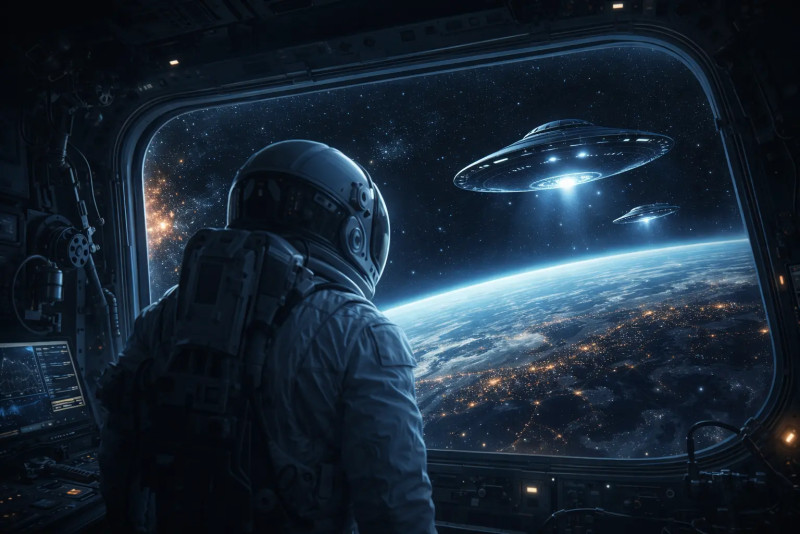
NASA’s Hidden Files: The Unexplained Objects Seen by Astronauts
There is a specific kind of silence that only exists in the vacuum of space. It’s a place where the world you knew is just a fragile blue marble hanging in a dark basement. For most of us, space is a beautiful mystery seen through a telescope. But for the handful of people who have actually "gone up there," that mystery sometimes bites back.
While NASA usually sticks to talk of trajectory, thrust, and mineral samples, there is a "side folder" in history. These are the stories of objects that shouldn't have been there, lights that moved with purpose, and sightings that left even the coolest test pilots in the world sounding a little shaky on the radio.
From the early days of the Space Race to the high-tech windows of the International Space Station (ISS) in 2026, the question remains: What are they seeing out there?
The "Ghost" of Gemini 4: James McDivitt’s Cylinder
In June 1965, James McDivitt was orbiting Earth during the Gemini 4 mission. His partner, Ed White, was fast asleep. Suddenly, McDivitt spotted something that didn't fit the star map. He described it as a "white cylindrical shape" with a long arm or pole sticking out of its corner.
He didn't just report it; he grabbed his camera and snapped two photos. NASA later suggested it was just the second stage of his own Titan II rocket, but McDivitt—a man trained to identify every bolt in the sky—wasn’t so sure. He maintained that while it might have been man-made debris, its appearance and behavior were completely "unknown."
Apollo 11 and the "L-Shaped" Companion
Even the most famous mission in human history wasn't without its "guests." On the way to the moon, the crew of Apollo 11—Neil Armstrong, Buzz Aldrin, and Michael Collins—noticed something traveling alongside them.
Aldrin later recalled seeing a light that appeared to have a distinct "L" shape. They were cautious. If they shouted "UFO" into the headset, would Mission Control panic? Would they be ordered to abort? They played it cool, asking Houston about the location of the S-IVB rocket stage. Houston replied it was 6,000 miles away.
Whatever was outside their window was much closer. While Aldrin later leaned toward the idea that it was a reflection off a discarded panel, the mystery of that glowing companion has fueled debates for over half a century.
Gordon Cooper: The Astronaut Who Believed
If there was a "rebel" among the original Mercury Seven, it was Gordon Cooper. Unlike many who kept quiet to protect their careers, Cooper was vocal. He claimed that before he ever joined NASA, he had seen fleets of metallic, saucer-shaped objects while flying over Europe.
But his most chilling story came from Edwards Air Force Base. He claimed a camera crew he was supervising filmed a saucer-shaped craft landing on a dry lake bed on three legs, only to take off again as they approached. Cooper said he saw the film, sent it to Washington, and never saw it again. To his dying day, Cooper insisted that we were not alone.
The Modern Era: "Space Guests" on the ISS
The sightings haven't stopped with the moon landings. In 2020, Russian cosmonaut Ivan Vagner was filming the Aurora Borealis from the ISS when five mysterious objects appeared in a perfect line, moving together. He dubbed them "space guests."
While skeptics often point to "space dandruff"—bits of ice, paint chips, or insulation floating near the station—the sheer formation and synchronized movement of these lights continue to baffle observers. Even in 2026, with the most advanced cameras ever sent into orbit, we still catch "blips" that don't match our satellite tracking databases.
Why the Silence? The "Stigma" Factor
Why doesn't NASA just come out and say it? In 2023, NASA released its Unidentified Anomalous Phenomena (UAP) Independent Study Team Report. They didn't find "aliens," but they did find a massive problem: Stigma.
For decades, reporting something "weird" in space was a career-killer. Pilots were worried about being grounded or called "crazy." NASA is now trying to change that, encouraging a "rigorous, evidence-based approach." They want the data, but they want it without the "little green men" jokes.
"The haystack is filled with gold, but most people are too afraid to even look at the straw." — David Spergel, NASA UAP Study Chair
FAQs: The Truth Behind the Sightings
- Has NASA ever officially admitted to seeing aliens? No. NASA’s official stance is that there is no credible evidence of extraterrestrial life being responsible for these sightings. They categorize them as "Unidentified" because they lack the high-quality data to name them.
2. What is "Space Dandruff"?
It’s a real thing! In the vacuum of space, tiny flakes of frozen oxygen, paint, or debris can look like glowing, zooming objects when hit by the sun. This explains about 95% of sightings.
3. Did Neil Armstrong see UFOs on the Moon?
There is a famous story about Armstrong seeing "giant ships" on the rim of a crater. Most historians and his own family state this was a hoax perpetuated by science fiction writers in the 70s.
4. Why is the government talking about UAPs now?
Because the technology to track them has improved. With more sensors in the sky and on the ground, the "glitches" are becoming too frequent to ignore. It’s now seen as a matter of national and "orbital" security.
The Final Frontier of the Unknown
Whether these objects are top-secret human tech, natural space phenomena, or something truly "other," the accounts from our most trusted explorers can't be ignored. As we push further toward Mars, we have to accept that we might be walking into a neighborhood that isn't as empty as we once thought.
The "Hidden Files" of NASA might never give us a clear photo of a visitor, but they do give us something else: the realization that the universe is far stranger than we are currently allowed to believe.
Disclaimer: This article explores historical accounts and public reports regarding unidentified phenomena. NASA and other space agencies maintain that no definitive evidence of extraterrestrial technology has been found to date. Information provided is for educational and entertainment purposes.
References and Source Proof: