.png)
.png)


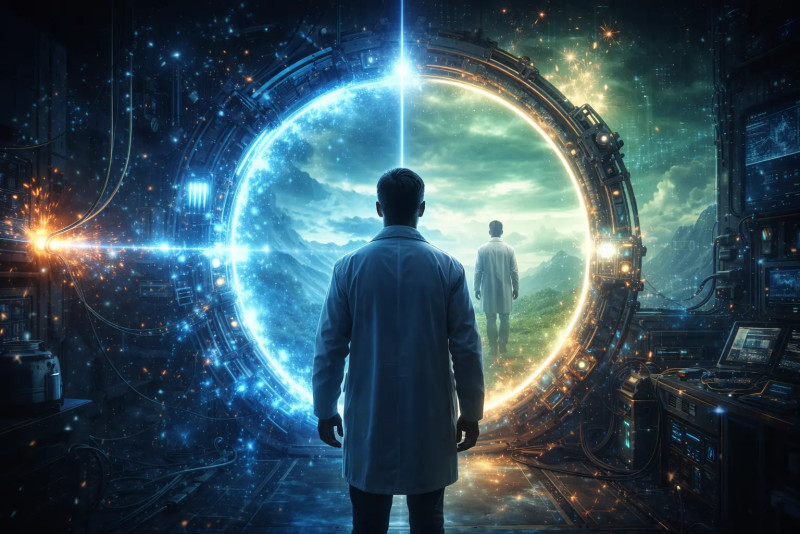
The Experiment That Opened a Door… But To Where?
For decades, science fiction has sold us the same dream: a shimmering portal, a step through a glowing ring, and suddenly, you’re standing in a world just like ours—but "wrong." Maybe the sky is green, or maybe you never decided to skip that breakfast date ten years ago.
But what if I told you that in a quiet lab in Tennessee, scientists aren't just writing scripts? They are actually looking for the "door." And while it doesn't look like a Stargate, the results are making the world’s smartest people sweat just a little bit.
This isn't just about big machines and lab coats. It's about a fundamental glitch in reality that we can no longer ignore.
The Mystery of the Missing Neutrons
The story starts with a "glitch." In the world of physics, neutrons (the tiny particles inside atoms) are usually pretty predictable. But when they are pulled out of an atom, they start to decay.
Here is where it gets weird: Scientists use two different ways to measure how long a neutron lasts.
-
The "Bottle" Method: You trap them in a magnetic bottle and count how many are left after a while.
-
The "Beam" Method: You count the protons that appear as the neutrons decay in a flying stream.
In a perfect world, both should give the same answer. But they don’t. There is a 10-second gap that nobody can explain. It’s as if some neutrons are simply vanishing into thin air. Or, as some daring physicists suggest, they are "oscillating" into a mirror version of our own universe.
The Oak Ridge "Portal" Experiment
Enter Leah Broussard, a physicist at the Oak Ridge National Laboratory. She and her team decided to stop scratching their heads and start looking for the exit sign.
They designed an experiment that sounds like something straight out of a thriller. They fired a beam of neutrons at a solid wall—an impenetrable barrier that no normal neutron should ever be able to cross. On the other side of that wall, they placed a high-tech detector.
The Logic: If a neutron can transform into a "mirror neutron," it would essentially become a ghost. It would pass right through the wall as if it weren't even there. Then, if they hit it with the right magnetic field on the other side, it might "pop" back into our reality.
If that detector clicked even once, it would mean we had successfully sent matter through a "door" to another realm and brought it back.
Is There a "Mirror You" Out There?
Before you pack your bags, let’s be clear: this isn't a door for people. It’s a door for the building blocks of existence.
The theory suggests a "Mirror Sector"—a whole different set of particles that interact with ours only through gravity. This could be the secret identity of Dark Matter, the mysterious stuff that makes up most of our universe but remains invisible to our telescopes.
If this mirror world exists, it would have its own mirror stars, mirror planets, and perhaps even mirror life. It would be a shadow reality sitting exactly where you are sitting right now, completely unaware of your existence, just as you are of theirs.
Why Does This Matter to You?
You might think, "Okay, cool, tiny particles are doing weird stuff. How does that help me pay my bills?" It matters because our understanding of reality is the foundation of everything. From the GPS in your phone to the way we treat cancer, every leap in technology comes from understanding a new "rule" of the universe. If there is a door to a mirror sector, it opens up possibilities we haven't even dreamt of:
-
Infinite Energy: Accessing the "dark sector" could change how we power our world.
-
Space Travel: Understanding these "shortcuts" could be the key to moving across the stars.
-
The Truth of Existence: It proves that what we see is only a tiny fraction of what is actually there.
The Big Question: Did They Find It?
The initial results from Oak Ridge didn't show a "smoking gun" yet. They didn't see a flood of neutrons rushing through the wall. But in science, a "no" is often just a "not this way."
The team is already refining the experiment, using stronger magnets and more sensitive sensors. The 10-second gap in neutron life is still there. The "glitch" hasn't gone away. Something is happening, and the door is cracked open—we just haven't figured out how to see through it yet.
FAQs: Your Questions Answered
- Is this the same as the "Upside Down" from Stranger Things? The scientists actually joke about this! While it’s not a dark, monster-filled forest, the idea is similar: a parallel reality that occupies the same space as ours but is invisible to us.
2. Can I accidentally fall into a portal?
Nope. These interactions happen at the subatomic level. You are way too big and way too "solid" in this dimension to slip through.
3. Does this prove the Multiverse exists?
It’s a strong piece of the puzzle. If matter can swap between "our" version and a "mirror" version, it suggests that our universe is just one layer in a much larger, more complex sandwich.
4. When will we know for sure? With experiments running through 2026 and new data coming from the Large Hadron Collider (CERN), we are closer than ever. We might have a definitive answer within the next few years.
The Bottom Line
We live in a world that feels very solid, very "real." But experiments like the one at Oak Ridge remind us that we are just scratching the surface. There is a door. We know there is something on the other side because the math tells us so.
Now, we just have to be brave enough—and smart enough—to look through it.
Disclaimer: This article discusses theoretical physics and experimental research. While the experiments mentioned (like those at Oak Ridge) are real, the interpretation of "parallel universes" remains a scientific hypothesis under investigation and should not be confused with established fact or science fiction tropes.
References and Source Proof: